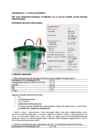
puhvri pudelisse, võtsime geeli aparaadist välja, eraldasime klaasplaadid teineteisest väga ettevaatlikult kasutades väikest spaatlit. 5. Panime geeli ööseks Coomassie G250 värvilahusesse. 6. Saime elektroforeesi tulemust : Lahtrites vasakust paremale : 1. Marker 2. BSA (Mw = 66,5 kDA) 3. Trypsin (Mw =23,8 kDA) 4. Lactate dehüdrogenase ( Mw = 35 kDA) 5. Tundmatu 6. Albumin (Ovalbumin) (Mw = 44,3 kDa) 7. Proteinase K ( Mw = 28,5 kDa) Migreerumistee Mw Valk pikkus (cm) (kDA) BSA 2.9 66.5 Albumine 4.6 44.3 Lactate dehydrogenase 5.2 35 Proteinase K 5.7 28.5 Trypsin 6.5 23.8
Seerumi ja astsiidivedeliku albumiini gradient Peamine probleem eksudaadi ja transudaadi eristamisel astsiidi korral on kõrge proteiini sisaldusega transudaat. Seetõttu peritoneaalvedeliku puhul efusiooni liigitamist transudaadiks või eksudaadiks vedelikus esineva valgu koguse põhjal enam ei toimu. 9 Nüüdisajal põhineb astsiitide klassifikatsioon hoopis seerumi albumiini ja kõhuõõnevedeliku albumiini gradiendil (SAAG serum-ascites albumin gradient). Antud näitaja võimaldab eristada portaalhüpertensioonist tingitud astsiiti (ehk siis transudaati) kõigist muudel põhjustel tekkinutest (eksudaadist). Astsiidi korral kasutatakse gradiendi väärtust 11g/l. 11g/l väiksem väärtus on eksudaadi näitaja ja transudaadi ehk portaalhüpertensioonist tingitud astsiidi korral on gradiendi väärtus 11 g/l kõrgem. Antud parameeter ei sobi eksudaatide ja
A CEMS technique has been developed for age estimation of silk textiles based on amino acid racemization rates ranging in age from several decades to a fewthousandsyears old. The analysis takes ~20 min., consumes only nanolitres of amino acid mixture, and provide both amino acid composition profiles and d/l ratios for 11 amino acids. Lysozymem bovine serum albumin and betagalactosidase were 27 succesfully separated using a laboratorymade miniaturized capillary electrophoresis apparatus with a confocal fluorescence spectrometry (Sekhon, 2011). Conclusions and perspectives Capillary electrophoresis combines the resolution of conventional electrophoresis with ease
(no juice, no fruit) and the second after one week of consuming 14 ounces--about 1.5 large glasses--of pulp-free orange juice upon waking and before bed. The orange juice was the only thing distinguishing diets A and B. The changes were incredible. Before (10/16, no fructose) and after (10/23, orange juice): Cholesterol: 203 243 (out of "healthy" range) LDL: 127 165 (also out of range) There were two other values that shot up unexpectedly: Albumin: 4.3 4.9 (out of range) Iron: 71 191 (!) (out of range aka into the stratosphere) Albumin binds to testosterone and renders it inert, much like SHBG (discussed in "Sex Machine") but weaker. I don't want either to be out-of-range high. Bad for the manly arts. If you said "Holy sh*t!" when you saw the iron jump, we're in the same boat. This result was completely out of the blue and is not good, especially in men. It might come as a surprise, but men don't menstruate
Catechin Blood pressure level Peptides Casein dodeca peptide, Sardine peptide, Isoleucyl tyrosine, 4-Aminobutyric acid Mineral (Ca/Fe) level Caseinphospho peptide, Calcium citrate malate, Heme iron Bone density Soy isoflavone, Milk basic protein, Vitamin K2, Polyglutamic acid Dental caries Xylitol, Maltitose, Palatinose, Tea polyphenol Blood sugar level Indigestible dextrin, Arabinose, Wheat albumin Blood neutral fat level Diacylglycerl, Globin hydrolyzate, Catechin Functional Meat Products 425 Figure 24.1. Sugar-free meat products “Zero” (Nippon Meat Packers, Inc., Japan). Left, sliced roast ham; right, sliced half bacon. “low” type of products, meat products with have beneficial effects on intestinal disor- additional physiologically functional proper- ders
 annaabi.ee