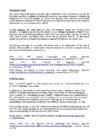
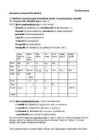
CHANGES · Only changes is the increasing usage of loan-words · Less important · Vanishing in my opinion FEATURES Consonants Bilabial Labio-dental Dental Post-alveolar Velar Pharyn-geal Glottal Nasal m n voiceless p t k Plosive voiced b d voiceless ts t Affricate voiced dz d voiceless f s Fricative voiced v z
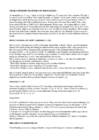
Available at http://home.cc.umanitoba.ca/~krussll/phonetics/articulation/describing-vowels.html, accessed January 19, 2016. Michigan State University. 2003. Phonetics: the physical part of speech, again. Available at https://www.msu.edu/course/lin/401/fs03-s2/phonetics-lecture2.pdf, accessed January 19, 2016. FORTIS CONSONANTS A fortis consonant is a “strong” consonant produced by increased tension in the vocal apparatus. These strong consonants tend to be long, voiceless, aspirated, and high. With fortis consonants, following thumb rules stay true: articulation with more muscular effort and greater breath force, voiceless in all positions, fortis plosives are aspirated in syllable-initial position, vowels are shortened before a fortis consonant. Example: voiceless [bb ] is "lenis", whereas [p] is "fortis". Lenis plosives have less intraoral pressure than fortis ones. The difference is easily noticed in the English pair "touched" vs. "judged" (said in
European family) in the 1st millennium BC. It establishes a set of regular correspondences between early Germanic stops and fricatives and the stop consonants of certain other centum Indo-European languages (Grimm used mostly Latin and Greek for illustration). Grimm's law consists of three parts which form consecutive phases in the sense of a chain shift. [1] The phases are usually constructed as follows: - Proto-Indo-European voiceless stops change into voiceless fricatives. - Proto-Indo-European voiced stops become voiceless stops. - Proto-Indo-European voiced aspirated stops become voiced stops or fricatives (as allophones). Grimm himself already noticed that there were many words that had different consonants from what his law predicted. These exceptions defied linguists for a few decades, but eventually received explanation from Danish linguist Karl Verner in the form of Verner's law. VERNER'S LAW
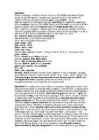
Otto Jespersen: "The Norman invasion broke the proud Teutonic backbone of the English language" From now on, English open to loanwords Flower, forest, valley, river*, face-norman french loans Peculiarities of Old English pronunciation and spelling /f/ and /v/ were allophones, i.e. there was no phonemic difference between them: no minimal pairs where /f/ and /v/ would make a difference in meaning. The letter f used for both. In a voiced environment the pronunciation voiced, ie /v/, in a voiceless environment unvoiced, ie /f/. At the beginning of words: debatable. By constrast, vowel length was phonemic: man /man/ human being, man mn /ma :n/ - evil; witchcraft In old manuscripts vowel length indicated by ´ (like a stress mark), in modern editions a strike over the vowel. The scribes proceeded from the Latin alphabet. However, there were sounds in Old English that Latin did not have. Solutions had to be found.
g. pie [paý] NB! K, p, t are unvoiced/aspirated consonants and g, b, d are unaspirated/voiced consonants. These unvoiced stops are completely unaspirated (spy, sty, sky), because stop is immediately following word-initial s. Fricatives, Affricates, Nasals. Fricatives - narrowing the distance between two articulators so that the airstream is partially obstructed and a turbulent airflow is produced (i.e. friction). Fricatives may be voiced or voiceless. Consonants can be classified by: place of articulation( bilabial /p/; /b/; /m/ ; labiodental /f/; /v/; alveolar /t/; /d/; /n/; velar /k/; /g/ manner of articulation refers to variation in the way the airstream is affected (blocked vs.partially blocked; vocal folds are vibrating or no vibration). Affricate a stop followed by a homorganic fricative (phonological)/ a stop plus a fricative (phonetics). These are the only sequences that can occur at both the
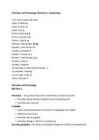
4) poolvokaalid (semivocales) ehk aproksimandid
See jaotus rajaneb kõnetrakti neljal põhiasendil: 1) sulg; 2) sulg koos avatud ninakäiguga; 3) kitsas
läbipääs (ahtus), kus hõõrduva õhuvooluga kaasnevad mürad (
riche displaying their flagrant spending with these cars. So much of this money could have been used for curing starvation on the continent instead of purchasing these nebulous products. There is a major and intelligent sense in the Rev. Al Sharpton unorthodox madness: he understands that unless Black newspapers receive advertisements from major companies, they will die out and the people will be voiceless. Millions of other Africans have to understand the same madness which is driving Rev. Al Sharpton to target Madison Avenue to convince the companies they represent to stop the handouts of social advertising the occasionally do in Black newspapers, and advertise on the basis that we use their products as much as other communities. Al Sharpton is a true “Capitalist Nigger.” Many of us should borrow a leaf from his madness. The Day of Atonement is a day you wake up with a prayer, thuse:
are so common. In English, only ten of these words constitute more than one quarter of any text: the, of, and, to, a, in, that, it, is, and / totalled 26,677 of 100,000 words in a count made by Godfrey Dewey. Inevitably this preponderance will affect the frequency table. H, for example, owes most of its occurrences to the. The second source of redundancy stems from the human laziness that favors sounds easier to pronounce and identify. The voiceless stops /ptk/ require less energy to articulate than the corresponding voiced stops /bdg/ and they average twice the frequency of voiced stops in sixteen widely varying languages surveyed by George K. Zipf. Similarly, short vowels are markedly more frequent than long vowels or diphthongs. In the same way, auditors of English, at least, seem to prefer sounds that are easier to identify. Tests made with nonsense syllables show that listeners seldom confuse consonants produced with the vocal organs
 annaabi.ee