Smog Author: Uku Volke 12.A TKiG, 2012 Problem · Highly toxic · Term originates from the 19th century London · Coined in Daily Telegraph July 26, 1905 · Worsened by thermal inversions Origin: Smo(ke) + (fo)g = Smog Main Causes The London Smog: coalpowered industry. Photochemical smog = vehicular fumes + industrial fumes + sunlight The main pollutants: NO2, SO2 Thermal Inversion Health Risks · Bad for everyone · Extra risk for people with heart, lung conditions and children, elderly Smog in NYC, 1988 Beijing, 2005 The Worst Case Scenario 5 "Smoggiest" Cities · Beijing, China · New Delhi, India · Santiago, Chile · Mexico City, Mexico · Ulanbataar, Mongolia Alternative Meanings Smog may also refer to..
To build new roads Selling the lumber to Japan To generate electricity Trees are used in flooring, furniture and other items Make more space for grazing lands Solution To enforce their anti-logging laws Provide alternatives to poor farmers Use less firewood and paper products Recycle old furniture and wood Educate yourself Ari Pollution Second largest environmental problem Industrial activities are the major causes Urbanisation Vehicular gas emissions dropped by 94% Burning trees Solution of air pollution Use more public transport To limit emissions of carbon dioxie Recycle different products Need to stop or low burning trees Clear the rainforests Use of wind power Use solar energy Waste disposal Brazil produces an enormous amounts of solid waste More than 161 000 tons of waste per day Recycles only 13% of waste Output of harmful gases Takes a lot of place from free lands
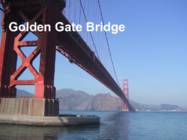
47,005 voted against it. • On January 5, 1933 construction of the bridge begins. Joseph Baermann Strauss Construction Safety • Protective headgear that Strauss insisted be worn on the job • Special hand and face cream protected against the wind • Special diets helped fight dizziness • Safety net Construction • May 27, 1937 The Golden State Bridge was completed and opened to pedestrian traffic. • May 28, 1937 it was opened to vehicular traffic. • The bridge was opened ahead of schedule and under budget. Opening day • February 22, 1985 one billionth car crosses the bridge. • 1986 the bridge was redecked, it was completed in 1987(before 150,952,000 kg after 139,790,700 kg) • September 3, 1998 United States Postal Service unveils Golden Gate Bridge commemorative stamp. Stamp • July 13, 2000 FasTrak electronic toll collection launched on the Golden Gate Bridge. • September 1, 2002 - $5
• Special hand and face cream protected against the wind • Special diets helped to fight dizziness • Safety net. the net saved the lives of nineteen men who became known as the "Half-Way-to-Hell Club." On February 17, ten men lost their lives when a section of scaffold carrying twelve men fell through the safety net. • May 27, 1937 The Golden State Bridge was completed and opened to pedestrian traffic. • May 28, 1937 it was opened to vehicular traffic. • The bridge was opened ahead of schedule and under budget. • February 22, 1985 one billionth car crosses the bridge. • 1986 the bridge was redecked, it was completed in 1987(before 150,952,000 kg after 139,790,700 kg) • September 3, 1998 United States Postal Service unveils Golden Gate Bridge commemorative stamp. • July 13, 2000 FasTrak electronic toll collection launched on the Golden Gate Bridge.
They were favoured for deep gorges or wide fast-flowing streams where false work, a temporary structure, usually of timber, erected to assist in the construc- tion of the permanent bridge, is impossible to build. The three principal types - beam, arch, and suspension - often were combined in a variety of ways to form composite structures, the type selected depending on the nature of the crossing, the span required, the materials at hand, and the type of load anticipated - pedestrian, vehicular, railroad, or a channel of water as in aqueducts. Primitive bridges Other than the clapper bridges of England and similar spans surviving in other countries, bridges dating from prehistoric periods are rare. Bridges of twisted vines and creepers found in India, Africa, and South America, the ancient cantilevers of China, Kashmir, and Japan, if any survive, or the
and were extensively bombed. Operation Barbarossa included the goal to capture the Baku oilfields, as it would provide much needed oil-supplies for the German military which was suffering from blockades. Oil exploration in North America during the early 20th century later led to the U.S. becoming the leading producer by mid-century. As petroleum production in the U.S. peaked during the 1960s, however, the United States was surpassed by Saudi Arabia and Russia. Today, about 90 per cent of vehicular fuel needs are met by oil. Petroleum also makes up 40 per cent of total energy consumption in the United States, but is responsible for only 1 per cent of electricity generation. Petroleum's worth as a portable, dense energy source powering the vast majority of vehicles and as the base of many industrial chemicals makes it one of the world's most important commodities. Viability of the oil commodity is controlled by several key parameters, number of vehicles in the world
 annaabi.ee