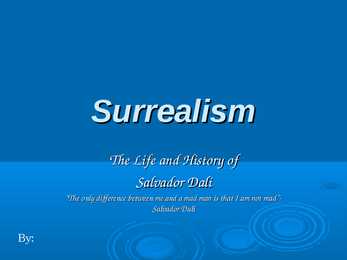
By: Salvador Dali Salvador Felipe Jacinto Dali, was born on May 11, 1904 in Catalonia, Spain Salvador Dali Salvador was a Spanish painter, sculptor, graphic artist, and designer Salvador Dali After passing through phases of cubism, futurism, and metaphysical painting. He joined the surrealists in 1920. Soon he became the most famous surrealist of the time Dali's artwork He said he believed that his paintings came from an unreal dream space, which is understandable because of the hallucinatory things in them. Dali's artwork Clocks Elephants Eggs Ants In 1955 he moved back to Spain and died in1989 Thank you for attention !
Biography of Navitrolla Heiki Trolla, better known by his artist name Navitrolla. He was born on the 10th of August in 1970 in Võru. He is an Estonian painter whose work has been described as naivist or surrealist. Most of his works depict fantastic landscapes and animals. He spent his childhood in the villages of Trolla and Navi near Võru, which is the source of his pseudonym. There, he also learned how to paint from a local artist. He has finished Viive Kuksi’s three year artstudio. In 1990 he participated in the establishment of the „Lüliti“ group. In 1993 Heiki started to work as a professional artist and he quickly became famous because of his naivist paintings.
Holbein der Jüngere und der wohl bekannteste Albrecht Dürer. Während der ersten Jahre von 1495 vorwärts arbeitete er in den hergestellten germanischen und Nordformen aber war zu den Einflüssen der Renaissance geöffnet.Die bedeutendsten aus Deutschland stammenden Barockmeister sind Cosmas Damian Asam, sowie der in Siegen geborene, aber nach Antwerpen ausgewanderte Peter Paul Rubens. Weitere Künstler von Weltruf sind der Romantiker Caspar David Friedrich, der Surrealist Max Ernst, der Konzeptualist Joseph Beuys oder der Neoexpressionist Georg Baselitz.
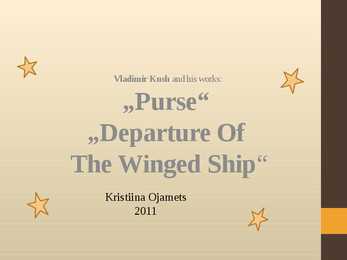
Vladimir Kush and his works: ,,Purse" ,,Departure Of The Winged Ship" Kristiina Ojamets 2011 Vladimir Kush A Russian surrealist painter and sculptor Prefers to define his art as metaphorical realism rather than surrealism He was born in Moscow in 1965 (age 46) Entered the Moscow Higher Art and Craft School at age 17, but a year later he was conscripted. After 6 years military training the unit commander thought he should better paint propagandistic posters. After military service graduated the Institute of Fine Arts In 1987 Kush began to take part in the Union of Artists
finally planned and implemented by architect Heinz M. Springmann. It contains 105 apartments, an inner courtyard, a small artificial lake and also a playground for children. The building has 12 floors. 3. The Torre Galatea Figueras (Spain) The first things you notice are the giant egg sculptures along the roofline. Then it hits you that the Salvador Dali Theater Museum in Figueras, Spain, is no ordinary building. The museum’s tower, Torre Galatea, was named for the surrealist artist’s deceased wife, and Dali himself lived there until his death in 1989. Interestingly, the museum sits next to the parish church where Dali was baptized in 1904; he is buried in an unmarked crypt in the museum’s main exhibition hall. 4. The Basket Building (Ohio, United States) This may look like a picnic basket kept in the park. But this actually is a 7-story building which is Longaberger's Home Office located in Newark, Ohio. This monument is in-fact world’s largest basket
Jackson Pollock (mid-C20). His work is abstract, violent and expressive. He poured and spray painted canvases in repeated rhythmic gestures. A vortex of swirling lines, spatters and drips were cast on the canvas. He used commercial enamels and metallic paints to pour and drip. Willem de Kooning (mid-C20). His paintings retained figural images. His style was influenced by Cubist structures, Expressionist handling and Surrealist automatism. The foreground and background are constantly interchanged. Subsidiary artists: Franz Kline, Hans Hoffman. Color-Field. Simply composed paintings became prevalent. Paintings appeared as unified optical textures and increased in scale. Various shapes were united into dominant islands, zones and boundless fields of intense and homogenous color. Expanses of bright hues produced unbroken "color fields" and did not stress sequential linear detail and formal diversity
Jackson Pollock (mid-C20). His work is abstract, violent and expressive. He poured and spray painted canvases in repeated rhythmic gestures. A vortex of swirling lines, spatters and drips were cast on the canvas. He used commercial enamels and metallic paints to pour and drip. Willem de Kooning (mid-C20). His paintings retained figural images. His style was influenced by Cubist structures, Expressionist handling and Surrealist automatism. The foreground and background are constantly interchanged. Subsidiary artists: Franz Kline, Hans Hoffman. Color-Field. Simply composed paintings became prevalent. Paintings appeared as unified optical textures and increased in scale. Various shapes were united into dominant islands, zones and boundless fields of intense and homogenous color. Expanses of bright hues produced unbroken "color fields" and did not stress sequential linear detail and formal diversity
Surrealism lastly — to remain on the level of this prehistory of modernity — surrealism doubtless could not accord language a sovereign place, since language is a system and since what the movement sought was, romantically, a direct subversion of all codes — an illusory subversion, moreover, for a code cannot be destroyed, it can only be “played with”; but by abruptly violating expected meanings (this was the famous surrealist “jolt”), by entrusting to the hand the responsibility of writing as fast as possible what the head itself ignores (this was automatic writing), by accepting the principle and the experience of a collective writing, surrealism helped secularize the image of the Author. Finally, outside of literature itself (actually, these distinctions are being superseded), linguistics has just furnished the destruction of the Author with a precious analytic instrument by
victims as humans Luis Bunuel-surrealism and its aftermath Born in spain, in bourgeois family, went to jesuit school, studied agriculture in madrid and met salvador dali. Leaves paris, wants to fight for republicans, wants to fight for homecountry, other forces win. Goes to hollywood, working, loses his job, accused of communism, goes to mexico, becomes a filmmaker. Dies in mexico city as a result of liver disease, liver cancer Bunuel three periods: 1) The surrealist period. Parents money. ,,Le chien andalou" ad ,,L'age d'or" 2) The mexican period. Broke parents. Franco forces bunuel to live abroad. 3) The second french period. Creative freedom. Two of bunuel's films were banned from distribution: l'age d'or and virdinia Filmiography: un chien andalou, l'age d'or, los olivados, viridiana, le journal d'une femme de chambre, belle de jour, le charme discret de la bourgeoisie, cet obscur du desir 1930- l'age d'or
consciously imitative of the patterns and forms developed as early as in the 19th century. The 21th century In the 21st century, a new generation of Russian authors appeared differing greatly from the postmodernist Russian prose of the late 20th century, which lead critics to speak about "new realism". Having grown up after the fall of the Soviet Union, the "new realists" write about every day life, but without using the mystical and surrealist elements of their predecessors. The "new realists" are writers who assume there is a place for preaching in journalism, social and political writing and the media, but that "direct action" is the responsibility of civil society. Leading "new realists" include Ilja Stogoff, Zakhar Prilepin, Alexander Karasyov, Arkadi Babchenko, Vladimir Lorchenkov and Alexander Snegiryov. Popular genres Children's literature in Soviet Union was considered a major genre, because of its educational role
 annaabi.ee