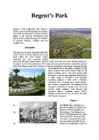
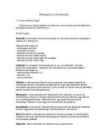
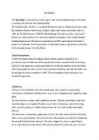
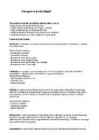
partly in the London Borough of Camden. It contains Regent's College and the London Zoo. Description The park has an outer ring road called the Outer Circle (4.3 km) and an inner ring road called the Inner Circle, which surrounds the most carefully tended section of the park, Queen Mary's Gardens. Apart from two link roads between these two, the park is reserved for pedestrians. The south, east and most of the west side of the park are lined with elegant white stucco terraces of houses designed by John Nash. Running through the northern end of the park is Regent's Canal which connects the Grand Union Canal to the former London docks. The 166 hectare (410 acre) park is mainly open parkland which enjoys
Paberkrohvi - vanast makulatuurist valmistatud krohvi sideaineks on kaseiin või metültselluloos. Samuti on võimalik traditsiooniliste krohvide sideaneid -nagu lubi või savi-kasutada paberkrohvides. Paberkrohvid on väga heade helisummutavate omadustega. Võimalik on luua väga erinevaid dekoratiivseid pindasid. Kaseiinkrohv on kaseiinsetel sideainetel baseeruvad ja erinevaid täiteianeid sisaldavad krohvid. Väga heade nakkeomadustega. Sobilikud peeneks viimistluseks. Stucco lubipahtel on lubjapastast ja täiteainetest koosneva pastaga on võimalik pärast vahatamist saavutada väga elavaid läikega pindasid. Sobilik nii niisketesse ruumidesse kui kuumadele pindadele. Kipskrohv- sellest vormitakse või valatakse seina- ja laekaunistusi. 2.2 Krohvimördid, nende valmistamine ja omadused. Lubimördid P I - Kasutatakse kõige rohkem puit-, tellis-, betoon- ja teiste pindade krohvimiseks. Need mördid on plastilised ja tugevad, nakkuvad hästi mitmesuguste
sapphire came from Sri Lanka and the carnelian from Arabia. In all, twenty eight types of precious and semi-precious stones were inlaid into the white marble. Exterior decoration The exterior decorations of the Taj Mahal are among the finest to be found in Mughal architecture. As the surface area changes, a large pishtaq has more area than a smaller one, and the decorations are refined proportionally. The decorative elements were created by applying paint or stucco, or by stone inlays or carvings. In line with the Islamic prohibition against the use of anthropomorphic forms, the decorative elements can be grouped into either calligraphy, abstract forms or vegetative motifs. Interior The interior chamber of the Taj Mahal steps far beyond traditional decorative elements. the inlay work is not pietra dura, but lapidary of precious and semiprecious gemstones. The inner chamber is an octagon with the design allowing for entry from each face, though only the
Paberkrohvi - vanast makulatuurist valmistatud krohvi sideaineks on kaseiin või metültselluloos. Samuti on võimalik traditsiooniliste krohvide sideaneid -nagu lubi või savi-kasutada paberkrohvides. Paberkrohvid on väga heade helisummutavate omadustega. Võimalik on luua väga erinevaid dekoratiivseid pindasid. Kaseiinkrohv on kaseiinsetel sideainetel baseeruvad ja erinevaid täiteianeid sisaldavad krohvid. Väga heade nakkeomadustega. Sobilikud peeneks viimistluseks. Stucco lubipahtel on lubjapastast ja täiteainetest koosneva pastaga on võimalik pärast vahatamist saavutada väga elavaid läikega pindasid. Sobilik nii niisketesse ruumidesse kui kuumadele pindadele. Knauf tooteinfo. Nakkekihi pritskrohv saneerimistöödeks / MCO2 Kasutusala: Niiskus- või soolakahjustustega alusmüüritise esmase kihina paigaldatav nakkepritskrohv sise- ja välistöödeks
suppress architectonic divisions of architrave, frieze and cornice for the picturesque, the curious, and the whimsical, expressed in plastic materials like carved wood and above all stucco (as in the work of the Wessobrunner School). Walls, ceiling, furniture, and works of metal and porcelain present a unified ensemble. The Rococo palette is softer and paler than the rich primary colors and dark tonalities favored in Baroque tastes. A few anti-architectural hints rapidly evolved into full-blown Rococo at the end of the 1720s and began to affect interiors and decorative arts throughout Europe. The richest forms of German Rococo are in Catholic Germany (illustration, above).
According to the designs of the architect Niccolo Michetti, invited from Rome, the palace was built after the Italian villas, consisting of a main building and of two annexes. The well-preserved great hall is one of the best examples of Baroque architecture not only in Estonia but also in the whole Northern Europe. Besides Russian and Italian artists, masters from Stockholm, Riga and Tallinn took part in its building work. The two-storied hall is decorated with rich stucco work and ceiling paintings. The vestibule and some other rooms in the main building, as well as some of the stoves have retained their 18th-century appearance. The park was named Kadriorg (Catherine's Valley) after the empress Catherine I. Most of the Russian rulers, from Peter's daughter Elizabeth, to the last Romanov emperor Nicholas II, have visited this imperial summer residence. From 1921 the Estonian Museum in Tallinn was situated in the palace. In 1928 it was
 annaabi.ee