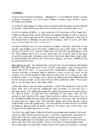
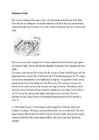
This is Toompea Castle. The history of Toompea is actually the story of rulers and power in Estonia. The times and rulers changed and so did power and mentalities – each new ruler built and fortified this place according to his needs and taste. Today, visitors to Toompea can find here buildings mostly dating from three periods: the medieval order’s stronghold with its impressive western wall and towers, the most well-known of which is the tower of Tall Herman; the Russian-era government administration building with a facade representing classical styles and opening onto Castle Square; and the building of the Riigikogu, which originates from the time of the First Republic of Estonia and is hidden behind the walls of the castle Time has been generous to Toompea castle. The well-protected fortress has been almost impregnable
Over thousands of years the falling water has worn out the edge of the limestone banks and as a result a steep-sided valley about 300 m long and 12-14 m deep has been created. The oldest written information about a water mill (the beginning of the 13th century) derives from this place. The best impression of the mightiness of the waterfall can be obtained in the period of high waters in spring and autumn. · Narva Stronghold is the oldest and biggest stronghold in Estonia (built in 13- 17th century) creating with the Ivangorod Stronghold on the opposite shore of the River Narva a unique architectural ensemble in Northern Europe. Three wings of the stronghold and the Tower of Tall Hermann are open to visitors. The historical interiors in the West and North wings have been restored. In the five halls of the stronghold the history of the town of Narva of the period from the
importance of Haapsalu as a summer town hosting the crowned heads of Russia. · The Ridala Church, erected in the 13th century, is one of the bestpreserved Middle Ages churches, built in the characteristic Western Estonian onenave style, in the whole of Estonia. There are fragments of the ceiling paintings (probably from the 14th century), a Baroquepulpit (1656, E. Thiele) and an altar preserved in the Church. · The Germans built the Lihula Stronghold in 1242. In 12341251 Lihula was the center of the Diocese of SaareLääne. The Stronghold together with the settlement formed next to it was destroyed in the Livonian War (15581583). On the ruins if the stronghold there is a singing ground today and from here a beautiful view opens onto the surrounding area. · Kuressaare Bishop Stronghold is probably the bestpreserved medieval stronghold in all the Baltic States, being erected in the second half of the 13th
TOOMPEA CASTLE Toompea Castle is a castle on Toompea hill Perched on a limestone cliff and towering over the rest of the city Time has been generous to Toompea castle -the well-protected fortress has been almost impregnable Location History Story of rulers and power in Estonia As times and rulers changed so did power and mentalities Today, we can find here buildings mostly dating from 3 periods: - the medieval order's stronghold with its impressive western wall and towers - the Russian-era government administration building with a facade representing classical styles and opening onto Castle Square - the building of the Riigikogu, which originates from the time of the First Republic of Estonia and is hidden behind the walls of the castle. Beginning Old legend - the hill of Toompea was heaped up, stone by stone, by Linda
Bridge When you walking along a footpath you will soon get to the famous suspension bridge. The first bridge in 1931 was a contribution to the town by the landlord of Tarvastu, Karl von Mensenkampff. The bridge is over 50 m long. It has been rebuilt many times over the years, last time in 1995. The Viljandi Order Castle Order Castle was started in 1224 by the Order of the Sword in place of an earlier wooden one. This stronghold became the residence of a politically and economically influential komtuur. The castle of this stronghold was largest in Old Livonia. Due to damages during different wars the stronghold now lies in ruins. These days our theatre "Ugala" gives open air performances on Kaevumägi in the ruins. Every summer a grand Folk Music Festival takes place here. In Estonia everyone knows the song of a boatman rowing on Lake Viljandi
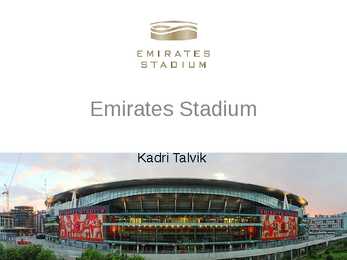
Fifth level Stadium project Highbury Stadium reconstruction New location Redevelopment of Dayton Park New waste station in Lough Road Creating 1 800 new jobs 2 300 new homes Improvements on the railway stations Measurements North- South 245,6m East- West 199,6 Height 41,466m 17 acres Facts Over 2 000 doors 100 flights of stairs 13 elevators 5 escalators 900 toilets 41 TV camera positions 16 trees 1 dog toilet Arsenalisation "visible stronghold of all things Arsenal through a variety of artistic and creative means" 32 legends on the walls 12 greateast Arsenal moments The Arsenal Museum and Tours Northern Triangle building Self- guide audio tour Legends tour Sources http://images.google.com/ http://en.wikipedia.org/wiki/Emirates_Stadium http://www.arsenal.com/emirates Thank you for listening!
TOOMPEA Toompea (from German Domberg – Cathedral Hill ) is a limestone hill with an area of about 7 hectares in the central part of Tallinn. It towers about 30-40 m above the surrounding areas. According to the legend it´s the tumulus mound over the grave of the national hero Kalev, erected stone by stone in his memory by his grieving wife Linda. It is the birthplace of Tallinn - a place where in 1229 the Knights of the Sword built a fortress instead of the wooden Estonian stronghold. Toompea Castle is also one of the most potent symbols of the reigning power. Today Toompea is the seat of the Government of Estonia as well as the Riigikogu, both of which are often simply colloquially referred to as Toompea. For centuries there was only one access to Toompea - Pikk Jalg - but there is also another way leading up to Toompea - Lühike Jalg, which was made in the 14th century. At present Pikk Jalg and Lühike Jalg are used only by pedestrians. Until
pasta kujul. Tabletid on suuremalt jaolt komplekspreparaadid, kus on kaks või enam toimeainet, eesmärgiga toimida nii solkmetesse, muudesse ümarussidesse kui paelussidesse. Kutsikatele sobivad hästi ka pastad, mis võivad olla nii ainult solkmetesse (ja muudesse ümarussidesse) mõjuvad kui laia toimega komplekspreperaadid. Nii pastad kui tabletid on lühiajalise toimega: ravim soolestikust eriliselt ei imendu ja mõjub nii kaua kuni roojaga väljutatakse. Lisaks on olemas Stronghold: see on süsteemne ravim, mis imendub vereringesse ja toimib nii välis- kui siseparasiitidele. Stronghold tapab solkmed, aitab hävitada kuulmelesti, tapab sügelislestad ja kirbud. Strongholdil on kaks suurt eelist: seda saab manustada mugavalt turjale tilgutades ja toime kestab tervelt kuu aega. Üks miinus on ka: ei mõju paelussidele. Kuna Eestis on registreeritud ja saadaval arvukalt usside hävitamiseks mõeldud ravimeid, ei ole registreerimata ravimite nn
Castles and museums Cardiff castle Robert Fitzhamon built Cardiff castle. Cardiff Castle is one of Wales' leading heritage attractions and a site of international significance. During 2000 years of history, the Castle has been a Roman Garrison, a Norman stronghold and in Victorian times was transformed into a gothic fairytale fantasy. St Fagans St Fagans is an area in the west of the city of Cardiff, capital of Wales. To the south lies the village of Michaelston-super-Ely, and to the east the suburb of Fairwater. St Fagans lies on the River Ely, and previously had a railway station on the South Wales Main Line, and currently there is a level crossing. St. Fagans is home to St. Fagans Cricket Club. It is home to St
Old Tallinn The history of Tallinn has been long and dignified and up to the end of the medieval times connected with the area forming the foundation of current Old Town.The frist settlements on the coast of Northern Estonia appeared at the end of the 10th century,when the Estonians established a stronghold in the neighborhood of a favorable port- on the hill of Toompea. The dominants of that time are preserved in their medieval from : churches, public buildings,the Town Hall with the square in of it and the order castle on the hill of Toompea. The O ld Town is the spiritual centre of Estonia with the most important shrines,museums and its historical heritage. The Old Town has surprise for the one-day tourist as well as for its own citizens who have walked the streets of the medieval city for
Edinburgh Castle UK, Scotland an ancient stronghold. History a centre of military activity. Human habitation since 9th century BC. Nowadays Scotland's second-most-visited tourist attraction. The New Barrack Block is home to the official headquarters of the Royal Regiment of Scotland. St. Margaret's Chapel the oldest surviving building in the castle and in Edinburgh. dates from the early 12th century. King David I built it as a private chapel for the royal family. He dedicated it to his mother, Saint
and Danish languages as Reval (Latin: Revalia). The name originated from (Latin) Revelia (Estonian) Revala or Rävala, the adjacent ancient name of the surrounding Estonian county. The origin of the name "Tallinn(a)" is certain to be Estonian, although the original meaning of the name is debated. It is usually thought to be derived from "Taani- linn(a)" (meaning "Danish-castle/town"; Latin: Castrum Danorum) after the Danes built the castle in place of the Estonian stronghold at Lindanisse. However, it could also have come from "tali-linna" ("winter-castle/town"), or "talu-linna" ("house/farmstead-castle/town"). The element -linna, like Germanic -burg and Slavic -grad / -gorod, originally meant "fortress" but is used as a suffix in the formation of town names.
guarding the Honours of Scotland. Fyvie Castle in the village of Fyvie, is a castle near Turriff in Aberdeenshire, Scotland.The earliest parts of Fyvie Castle date from the 13th century - some sources claim it was built in 1211 by William the Lion. Fyvie was the site of an open-air court held by Robert the Bruce, and Charles I lived there as a child. Following the Battle of Otterburn in 1390, it ceased to be a royal stronghold and instead fell into the possession of five successive families - Preston, Meldrum, Seton, Gordon and Leith - each of whom added a new tower to the castle.Inside, the castle stronghold features a great wheel stair, a display of original arms and armour, and a particularly fine collection of portraits.Manus O'Cahan and Montrose fought a successful minor battle against the Covenant Army at Fyvie Castle on August 24th 1644
West measures in at 199.6m. The total height of the stadium is 41.466m with the eaves(räästad) reaching a height of 34.190m. · The stadium covers an area of 17 acres · Some fun facts about the stadium. There are over 2 000 doors, 100 flights of stairs, 13 elevators, 5 escalators, 900 toilets, 41 television camera positions, 16 trees and 1 dog toilet in the Stadium. · In 2009 Arsenal started the project of 'Arsenalisation' . The intention was to turn the stadium into a "visible stronghold of all things Arsenal through a variety of artistic and creative means" · Eight large murals(seinamaaling/kaunistus) on the exterior of the stadium were installed, each depicting four Arsenal legends linking arms, such that the effect of the completed design is 32 legends in a huddle(üksteise vastu, kobaras) embracing the stadium. · Around the lower concourse of the stadium, further murals depicting 12 "greatest moments" in Arsenal history voted for by a poll on the club's website
monastery, as the bishop. These boundaries of the new diocese were permanently fixed by a legate of Pope, Wilhelm of Modena in 1234. The first residence of the diocese was located in Lihula, where with the help of the Order the Bishop transferred the diocese's residence to Vana-Pärnu, wich was burned and destroyed by Lithuanians ten years later. A new centre for the diocese was chosen in Haapsalu, where a cathedral was built and an Episcopal stronghold was started During the reign of Ösel-Wiek Bishop, every canon was supposed to lead a chaste and virtuous life according to the rules of the monastery. Access of women to the Episcopal Castle was forbidden by threat of death. A legend tells that a canon fell in love with an Estonian girl and brought secretly the maiden into the castle. She hid by dressing as a choirboy and remained a secret for a long time, but when the bishop
The Haapsalu Bishop's Castle The Haapsalu Bishop's Castle and Cathedral, which was established in the 13th century as the centre of the SaareLääne Diocese, is one of the best preserved castles in Estonia. It is located on the western coast of Estonia in Haapsalu. The Haapsalu Castle is one of the most remarkable examples of Estonian MiddleAge fortress architecture. The stronghold construction, widening and reconstruction went on throughout several centuries, with architecture changing according to the development of weapons. The fortress achieved its final dimensions area of more than 3 hectares, thickness of the wall between 1.2 and 1.8 meters, and maximum height over 10 metres under the reign of Bishop Johannes IV(fourth). In the 17th century, the castle was no longer used as a defensive building by the Swedes who now ruled the Swedish Estonian Province
Kuressaare Castle The convent building of Kuressaare castle is the only medieval fortification in the Baltic States that has not undergone considerable alterations and due to that is an internationally important architectural monument. This castle is built of limestone. The roof is made of red stone. The construction of the stronghold was closely connected with the Estonians fight against the German feudals. The first documented data about Kuressaare castle originate only from 1380s. Kuressaare castle remained the residence for the bishops of Saare-Lääne Bishopric until the beginning of the Livonian War. At the end of the XIV and the beginning of the XV century the castle was surrounded by a new mighty 625 m long and 7 m high belt of walls, erected around the old belt of walls dating from the XIII century
2,600 clubs on the island. In 2003 it represented 34% of total sports attendances at events in Ireland and abroad, followed by hurling at 23%, soccer at 16% and rugby at 8% and the All- Ireland Football final is the most watched event in the sporting calendar Places of interest Bunratty Castle Large tower house in Ireland. Blarney Castle It is the one of the most visited sights in Ireland. A medieval stronghold in Ireland. It was destroyed in 1446, but subsequently rebuilt by Cormac Laidir MacCarthy, Lord of Muscry. Ireland details Population - 2011 census 4,581,269(119th) Density 65.2/km2 (142nd) 168.8/sq mi Currency:Euro Area Total 70,273 km2 (120th) 27,133 sq mi - Water (%) 2.00 Largest city Dublin
In 1980 Tallinn was awarded the European Gold Medal for preserving several architectural monuments. Old Tallinn is also famous for its cosy, romantic bars and cafes. Tallinn of today offers modern hotels, restaurants, sport and cultural centres. The town is also a well-known sailing centre. The yachting regatta of the 1980 Moscow Olympic games was held at Pirita. At various times in history, the city has been given different names. In 1219 Henricus de Lettis wrote about the Lyndanise stronghold of the Rävala people. On 13 June that year King Waldemar II of Denmark came to conquer north Estonia. The Estonians lost the battle and the Danse renamed the town Reval, as it was the centre of the ancient Estonian province of Rävala. The Estonian, however, rejected the name and began to call the city Taani linn, the Estonian for Danish castle. Tallinn's economy started to boom in the 19th century with the emergence of machine- building, woodworking and textile industries
strongholds, homes, and historic sites throughout the years. While some tourists come to see the castles England features as the primary focus of their Europe vacation, other travelers hope to visit the castles England has as part of a larger trip. No matter what your particular focus, castles in England are one of the most impressive attractions in England. http://www.youtube.com/watch?v=VoXFfvVj6WQ Windsor Castle Windsor Castle is the largest inhabited stronghold in the world as well as the largest castle to be found in England. Windsor castle is a favorite residence of the current royal family, and has served the purposes of the monarchy since the days of William the Conqueror. Tours of the castle are available daily. The Tower of London Being situated along the River Thames in the heart of London, this castle is one of England's best known. It was established just after William the Conqueror arrived in 1066 of our Common Era
In 1980 Tallinn was awarded the European Gold Medal for preserving several architectural monuments. Old Tallinn is also famous for its cosy, romantic bars and cafes. Tallinn of today offers modern hotels, restaurants, sport and cultural centres. The town is also a well-known sailing centre. The yachting regatta of the 1980 Moscow Olympic games was held at Pirita. At various times in history, the city has been given different names. In 1219 Henricus de Lettis wrote about the Lyndanise stronghold of the Rävala people. On 13 June that year King Waldemar II of Denmark came to conquer north Estonia. The Estonians lost the battle and the Danse renamed the town Reval, as it was the centre of the ancient Estonian province of Rävala. The Estonian, however, rejected the name and began to call the city Taani linn, the Estonian for Danish castle. Tallinn’s economy started to boom in the 19 th century with the emergence of machine-building, woodworking and textile industries
They fought over colonies and areas in that war. By 1758 the British had captured the French fortress of Louisbourg. It was an important position for the British to acquire because it guarded the entrance of the St. Lawrence river. This marked the beginning of the end for French rule in North America. In 1759 a famous battle on the Plains of Abraham just outside of Quebec City was fought. Yhe British were victorious and on the following spring they conquered the last French stronghold Montreal. At the present day more than five million French-speaking peole live in the Quebec province. Even today there are tensions bettween the British people and the French people and it threatens the unity of Canada. When the British took over they didn't change much in French traditions. They allowed the French peole to keep their religion, civil law system and language. The British didn't want any French people to try to break away from Britain.
William the Conqueror in 1078 as a castle and a palace but even before the site had been used by the Romans and Anglo-Saxons. The tower comprises not one, but 20 towers, the oldest, the White Tower, dates back to the 11 th Century. The Roman stone wall, parts of which can still be seen on the territory of the Tower, may have been a small Roman fort near the river. The White Tower, called so on account of the white Caen stone Brought from Normandy, is the original Norman stronghold. It is the central building of the Tower of London. The white tower has three small square towers and one round one. Later other buildings were added. It has served as a palace as well as a fortress, but it is as a prison that it is known best. Many people have been locked in the Tower, for religious beliefs or suspected treason. Traitors' Gate, set in the southern wall of the Tower, has steps leading down to the river Thames. Countless prisoners, including the future Queen Elisabeth I,
restaurants, sport and cultural centres. Every five years national song and folk dance festivals take place in Tallinn. The yachting regatta of the 1980 Moscow Olympic Games was held at Pirita. History Tallinn means in English "Danish town". The place is believed to have been settled by Finno-Ugric people about 2500 BC. It was first marked on a map of the world by the Arab geographer al-Idrisi in 1154. The Estonians were the first to build a stronghold on the spot of the Toompea Hill, but the real Tallinn was built by the Danes who conquered the north of Estonia in 1219. Legend has it that one day, when the Danes were about to lose a bloody battle, the sky suddenly opened and a red flag with a white cross on it dropped down upon them from the heaven. This is how the Danes obtained their national flag. In 1346 the Danish king sold his Estonian lands to the Teutonic Order, who a year later resold them to the Livonian Order
by making a racket if something tries to enter the cave. In similar fashion, villains of 49 T H E W R I T E R ' S JOURNEY ~ T H I R D EDITION Christopher Voghr stories often rely on underlings such as doorkeepers, bouncers, bodyguards, sentries, gunslingers, or mercenaries to protect and warn them when a hero approaches the Threshold of the villain's stronghold. P S Y C H O L O G I C A L F U N C T I O N : NEUROSES These Guardians may represent the ordinary obstacles we all face in the world around us: bad weather, bad luck, prejudice, oppression, or hostile people like the waitress who refuses to grant Jack Nicholson's simple request in Five Easy Pieces. But on a deeper psychological level they stand for our internal demons: the neuroses, emotional scars, vices, dependencies, and self-limitations that hold back our growth and progress
By 1630, his solutions had made him rich enough to build a small but elegant chateau at Juvisy, 12 miles south of Paris, later surrounding it with a charming informal garden designed by Le Notre, the gardener of Versailles. Here Louis XIII stopped to visit the young crypt-analyst in 1634, 1635 and 1636 on his returns to Paris from Fontainebleau. In the swashbuckling court of that monarch, and then in the resplendent one of Louis XIV, Rossignol served with an extraordinary facility. The stronghold of Hesdin surrendered a week sooner than it otherwise would have because he solved an enciphered plea for help, and then composed a reply in the same cipher telling the townspeople how futile their hopes were. How many other towns he compelled to surrender, how many diplomatic coups he made possible, how many betrayals he uncovered among the great nobles in those days of shifting allegiances, he never discussed. This reticence caused some at the court
 annaabi.ee