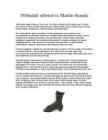
majapidamistööst. Naised lasid end meelitada sellesse lõksu kus sõja-aastatel kättevõidetud vabadus vahetatakse taas koduperenaise rollil vastu. Mood propageerib naiselikkust, peenetundelisust ja luksust. Peene tooniga oli kooskõlas ka väike koketinoot. Päeva edenedes oli ette nähtud mitu erinevat paari kingi. Loomulikult pidi arsenalis olema esindatud peene kõrge kontsaga kõpskingad, olgu need siis kandmiseks kas või tolmuimemisel. Dekaadi alguse märksõnaks on sitletod (stiletto pistoda tüüp). Kerged elegantsed kõrge kontsaga kingad said Itaalia põhiliseks ekspordiartikliks. Disaineritest teevad stiletodega nime Roger Vivier ja Charles Jourdan. Kümnendi teine pool annab siiski jalgadele armu. Tänu filmidiiva Audrie Hepburnile saavad populaarseks balletikingad. Toonaste moeikoonidena on tuntud veel Brigitte Bardot, Gina Lollobrigida ja Sofia Loren. Ülevõimendatud tarbimisühiskonna roosamannale tekib 50ndate lõpus vastukaaluks
Secondly to suggest characters educational status, social backround. To create irony when describing the interest and hobbies of common people. Aldington "Death of a hero" describes uses of psychology terms. Lastly, for the sake of humour when terms are used instead of everyday words. Foreign words and barbarism Barbarisms are words from other languages borrowed into English but no assimilated to the full extent. However, registered in dictionaries. E.g. vacuum, bizarre, stiletto Foreign words and phrases are facts of other languages. They don't belong into English. E.g. mein Gott! Avanti (go ahead), soleil (sun), kummel (vodka). Appear in italics. The function: 1. to supply local colour writer is describing. E.g. spain and used Spanish. 2. suggest persons nationality 3. to suggest a social status 4. desire to be above the average 5. to sften the utterance by using less familiar foreign words.
In fiction terms are used in order to: · Reflect a true-to-life atmosphere of some profession · Indicate the character's educational status and background. · Create irony and humour. It happens when the terms are used in everyday context. Foreign words do not belong to English vocabulary; they are parts of another language. (Mein Gott, interessant, soleil) Barbarism belong to English vocabulary but they are nor assimilated (vacuum, stiletto, saga etc) Function: · To supply local colour · To suggest the person's nationality · To render the social status of the character · To convey the character's desire to be above the average (to show off) · To soften the utterances (understatement) · For the sake of humour, esp. when these words clash with colloquial ones. Archaic words are not used any more. They are also called out-dated, cave words (timepiece, wot--know)
atmosphere of some professionals). b) They may suggest character's educational status or social background. c) Their effect may be irony (e.g. R. Aldington's "Death of a Hero"). d) Their effect may be humour, when applied to everyday concepts. 2. Foreign words and barbarisms (barbarisms are borrowed foreign words that are not assimilated but are still English and are registered in dictionaries: "bizarre", "stiletto", "vacuum", saga"). Foreign words are facts of other languages and not belong to English: "Mein Gott!" (German). Such words appear in Italics. In fiction they are used: a) to supply local colouring (usually a couple of such words is enough) b) to suggest the speaker's or character's nationality c) to render the speaker's or character's social status
c) Their effect may be irony (e.g. R. Aldington's "Death of a Hero"). d) Their effect may be humour when terms are applied to everyday concepts (e.g. Leacock's favourite devices). 2. Foreign words and barbarisms (barbarisms are borrowed foreign words that are not assimilated but are still English words and are registered in dictionaries: "bizarre", "stiletto", "vacuum", saga", etc. Foreign words are just facts of other languages and not belong to English: "Mein Gott!" (German), "avanti" (Italian). Such words appear in Italics. In fiction they are used: a) to supply local colouring (usually a couple of such words is enough) b) to suggest the speaker's or character's nationality c) to render the speaker's or character's social status
Would I ever get used to his perfection? "I did mention that you looked very nice, didn't I?" I verified. "Yes." He grinned again. I'd never seen him dress in black before, and, with the contrast against his pale skin, his beauty was absolutely surreal. That much I couldn't deny, even if the fact that he was wearing a tuxedo made me very nervous. Not quite as nervous as the dress. Or the shoe. Only one shoe, as my other foot was still securely encased in plaster. But the stiletto heel, held on only by satin ribbons, certainly wasn't going to help me as I tried to hobble around. "I'm not coming over anymore if Alice is going to treat me like Guinea Pig Barbie when I do," I griped. I'd spent the better part of the day in Alice's staggeringly vast bathroom, a helpless victim as she played hairdresser and cosmetician. Whenever I fidgeted or complained, she reminded me that she didn't have any memories of being human, and asked me not to ruin her vicarious fun
 annaabi.ee