Collectively, they were known as the Whites while the Bolsheviks were known as the Reds. But why did it really breake out? There were three reasons why Civil War broke out in Russia in 1918.The first reason was that there was bound to be a challenge to the Bolsheviks, who had seized power by a surprise coup. After 1918, their political opponents tried to reverse it. The Bolsheviks had many enemies. One group who wanted to destroy the Bolsheviks were the Social Revolutionaries. At first, they had supported the November Revolution. Elections had been held in November 1917 for a new government, the Assembly in which the Bolsheviks had won 175 seats and the Social Revolutionaries 370 seats. However, when it met in 1918, Lenin used the Red Guards to close the Assembly, and killed anybody who objected. The Social Revolutionaries fought back by attacking the Bolshevik government. The Bolsheviks were also opposed by the
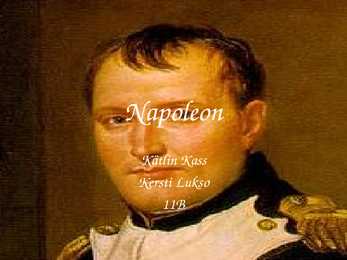
Napoleon Kätlin Kass Kersti Lukso 11B Napoleone di Buonaparte · 1 5 Aug us t 1 7 6 9 5 Ma y 1 8 2 1 · Fre nc h m ilita ry a nd p o litic a l le a d e r · Em p e ro r o f th e Fre nc h · King o f Ita ly · Mediator of the Swiss Confederation · Protector of the Confederation of the Rhine Early career · commissioned a second lieutenant in La Fere artillery · a complex threeway struggle was playing out between royalists, revolutionaries, and Corsican nationalists · conflict with Pasquale Paoli · appointed artillery commander of the French forces besieging Toulon Early Career · imprisoned in the Chateau d'Antibes in August 1794, but was released within two weeks · engaged to Desiree Clary Coronation as Emperor · the arrest of Duke of Enghien · crowned himself Emperor in1804 · was crowned King of Italy · declared the Papal States
One of the most important developments in the western intellectual tradition was the Scientific Revolution. The Scientific Revolution was nothing less than a revolution in the way the individual perceives [ tajub ] the world. As such, this revolution was primarily an epistemological revolution it changed man's thought process. It was an intellectual revolution a revolution in human knowledge. Even more than Renaissance scholars who discovered man and Nature, the scientific revolutionaries attempted to understand and explain man and the natural world. Thinkers such as the Polish astronomer Nicholas Copernicus(14731543), the French philosopher René Descartes(15961650) and the British mathematician Isaac Newton(16421727) overturned the authority of the Middle Ages and the classical world. And by authority I am not referring specifically to that of the Church the demise of its authority was already well under way even before the Lutheran Reformation had begun
1880. aastal. Place de la Bastille on väljak Pariisis, kus oli Bastille enne selle vallutamist ja hävitamist. Bastille' plaan Bastille' vallutamine Kasutatud materjal: http://miksike.ee/docs/lisa/8klass/1teema/ajalugu/prantsuse_revolutsioon_gerda.htm http://et.wikipedia.org/wiki/Prantsuse_revolutsioon#Bastille.27_vallutamine http://www.historywiz.com/bastillefall.htm http://www.history.com/this-day-in-history/french-revolutionaries-storm-bastille http://www.britannica.com/EBchecked/topic/55622/Bastille http://en.wikipedia.org/wiki/Bastille http://miksike.ee/docs/referaadid/prantsuse_revolutsiooni_algus_liina.htm http://en.wikipedia.org/wiki/Place_de_la_Bastille
Tartu: Greif. 2. Geifman, A. (1997). The Russian Intelligentsia, Terrorism and Revolution. Brovkin, V. (toim) The Bolsheviks in Russian society : the revolution and the civil wars. New Haven, London: Yale University Press 3. Heywood, A. (1999). Modernising Lenin's Russia : economic reconstruction, foreign trade and the railways. Cambridge: Cambridge University Press. 4. Malia, M.E. (1994). The Soviet tragedy. Stuttgart: Klett-Gotta 5. Melancon, M. (1997). The Left Socialist Revolutionaries and the Bolsevik. Brovkin, V. (toim) The Bolsheviks in Russian society : the revolution and the civil wars. New Haven, London: Yale University Press 6. McCauley, M. (2008). The rise and fall of the Soviet Union. Pearson/Longman. 7. Laqueur, W. (1987). The fate of the revolution: interpretations of Soviet history from 1917 to the present. New York: Scribner 8. Pipes, R. (1991). The Russian Revolution. New York: Vintage Books 9. Pipes, R. (1980)
remember his virtue, which you must never cease to emulate." The painting itself is very symbolic. In Marat's left hand there is a letter from Corday and beside it a letter with some money to a soldier's widower. This portrays him as a good hearted and humble man, who supports the poor and weak. Furthermore, Marat is writing on an old box that was used as a table. On the panting the box symbolizes the conditions of the revolutionaries supporting the Republic, because usually only the rich and the supporters of the king could own luxurious furniture. All in all, David represented Marat on the panting as a loyal and true friend with strict principles. (Graham-Dixon, 2008, p.269) Although The death of Marat is a portrait, many of art historians consider it to be a history painting. In the later years historians have started to consider new perspectives and therefore
' (Murphy, 1992, p. 26). Eva Hoffman transcribes similar instances of low self-esteem and accepted resignation. However, there are also more assertive (although equally naive) constructions of cultural identity: `We are brave people, our revolutionaries had no weapons, only they were brave, to go out and get thousands killed to get freedom for us all' (Murphy, 1992, p. 41; italics mine); `You see, that's how we are, a very emotional people. We're part Greek, part Dacian, part Latin' (Hoffman, 1999, p. 243).
against france and brought Bengal under British control. Financial indiscipline led to the loss of independence of the company and its powers were handed over to the Briish crown. *The American War of Independence 1775-1783 began as a war between Great Britain and thirteen united former British colonies on the North American continent and ended in a global war between several European great powers. The war was the culmination of the political American Revolution. In 1775, Revolutionaries gained control of each of the thirteen colonial governments, set up the Second Continental Congress, and formed a Continental Army. The following year, they formally declared their independence as a new nation, the United States of America. Throughout the war, the British were able to use their naval superiority to occupy coastal cities, but control of the countryside largely failed due to their relatively small land army. In 1783, the Treaty of Paris ended the war and recognized the
violence. Perhaps the most prominent proponent of this argument is James C. Davies (1962, 1969) who states that we are most likely to find revolutions at a time when a period of improving economic and social conditions is followed by a short, sharp reversal in those conditions. Thus, it is not the traditionally most downtrod- den people-those who have come to see their deprivation as part of the natural order of things-who are especially likely to revolt. Instead, revolutionaries are more likely to be those who have been given at least some taste of a better life. When the economic and social improvements they have experienced and come to expect suddenly become less available, they desire them more than ever and often rise up violently to secure them. For instance, it is little recognized that at the time of the American Revolution, the colonists had the highest standard of living and the lowest taxes in the Western World
 annaabi.ee