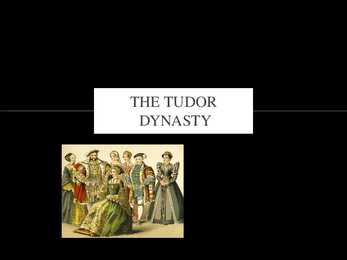
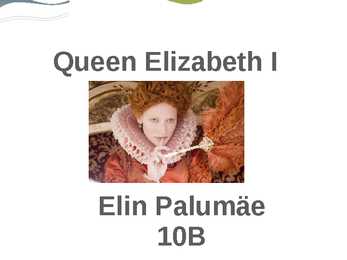
because none of them gave birth to a son Henry had desire to provide England with a male heir. THE TUDOR DYNASTY Henry VIII In later life he became morbidly obese and his health suffered; his public image is frequently depicted as one of a lustful, egotistical, harsh, and insecure king. He died 28 January 1547. THE TUDOR DYNASTY ELIZABETH I Elizabeth I was queen regnant of England and Ireland from 17 November 1558 until her death. Sometimes called The Virgin Queen, Gloriana, or Good Queen Bess, Elizabeth was the fifth and last monarch of the Tudor dynasty. THE TUDOR DYNASTY ELIZABETH I Elizabeth's reign is known as the Elizabethan era, famous above all for the flourishing of English drama. After the short reigns of Elizabeth's brother and sister,
because none of them gave birth to a son Henry had desire to provide England with a male heir. THE TUDOR DYNASTY Henry VIII In later life he became morbidly obese and his health suffered; his public image is frequently depicted as one of a lustful, egotistical, harsh, and insecure king. He died 28 January 1547. THE TUDOR DYNASTY ELIZABETH I Elizabeth I was queen regnant of England and Ireland from 17 November 1558 until her death. Sometimes called The Virgin Queen, Gloriana, or Good Queen Bess, Elizabeth was the fifth and last monarch of the Tudor dynasty. THE TUDOR DYNASTY ELIZABETH I Elizabeth's reign is known as the Elizabethan era, famous above all for the flourishing of English drama. After the short reigns of Elizabeth's brother and sister,
He was President of the Industrial Welfare Society, an area of special concern. He married Lady Elizabeth Bowes-Lyon in 1923 and became King on the abdication of his brother Edward VIII in 1936. He and Queen Elizabeth The Queen Mother were held in great affection by the population for the courage and sense of duty they showed during the War. Following his death in 1952, he was succeeded by his eldest daughter who became Queen Elizabeth II. Queen Elizabeth II (1926-), Queen regnant Princess Elizabeth became heir to the throne in 1936 on the accession of her father George VI. She married Philip Mountbatten in 1947 and their first children, Prince Charles and Princess Anne, were born in 1948 and 1950. Elizabeth became Queen in 1952, whilst on an official trip to Kenya, after the death of her father. Her coronation in 1953 was the first to be televised and was broadcast internationally. Her sons, Princes Andrew and Edward, were born in 1960 and 1964
Elizabeth from the succession. but her support quickly Instead declared as his heir crumbled, and she was Lady Jane Grey, deposed after reigning nine granddaughter of Henry VIII's days. sister Mary, Duchess of Mary rode triumphantly into Suffolk. London, with Elizabeth at her side. Mary, the country's first undisputed Elizabeth was brought to court and queen regnant, was determined to crush interrogated. the Protestant faith in which Elizabeth Though it is unlikely that she had had been educated. plotted with the rebels, some of them This included Elizabeth, who had to were known to have approached her. outwardly conform. Elizabeth's supporters in the Mary's initial popularity ebbed away government, including Lord Paget.
abdication of his brother Edward VIII. She began to undertake public duties during the Second World War, in which she served in the Auxiliary Territorial Service. On the death of her father in 1952, she became Head of the Commonwealth and queen regnant of seven independent Commonwealth countries: the United Kingdom, Canada, Australia, New Zealand, South Africa, Pakistan, and Ceylon. Her coronation service in 1953 was the first to be televised. Between 1956 and 1992, the number of her realms varied as territories gained independence and some realms became republics. Today, in addition to the first four aforementioned countries, Elizabeth is Queen of Jamaica, Barbados, the Bahamas, Grenada, Papua New
 annaabi.ee