Rubens- The Fall of Phaeton Rubens- The Fall of Man Rubens- Venus at the Mirror Rubens- Nymphs filling the horn of plenty Rubens- Venus, Cupid, Baccchus and Ceres Rubens- The Three Graces IV maalikunst ● Hollandi maalikunst oli teistsugune: elulähedane ● Olustikumaalid ehk elu-olu täpselt kujutavad pildid ● Natüürmordid: puuviljade ja esemete kujutamine Rembrandt- Girl with a Pearl Earring Rembrandt- The Prodigal Son in the Tavern Van Dyke- The Arnolfini Wedding IV maalikunst ● Rokokoo maalikunst oli stiilist sama õrn ja mänglev nagu arhitektuurgi ● Kuulsaim kunstnik: Jean-Honoré Fragonard Fragonard- Blind Man’s Buff Fragonard- The Stolen Kiss Fragonard- The Swing Lancret- Mademoiselle De Camargo Dancer IV maalikunst ● Klassitsismi kunstis nagu arhitektuuriski rõhutati sümeetriat ja puhtaid vorme
aastast. Kõik liikmed on õppinud Eesti muusika- ja teatriakadeemias ning on muusikud Eesti Riiklikus Sümfooniaorkestris. Nende repertuaar on mitmekesine, hõlmates klassikalist kvartetirepertuaari, kaasaaegset muusikat ning ka popmuusika töötlusi. Keelpillikvarteti ja Rannapi kontsert koosnes viiest osast. Peale esimest kahte osa oli väike vaheaeg. Esimesena kõlas keelpillikvarteti esituses Rannapi 1992. aastal kirjutatud lugu „Prodigal Son”. See lugu ei puudutanud mind sügavamalt. Loo esimene pool oli kiire ning sünge, meenutades õudusfilmi taustamuusikat. Loo teine pool oli aeglasem ning malbem, meeldides mulle rohkem, kui kvarteti esimene osa. Kohati mind isegi häiris antud pala juures, et pille ei mängitud terve aeg poognaga, vaid vahepeal ka sõrmitseti. Lugu kõlas üldjoontes kuidagi dramaatiliselt ja kohati isegi süngelt. Igatsesin kuulda seal kõrval malbet klaverit.
Timon of Athens Julius Caesar Macbeth Hamlet Troilus and Cressida King Lear Othello Antony and Cleopatra Cymbeline poems Shakespeare's sonnets Venus and Adonis The Rape of Lucrece The Passionate Pilgrim[nb 5] The Phoenix and the Turtle A Lover's Complaint Lost plays Love's Labour's Won The History of Cardenio Apocrypha Arden of Faversham The Birth of Merlin Edward III Locrine The London Prodigal The Puritan The Second Maiden's Tragedy Sir John Oldcastle Thomas Lord Cromwell A Yorkshire Tragedy Sir Thomas More Thank you for listening J
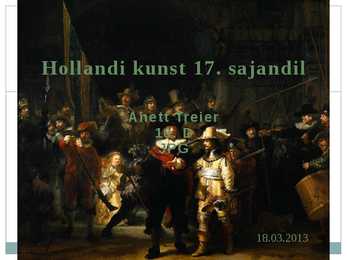
http://en.wikipedia.org/wiki/File:Jan_Vermeer_van_Delft_018.jpg http://www.artcyclopedia.com/artists/heda_willem_claesz.html http://en.wahooart.com/A55A04/w.nsf/Opra/BRUE-8LT4G9 http://commons.wikimedia.org/wiki/File:Saskia_van_Uylenburgk_-_Rembrandt_Harmenszoo http://yovisto.blogspot.com/2013/01/rembrandt-and-anatomy-of-dr-tulb.html http://www.oceansbridge.com/oil-paintings/product/80015/holyfamily http://christchurchwindsor.ca/2012/03/21/lenten-meditation-iii-the-prodigal-son/ http://www.thefastertimes.com/overlookedhistory/2009/09/14/today-in-overlooked-history-rem http://everydaylexy.blogspot.com/2012/05/kunstiajalugu.html Tänan kuulamast!
Web. 11 Feb.
2015.
Link: http://en.wikipedia.org/wiki/File:Artemisia,_by_Rembrandt,_from_Prado_in_Goog le_Earth.jpg 7 Autor: Rembrandt Harmenszoon van Rijn Pealkiri: Belshazzar's Feast Aasta: 1635 Asukoht: The National Gallery, London Link: http://en.wikipedia.org/wiki/Belshazzar%27s_Feast_(Rembrandt) 8 Autor: Rembrandt Harmenszoon van Rijn Pealkiri: Rembrandt and Saskia in the parable of the Prodigal Son Aasta: 1635 Asukoht: The Gemäldegalerie Alte Meister (English: Old Masters Gallery or Old Masters Picture Gallery), Dresden, Saksamaa Link: http://en.wikipedia.org/wiki/File:Rembrandt_- _Rembrandt_and_Saskia_in_the_Scene_of_the_Prodigal_Son_- _Google_Art_Project.jpg 9 10 Autor: Rembrandt Harmenszoon van Rijn Pealkiri: Danaë Aasta: 1636-1643 Asukoht: Hermitage Museum, Saint-Petersburg, Venemaa Link: http://en.wikipedia
"dark woods" and journeys to nine regions arranged around the wall of a huge funnel in nine concentric circles representing Hell. He is led by the ghost of Virgil, the Roman poet, who has come to rescue Dante from the dark forest and lead him through the realms of the afterlife. The first circle they enter is Limbo, which consists of heathen and the unbaptized, who led decent lives. The second through the fifth circles are for the lustful, gluttonous, prodigal, and wrathful. The sixth circle is where heretics are punished. The seventh circle is devoted to the punishment of violence. The eighth is devoted to those guilty of fraud and the ninth for those who betrayed others. In the last section, Satan remains imprisoned in a frozen lake. The journey is difficult and full of revelations, disappointment and questions, but they persevere. The end of their journey leads Dante and Virgil to the bottom of Hell. Lucifer is seen in all his ugliness
Sisukord 1. Sissejuhatus.................................................................................... 2 2. Elulugu.............................................................................................3 2.1. Nooruspõlv (1606-1624)..............................................................3 2.2. Leiden (1625-1630).....................................................................4 2.3 Amsterdam. Kuldaeg (1631-1641)................................................5 2.4. Amsterdam. Üleminekuaastad (1642-1650).................................7 2.5. Amsterdam. Küpsus (1651-1669)................................................8 3. Kokkuvõte........................................................................................10 4. Kasutatud kirjandus.........................................................................11 5. Lisad .............................................................................................
Kuressaare Gümnaasium REMBRANDT VAN RIJN Referaat Karin Kilumets 11b Juhendaja: õp. Anne Mets Kuressaare 2007 SISUKORD SISSEJUHATUS Oma referaadi tegin ühest maailma kuulsaimast kunstnikust Rembrandtist. Kunstniku valimine ei võtnud mul kaua aega. Olin varem Rembrandtistst väga palju kuulnud, kuid eluloolistest faktidest ja loomingust teadsin vähe. See aga huvitas mind väga ning nüüd avaldus mul hea võimalus tema kohta mõndagi teada saada. Arvan, et ka teiste kunstnike elulood on väga huvipakkuvad, kuid kunstimaailmaga seostub mul tugevalt just Rembrandti nimi. Rembrandti olen alati hinnanud kui kunstnikku, kes oma töödega suutis jätta maailmakunsti tugeva jälje. Nüüd tutvusin põhjalikult tema elulooga, mis ei olnud kaugeltki roosiline, nagu võiks arvata. Raskuse...
It fits your wisdom so far to believe it As he in his particular act and place May give his saying deed; which is no further Than the main voice of Denmark goes withal. Then weigh what loss your honour may sustain, If with too credent ear you list his songs, Or lose your heart, or your chaste treasure open To his unmaster'd importunity. Fear it, Ophelia, fear it, my dear sister, And keep you in the rear of your affection, Out of the shot and danger of desire. The chariest maid is prodigal enough, If she unmask her beauty to the moon: Virtue itself 'scapes not calumnious strokes: The canker galls the infants of the spring, Too oft before their buttons be disclosed, And in the morn and liquid dew of youth Contagious blastments are most imminent. Be wary then; best safety lies in fear: Youth to itself rebels, though none else near. OPHELIA I shall the effect of this good lesson keep, As watchman to my heart. But, good my brother, Do not, as some ungracious pastors do,
prominence (Lehte Hainsalu, Uno Laht and Jaan Kross). Jaan Kross (1920-2008), renowned today for his historical novels1, was originally noted for his poetry, his collection Söerikastaja (The Coal Enrichment Facility Worker, 1957) though primarily satirical, critical of the times and intellectual, promoted not only poetry but also helped refresh the literary climate. The socio-psychological dramas Atlandi ookean (Atlantic Ocean, 1956) by Juhan Smuul (1922-1971), Kadunud poeg (The Prodigal Son, 1958) by Egon Rannet (1911-1983) were widely discussed in Estonia. As the world outlook and contacts widened, the fine arts attained a new level in their development. The first post-war exhibition of Estonian art abroad was held in Helsinki in 1957. The Soviet dogma on artist values was abandoned step by step. Artists from the elder and middle generation felt a fresh impulse to be creative again,
distinctive effectiveness and power of metaphor as a figure of speech, and the centrality of metaphor in each of several walks of life, but in this chapter I shall confine my attention to the more specifically linguistic questions. A few examples to work with: (1) Simon is a rock.1 (2) Juliet is the sun. 2 A more complex solar metaphor: (3) Now is the winter of our discontent Made glorious summer by this sun of York. 3 (4) When the blood burns, how prodigal the soul Lends the tongue vows.4 What seems to characterize (1)(4) and other sentences called metaphori- cal? Beardsley (1967) identifies two features working in tandem: Within such a sentence there is a conceptual "tension" (human beings differ categorially from rocks or suns, and souls and tongues are not the kinds of things that could interact commercially); yet the sentence is not only intelligible but
" I shivered, imagining only too clearly what he described -- the alley at night, the frightened girl, the dark man behind her. And Edward, Edward as he hunted, terrible and glorious as a young god, unstoppable. Would she have been grateful, that girl, or more frightened than before? "But as time went on, I began to see the monster in my eyes. I couldn't escape the debt of so much human life taken, no matter how justified. And I went back to Carlisle and Esme. They welcomed me back like the prodigal. It was more than I deserved." We'd come to a stop in front of the last door in the hall. "My room," he informed me, opening it and pulling me through. His room faced south, with a wall-sized window like the great room below. The whole back side of the house must be glass. His view looked down on the winding Sol Duc River, across the untouched forest to the Olympic Mountain range. The mountains were much closer than I would have believed.
 annaabi.ee