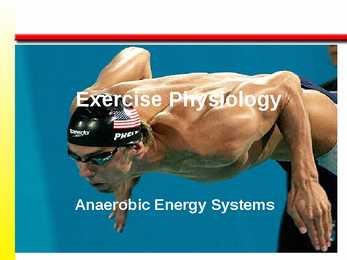
· Untrained individuals at 50-60% of VO2 max and at 65- 80% of VO2 max in trained. Exercise Physiology The Phosphate System The Sprinter · 100 m Sprinter World record male 9.69 Usain Bolt, female 10.49 - Florence Griffith-Joyner 36.8 km/h male, 34.3 km/h female Resynthesis ATP quickly Reach maximal velocity as fast as possible, maintain it as long as possible, slow down less · Energy system: ATP-PCr · Fuel: ATP and phosphocreatine (PCr) ATP-PCr Creatine kinase · PC + ADP ATP + C (creatine) · ATP and phosphocreatine (PCr) stored within muscles provides energy for performances of short duration and high intensity. E.g. 100m sprint, 25m swim, smashing a tennis serve, lifting a weight upwards. · ATP-PCr can provide energy for 1 min of a brisk walk, a slow run for 20-30 seconds, and all-out sprinting for 6 to 8 seconds. Cont...
‘junk’ implies no, function / purpose; ora function may not yet have been discovered; AVP; e.g. raw material for, evolution / natural selection, required for, cell division / mitosis / meiosis max 2 (b) straight line sloping up from left to right; (does not need to start at origin) 1 (c) ATP / NAD / NADP / RNA / phospholipid / GP / TP / RuBP / ADP / RUP / AMP / cAMP/ phosphocreatine / AVP; R DNA 1 [4] 179. DNA codes for, protein / polypeptide; transcription and translation (or described); enzyme is globular (protein); 3 bases 1 amino acid; sequence of bases / triplets, determines, sequence of amino acids / primary structure; coiling / helix / -pleated sheet / particular secondary structure; determines projecting side groups;
Since it the ATPase activity of myosin provides is so vital, muscle cells have developed energy for myosin bound to actin to swivel several ways of producing/regenerating ATP. and ultimately pull the thin filaments toward Muscle can use energy precursors stored in the center of the sarcomere. This produces the muscle cell, such as glycogen, lipids, and contraction by shortening the myofibril, the phosphagens (phosphocreatine, ATP), and it muscle cell, and eventually, the muscle. The can use energy sources recruited from the myosin and actin can disassociate when a blood stream (blood glucose and circulating new molecule of ATP is bound to the myosin lipids). Which of these reserves (intracellular head (Goll et al. 1984). In postrigor muscle, or circulating) the muscle cell uses depends the supply of ATP is depleted, resulting in on the activity the muscle is undergoing.
surface of the cell membrane, become maximally convexed into the environment where the hormones are circulating, thus allowing for maximal hormonal interaction with the receptor sites." Just water. Bah. Second: the sarcoplasmic volume increase is not just a uid (water) increase. It also corresponds to more mitochondria, more glycogen, and larger stores of both adenosine triphosphate (ATP, the energy currency of cells) and phosphocreatine (PC, a high-energy reserve). Not to mention increased capillarization from such training, which results in more efficient nutrient delivery through additional blood vessels. This is why Neil gained an average of 48.65% strength on his exercises (100% on one) in four weeks using what would be considered a sarcoplasmic lifting protocol. These strength increases are impressive by any measure, myofibrillar or otherwise. are impressive by any measure, myofibrillar or otherwise.
 annaabi.ee