Keskaeg kui pime aeg Mõiste "pime aeg" tuli kasutusele 1330ndatel, kui Itaalia teadlane Petrarch pidas Lääne-Rooma Keisririigi languse järgset aega "pimedaks ajaks", võrreldes seda klassikalise antiigi "valgusega". Ta kasutas seda väljendit, et häbimärgistada selle aja Ladina kirjandust. Ajaloolastel tekkis hiljem selgem arusaam ajastu saavutustest, seega hakati "pimedaks ajaks" pidama varakeskaega (5.saj-10.saj). Seda kutsuti nii, sest selle ajastu kohta on väga vähe informatsiooni säilinud ning see on iseloomustatud kui
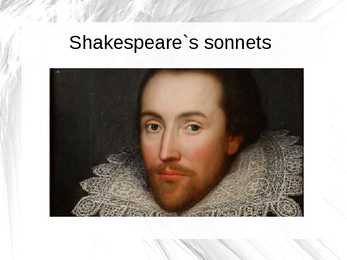
Shakespeare`s sonnets Sonnets in the world In Italy in the 14 century by Petrarch In England in the 15 century Fourteen lines Iambic pentameter 2 four-line and 2 three-line stanzas The structure of the Shakespearen sonnet It differs from Italian sonnet Three quatrians and a rhymed couplet In iambic pentameter The rhyme scheme is abab cdcd efef gg Shakespeare`s creation
The historical period of the poem's events can be dated in the 6th to 8th century. Much of the material of the poem is legendary and paralleled in other Germanic historical-mythological literature in Norse, Old English, and German. GEOFFREY CHAUCER (1340-1400) Politician and writer, fought in France during the 100 years war. He visited Genoa and Florence where he became acquainted with Italian literature and in particular with the works of Dante, Petrarch and Boccaccio. The French period (up to 1370). early works were based mostly on French models. The Italian period (up to c. 1387). Was influenced by Italian literature, especially Dante and Bocaccio. The English period. Wrote Canterbury tales. CANTERBURY TALES This unfinished poem of about 17,000 lines was written mostly after 1387. The poem introduces a group of pilgrims who are journeying from London to the shrine of Thomas à Becket at Canterbury
· Worked as a diplomat for a time · Translated works into English (from Latin, French, Italian) · Favourite of the royal court · At the time of his death was regarded as a great poet and was buried in Westminster · As a writer he was very prolific · His early works show a strong influence of French and Italian poets, especially the great Italian Renaissance geniuses Boccaccio, Dante, Petrarch · His masterpiece "The Canterbury Tales": o He imitates what Boccaccio does in Decameron. Introduces frame story/narrative. A springtime pilgrimage to Canterbury cathedral (which contained the important relics of St Thomas à Becket). Pilgrims would gather in groups because it was easier to protect themselves. The protagonists gather at an inn and wait for others. GC chooses people from the three major classes
Will started as an actor before starting to write his own plays; his career lasted for 21 years. Returned to Stratford in 1610, where he lived until his death atthe age of 52 and was buried in the local churh. Optimistic period wrote two long poems, ,,Venus and Adonis", ,,Lucrece", 154 sonnets, bright comedies, ,,Romeo and Juliet" and his historical plays. Sonnets the genre was developed in Italy, perfected by Petrarch, Shakespeare and Milton. In his poems there are the characters The Dark Lady, the Young Friend, the author. In his sonnets he criticizes human vices. Shakespeares ideal beauty differed greatly from the traditional beauty of the time. The Earl of Southampton was his friend. Comedies The Taming of the Shrew, A Mid-Summer Night's Dream, The Twelth Night, Much Ado About Nothing, The Merchant of Venice, The Merry Wives of Windsor, The Two Gentlemen of Verona, As You Like It
Before death designed his own epitaph( text on tombstone). If anybody touched is bones and ashes, he would be cursed. That stopped reburying Three periods in his literary period I Optimistic period II Pessimistic period III Romantic The Optimistic period He wrote poems and sonnets (154), world famous comedies, bright comedies, two tragedies "Romeo and Juliet" and some historical plays. 4 different items. Sonnet A poem of 14 lines, perfected in Italy by Petrarch. Each line has 10 syllables an d the stress is on everu other syllable. Adressed on two people. One was so called The Dark Lady. Other was The Writers Young Friend. Started to wrote them because sonnets abled him to criticise various human vices to express his feelings of love and friendship and his admiration of beauty. The above mentioned themes were very important in the Renaissance period. The ideal woman of those days looked like Elizabeth I. She had golden hair and ..
the study of Nature as the philosophy of Nature. According to the medieval world view, Nature was conceived [ kavandatud ] to be kept going from moment to moment by a miracle which was always new and forever renewed. It was God who ordered the universe through these miracles. This entire scheme depended not only upon God, but upon the individual's absolute and unwavering faith in God. If God pronounced it to be so, then it must be so. But after 1350, let's say, by the time of Petrarch (13041374), some men became more interested in the form of the miracle. Knowing that the cosmos was of divine origin and moved according to the will of God, some men embraced that Faustian spirit that wanted to know more. It was not enough to simply accept the existence of miracles the miracles now had to be explained. These men wanted to know what order, to what hierarchy the miracle conformed. And this brings us to the medieval view of cosmological order
 annaabi.ee