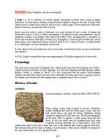
printed books. Traditionally, book papers are off white or low white papers (easier to read), are opaque to minimize the show through of text from one side of the page to the other and are (usually) made to tighter caliper or thickness specifications, particularly for case bound books. Typically, books papers are light weight papers 60 to 90 g/m² and often specified by their caliper/substance ratios (volume basis). For example, a bulky 80 g/m² paper may have a caliper of 120 micrometers (0.12 mm) which would be Volume 15 (120×10/80) where as a low bulk 80 g/m² may have a caliper of 88 micrometers, giving a volume 11. This volume basis then allows the calculation of books PPI (printed pages per inch) which is an important factor for the design of book jackets and the binding of the finished book. Different paper qualities are used as book paper depending on type of book: Machine finished coated papers, wood free uncoated papers, coated fine papers and special fine
stock. Inside calipers have inward curving legs for measuring inside diameters, such as the diameters of holes, the distances between two surfaces, the width of slots, etc. Combination caliper rule has jaws designed to make either inside or outside measurements and a needle to measure depths of holes. A depth caliper provided with a narrow blade is used for measuring the depth of holes, slots, keyways and other recesses. Micrometers are very precise instruments used for measuring. There are two types of micrometers: outside and inside micrometers. The outside micrometer is used for measuring outside dimensions, such as the diameter of a piece of round stock. The inside micrometer is used for measuring inside dimensions, as, for example, the inside diameter of a tube or hole, the bore of a cylinder, etc. VOCABULARY measuring tool mõõteriist
wavelengths up to 200 nm is possible. The advantage of direct passage of a beam of light through the capillary is the fact that in this case there is no band broadening caused by the detector cell and inlet capillaries. This detection does not introduce additional dead space. Its drawback, however, is a small internal diameter of capillaries (from 25 to 100 micrometers). Such a small optical path length, according to the BeerLambert law, results only a small absorption. Because of this constructive specificity, particular detection in CE, compared to other separation processes, is insensitive method. Elektrophoresis Electrophoretic separation is based on different rates of migration in an electric field, at that the ion velocity
111. Tsitraaditsükkel produtseerib kõrge energiasisaldusega ühendeid, mis transpordivad energia mitokondriaalsesse elektronide transpordi ahelasse (mETA), sest neid oksüdeeritakse mETAs. Need ühendid on: (õige variant alla kriipsutada) a. ATP ja CO2 b. CO2 ja FADH2 c. FADH2 ja NADH d. NADH ja ATP e. FADH2, NADH ja ATP Kloroplastid 112. Kloroplastide suurus. 2 - 10 micrometers in diameter 113. Kloroplastide peamised kompartmendid ja membraanid. Membraanid - Välismembraan, sisemembraan ja tülakoidide (lamellide)membraanid. Kompartmendid - Tülakoidid (väikesed lamedad vesiikulid), graanid (tülakoidide virnad), graanitülakoid (üksikud tülakoid graanis), stroomatülakoid (ühendab graanid üksikute hõredamalt paiknevate tülakoididega), strooma (kloroplastide sees väljaspool tülakoide paiknev piirkond), luumen (tülakoidide siseruum). 114
 annaabi.ee