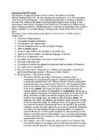
Medieval literature Religious literature- mostly written in church languages(Latin, Greek, Old Slavic) Secular literature- written in vernacular languages as well 6th -15th century Anonymity Religious writing Liturgical writing-hymns, psalms Theological writing-aquinas, abelard etc Religious poetry Mystery plays-reenactment of bible stories Secular writing Troubadour writing:"courtly love", romance Epic poem(song of roland) Travel writing History writing-chronicles Allegory The use of symbols and analogy to convey a certain meaning /message Literary output of medieval English Anglo-saxon or Old English literature(7th century-1066) Middle english literature(12th century-15th century)
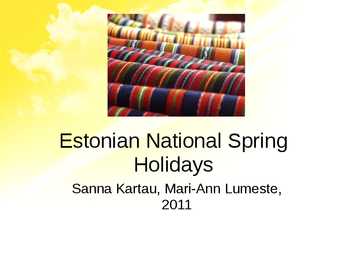
· First held in 1996, national holiday in 1999. · Celebration in our school with a speech contest called Demoshenes's Coronal · Celebration mostly in schools and cultural institutions. Children celebrating Example of Kristjan Jaak Peterson's poetry Cannot the language of this land In the wind of incantation Rising up to the heavens Seek for eternity? (K.J. Peterson) Demosthenes's Coronal Video of a contestant Easter (Lihavõtted) · Central feast in the Christian liturgical year · Bible legend · It's history goes beyond Christianity · Easter is a moveable feast. The date of Easter varies between March 22 and April 25. 2011 date is April 24th. Easter videos Coloring Eggs Rolling eggs down a hill Swinging May the 1st - Walpurgis Day and Night · Volbriöö (Walpurgis Day in English) is an important and widespread celebration of the arrival of spring in the country. · The night originally stood for the gathering and meeting of witches.
(The Virgin Queen restores order; Religious Settlement; cautious measures in foreign affairs) Authors: Thomas Kyd's "The Spanish Tradegy" (revenge); Christopher Marlowe (moral dramas; blank verse); Ben Jonson (comedies; theory of humors, caricature and satire); Edmund Spenser's "Faerie Queen" (longest, most famous poem; Spenserian stanza) Late Renaissance (until 17th century) humanism a set of ethics about how people should live/act Prose: influence of reformation on liturgical material; King James Bible (translation) Poetry: metaphysical poetry (unusual metaphors, simple verse forms, witty parallels between things) History: Union of Crowns (1603); English Civil War (16421651) Oliver Cromwell (d 1659); Restoration Age (16601700); The Glorious Revolution (1688) Restor. literature: contrasting puritanism of Cromwell's time; a shift in morality (brings free attitudes); continental influences (Dutch and French); new forms: fiction and journalism Restor
10. Mitmeks raamatuks/osaks on jagatud missa riitusi ja tseremooniaid käsitlev Caeremoniale Episcoporum? Sellele leidsin erinevad vastused. 8 osa Wikipedia järgi: 1. Episcopal liturgy in general 2. Mass 3. Liturgy of the Hours and Celebrations of the Word of God 4. Celebrations of the Mysteries of the Lord in the course of the year 5. Sacraments 6. Sacramentals 7. Noteworthy dates in the life of a bishop 8. Liturgical celebrations connected with solemn acts of episcopal governance http://en.wikipedia.org/wiki/C%C3%A6remoniale_Episcoporum Kui aga otsisin siit http://www.newadvent.org/cathen/ Siis oli kirjas, et see koosneb kolmest raamatust ning iga sisu oli põhjalikult lahti kirjutatud (http://www.newadvent.org/cathen/03133a.htm). Ilmselt see newadvent on usaldusväärsem. 11. Milliste nimede all on märgitud trükikohana Tartu 16.-18. sajandi trükistes?
o Ballads of humour "Get Up and Bar the Door" A husband and wife are too lazy to lock the door and whoever speaks first has to get up and do it. o Ballads of the supernatural ghosts, witches, fairies etc. "Thomas Rymer" Thomas' love for a fairy who takes him to Elfland. · Medieval drama began in the Middle Ages, is deeply rooted in folklore (pagan rites). Four stages of development. The earliest drama began as liturgical (a kind of sermon in church) drama. · Miracle plays or miracles, were performed by guilds of artisans in town squares. There were several cycles of miracle plays (around 50). They all had some kind of religious component, the lives of saints or stories of the Bible. · Morality plays were the beginning of secular (non-religious) drama. Mostly allegorical characters, a lot of moralising, the struggle of good and evil etc. The plot is closer to everyday lives.
over much of modern European Russia, Ukraine and Belarus was the Eastern branch of the Slavs, speaking a closely related group of dialects. The political unification of this region into Kievan Rus' in about 880, from which modern Russia, Ukraine and Belarus trace their origins, established Old East Slavic as a literary and commercial language. It was soon followed by the adoption of Christianity in 988 and the introduction of the South Slavic Old Church Slavonic as the liturgical and official language. Borrowings and calques from Byzantine Greek began to enter the Old East Slavic and spoken dialects at this time, which in their turn modified the Old Church Slavonic as well. The Ostromir Gospels of 1056 is the second oldest East Slavic book known, one of many medieval illuminated manuscripts preserved in the Russian National Library. Dialectal differentiation accelerated after the breakup of Kievan Rus' in approximately 1100.
architecture from the 13th to the 20th century. Several works of art that are exhibited in the church have been located there for centuries (e.g. the retable for the high altar made in the workshop of Hermen Rode in Lübeck, Danse Macabre by Bernt Notke, the retable of the Holy Passion, the seven-armed candelabrum, etc.); therefore, the St. Nicholas' Church as a museum offers a unique opportunity to exhibit these works of art in their historical and liturgical context. The objects, commissioned for the church in the Middle Ages and in later centuries, have been returned to their natural environment. Thus, the church and its art treasures compose a historical and cultural unit which value can hardly be overestimated. Many objects exhibited in the church are of extraordinarily high artistic and material value, above all the retable for the main altar with the paintings by Hermen Rode, and Dance Macabre by Bernt Notke which is unique in the whole world
sections resembling cantus firmus, a Gregorian chant.1 The first movement starts with the words “Te Deum laudamus”. Here, the whole thematic core of the work is expressed: Example 172. The tintinnabuli technique both for choir and orchestra has found freer application. The American concert organisation New World Classic claims that the Te Deum is possibly the most sold classical CD in the last decade (1993-2003).2 I cannot think of any other liturgical composition of recent years which could be compared to Te Deum, as its standard of performance served Pärt in all respects... with equal devotion as Pärt is serving the Divine Source.3 XIX. THE SEVENTIES. STYLISTIC DIVERSIFICATION. THE MATURE STYLES OF HEINO JÜRISALU, ANTI MARGUSTE AND EINO TAMBERG. This was also the time for the ripening of youth culture, including the hippie movement, Pop art, adoration of the Beatles, the “sexual revolution”, spread of the
 annaabi.ee