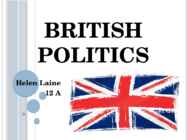
BRITISH POLITICS Helen Laine 12 A POLITICAL SYSTEM Democracy Constitutional monarchy Head of the state – Elizabeth II Actual power – Prime Minister Executive power - Her Majesty’s Government Legislative power – Parliament House of Commons and House of Lords Multi-party system MAIN PARTIES Two largest - the Conservative Party and the Labour Party Before labourers - The Liberal party Third largest – the Liberal Democrats Current: Conservative, Liberal Democrats ... Some other parties in UK: Democratic Unionist Party Scottish National Party Palace of Westminster UK Independence Party Green Party of England and Wales Scottish Green Party Social Democratic and Labour Party Alliance Party of Northern Ireland MAIN POLITICIANS
Ajanta (200 BC to 650 AD) Ellora (600 and 1000 AD ) Kailasa Temple Ajanta caves http://upload.wikimedia.org/wikipedia/commons/c/c3/Ajanta_ Ellora caves http://www.sacred-destinations.com/india/ellora-caves-photos/view-cc-shok.jpg Kailasa Temple Represents Mt. Kailasa, home of god Shiva; Largest monolithic structure in the world; 200 000 tons of removed rocks; 2x the area of Parthenon and 1,5 times higher; 7000 labourers; 150 years. Kailasa Temple Indo-Islamic Architecture Muslims in medieval time Imperial style under patronage of the Sultans of Delhi Mughal architecture round domes, high minarets, pillars, open courtyards Indo-Islamic style most important symbol is tomb provided spaciosness, massiveness and breadth Examples : Qutub Minar, Alai Darwaza, Tughlaqabad Fort, Fatehpur Sikri, Agra Fort, Taj Mahal, Red Fort Delhi
The Cape Dutch cookery style owes at least as much to the cookery of the slaves brought by the Dutch East India Company to the Cape from Bengal, Java and Malaysia as it does to the European styles of cookery imported by settlers, and this is reflected in the use of eastern spices and the names given to many of these dishes. Indian cookery Curry dishes are popular in South Africa among people of all ethnic origins; many dishes came to the country with the thousands of Indian labourers brought to South Africa in the nineteenth century. Restaurants and fast food outlets South Africa can be said to have a real "eating out" culture. While there are some restaurants that specialize in traditional South African dishes or modern interpretations thereof, restaurants featuring other cuisines such as Moroccan, Chinese, West African, Congolese and Japanese can be found in all of the major cities and many of the larger towns. In addition, there are also a large number of home-
Infiltrate sisse tungima 290.Influence on design mõju disainile 291.Informal vabakujuline 292.inlet - sissepääs 293.Interior- sisemaa, siseruum 294.Intervention sekkumine 295.Invaluable hindamatu 296.Inverted application pööratud rakendus 297.Involve managing sisaldab haldamist/juhtumist 298.irrigate niisutama 299.Irrigation - kastmine K 300.Kiosk- paviljon, suvemaja L 301.Labor-intensive - töömahukas 302.Labourers- tööline 303.Laden with salt- soolast koormatud 304.land area- maa-ala 305.Landscape gardening maastiku kujundamine 306.Landscape specialist- maastiku spetsialist 307.Large leafed- suureleheline 308.Lattice- võre 309.Lawn- muru 310.Layout- asetus, paigutus 311.Leaking lekib 312.Less fertile vähem viljakad 313.Life span eluiga 314.Limehating- aluselist lubjakivi talumatud 315.limitation- piirang 316
The Black Death is the name given to a disease called the bubonic plague. In 1377. Edward III's reign ended and it marks the end to the Plantagenet Kings. From 1377 - 1485 the Royal Houses of Lancaster and York became Kings of England in the Middle Ages and ruled the English. In 1377 Edward III was succeeded by his grandson Richard II. The Black Death of 1348 - 1350 decimated the population of England, so in 1349 King Richard II attempted to limit the wages paid to labourers to their pre-plague levels. That caused the Peasants Revolt in 1381. Richard II gave promises to the peasants to calm them down. The final outcome was that the King's promises were ignored, and the oppression of the peasants continued. In 1382 the Bible was translated into English by John Wycliffe. In 1399 Richard II was succeeded by his grandson Henry IV. He lead England until 1413 and was then succeeded by his son Henry V. Henry V reign lasted until 1422. In 1422 his son
Loyalists were American colonists, of different ethnic backgrounds, who supported the British cause during the American Revolution (1775–83). Tens of thousands migrated to British North America during and after the revolutionary war — boosting the population and heavily influencing the politics and culture of what would become Canada.The vast majority of Loyalists were neither well-to-do nor particularly high in social rank; most were farmers, labourers, tradespeople and their families. They were of varied cultural backgrounds, and many were recent immigrants. White Loyalists brought large numbers of slaves with them. Until 1834, slavery was legal in all British North American colonies but Upper Canada, where the institution was being phased out. The main waves of Loyalists came to what is now Canada in 1783 and 1784. 11. In which province is Scottish culture preserved? In 1910 an incredible 62,000 Scots emigrated to Canada
15. Wat Tyler's Rebellion took place in 1381. The first great popular rebellion in English history. Its immediate cause was the imposition of the unpopular poll tax of 1381, which brought to a head the economic discontent that had been growing since the middle of the century. The rebellion drew support from several sources and included well-to-do artisans and villeins as well as the destitute. Probably the main grievance of the agricultural labourers and urban working classes was the Statute of Labourers (1351), which attempted to fix maximum wages during the labour shortage following the Black Death. 16. The Wars of The Roses - a series of dynastic civil wars for the throne of England, fought between supporters of two rival branches of the Royal House of Plantagenet: the houses of Lancaster and York (the "red" and the "white" rose, respectively). They were fought in several
nobility on kõrgaadel. 3) gentry; Gentry on need kes on kõrgemast soost sündinud, gentleman’d. Siia kuulusid kõik aadligrupid, kes ei olnud kõrgaadli hulgas, kuid kes olid selgelt maavaldajad. Nende hulka viisid kuuluda ka rikkamad linnas kinnisvara valdavad isikud. Neil kujunes oma identiteet 4) husbandmenid; copy – freeholderid. poepidajad, väikekaupemehed (siseturg), käsitöölised. 5) elatist teenivad töötajad-töölised (labourers); 6) vaesed ja heategevusest sõltujad. kerjused, ka need inimesed kes vajasid abid( lesed, õpipoisid, vaeslapsed, madalad juhutöölised, vanurid). Oli veel rida elukutse esindajaid, keda inglased ise ka ei osanud kuhugile paigutada. Hierarhias vahepealsed elukutsed (kaupmehed, finantsistid, juristid, vaimulikkond, ametnikkond). 19 VI Inglismaa haldus- ja kohtukorraldus
 annaabi.ee