Kiek in de Kök tower The cannon tower Kiek in de Kök was founded in 1475-1483. The name was first recorded in the description of the second siege of Tallinn in 1577 as Kyck in de Kaeken, later on several forms of the same name were used, such as Kik (Kyk) in de Kok, Kiek in die Küche, Pulffer-Thurm Giecken Köck. In 1696 the present name Kiek in de Kök was also mentioned, meaning "peek into the kitchen" in Low German. And true enough, it was possible to watch what the enemy was doing in their "kitchen" i.e. on position lower down from the about 38m-high tower. Already in the late 15th century the tower was somewhat reconstructed. The outer walls were made thicker and the tower got a diameter of 17.3 m. The walls are 4 m thick but the tower was then lower than today. The waterproof upper floor made of cobblestones was open and had 22 embrasures in its parapet. The parapet must have been covered by some kind of a roof but the middle part o...
Kiek in de Kök is an old German language nickname for towers, mainly those that formed parts of town fortifications. They gained the name from the ability of tower occupants to see into kitchens of nearby houses. Due to the history of the Hanseatic League and the Teutonic Order, also towers far outside modern Germany bear this name, like in Gdask and Tallinn. The tower in Tallinn is an artillery tower built in 1475.The walls are 4 m thick but the tower was then lower than today. The waterproof upper floor made of cobblestones was open and had 22 embrasures in its parapet. The parapet must have been covered by some kind of a roof but the middle part of the floor was uncovered to get the mortars and catapults in place better. Compared to the other Tallinn towers Kiek in de Kök was predominant in its fire power, due to its 27 embrasures for cannons and 30 for handguns. The ground floor was a storage floor and there was also the initial ent...
... Gümnaasium English Project Sights of Estonia Student: .............................. Class: 6 ... Teacher: ............... Harjumaa 2011 1 1. Steamer-icebreaker Suur Tõll The ship was built in 1914 in Stettin (Szczecin) by Vulkan-Werke A. G. Suur Tll is the only pre-war steam ship of the Republic of Estonia remained up to now and, at the same time, the biggest icebreaker in the world preserved through two world wars. All the 3 original steam engines as well as most of the original arrangement of space and late Jugendstil interior of the officers' rooms are preserved. In 1914 the first home port of the ship was Tallinn. The ship ensured a regular winter sea navigation for Tallinn up to the end of the independency period. 2. The Tallinn Song Festival Grounds The Tallinn Song Stage was built in 1959 for arranging the Song Festivals....
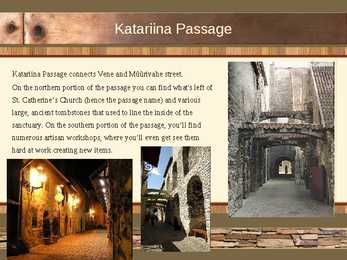
Katariina Passage Katariina Passage connects Vene and Müürivahe street. On the northern portion of the passage you can find what's left of St. Catherine's Church (hence the passage name) and various large, ancient tombstones that used to line the inside of the sanctuary. On the southern portion of the passage, you'll find numerous artisan workshops, where you'll even get see them hard at work creating new items. City wall Tallinn's medieval city wall is a sub-facility that was built to protect the lower Tallinn and upper Tallinn (Toompea). The building of the city wall began in 1310th years, and by improving over time it formed the city wall with defensive buildings (towers). It was finished by the end of the 1561. Then it was 2.35-kilometer-long circular wall, which had 27 wall gate, 8 tower gate and 21 other stone fortifications. Many parts of the to...
Kunda Ühisgümnaasium Tallin Old Town Report Student: Kristin Karu Teacher: Kristi Aron Kunda 2012 The Alexander Nevsky Cathedral The Alexander Nevsky Cathedral is an orthodox cathedral in the Tallinn Old Town,Estonia. It was built to a design by Mikhail Preobrazhensky in a typical Russian Revivalstyle between 1894 and 1900, during the period when the country was part of theRussian Empire. The Alexander Nevsky Cathedral is Tallinn's largest and grandest orthodox cupola cathedral. It is dedicated to Saint Alexander Nevsky who in 1242 won the Battle of the Ice on Lake Peipus, in the territorial waters of present-day Estonia. The late Russian patriarch, Alexis II, started his priestly ministry in the church. Interior of the Cathedral. The Alexander Nevsky Cathedral crowns the hill of Toompea where the Estonian folk hero Kalevipoeg...
Old Tallinn Old Town, a medieval walled city filled with old buildings and fortifications. The sheltered bay and the easily defended Toompea Hill made it a natural place to settle. Sometime about 1050 A.D. a fortress was built atop the hill, the first of many. In 1219 the Danes showed up as part of the Northern Crusade to subjugate the Baltics and convert the local pagans to Christianity whether they wanted to or not. The Danes improved the fortifications and expanded the town, which became part of the Hanseatic League, a trading organization of a hundred northern cities. The Danes sold Tallinn to the Livonan Order, a branch of the Teutonic Knights, in 1346. The Swedes came next in 1561. Tallinn weathered plague and the Great Northern War and became part of Russia in 1710. In 1918, Estonia declared independence from Russia and fought a bitter war against Bolshevik Russia. Independence didn’t last long, ...
Kunda Gymnasium Rait Türkel Old Tallinn Report Instructor:Teacher Kristi Aron Kunda 2012 Introduction Like most cities with an eight-hundred-year-old past, Tallinn is a patchwork of historic areas. The city's pride and joy is without a doubt its Medieval Old Town, but equally enchanting is the Kadriorg district, a throwback to the time when Estonia was ruled by the Russian Tsars. Tallinn is the capital and largest city of Estonia. It occupies an area of 159.2 km2 with a population of 416,470. It is situated on the northern coast of the country, on the shore of the Gulf of Finland, 80 km south of Helsinki, east of Stockholm and west of Saint Petersburg. Tallinn's Old Town is in the list of UNESCO World Heritage Sites. It is ranked as a global city and has been listed among the top 10 digital cities in the world.The city was a European Capital of Culture for 2011, along with urku, Finland.T...
Names of town ● Lindanise - it was first used in 1219, derived from mythical Linda, the wife of Kalev and the mother of Kalevipoeg, national hero. ● Koluvan - found in old Russian chronicles, the name possibly deriving from the Estonian mythical hero Kalev ● Reval - used after 1219; comes from two german words ‘reh’ and ‘fall’, meaning the falling of the deer - as they fall down the Toompea hill, probably when escaping from the Danish occupation or just the hunters. ● Tallinn - used after Estonia gained its independence in 1918, origin is definitely estonian; meaning Taani-linn, tali- linn. Liberty Square ● The central square of Tallinn, it was renovated in 2008. There used to be Harju gate, which can now be seen through glass. ● The statue of Liberty, 2009; represents freedom, Estonia has been under many foreign powers, starting with Danes, Sweden, German and Russia. The clock of liberty, 2...
TALLINN History Tallinn is one of the oldest cities in the Baltic Sea region. Tallinn was first mentioned in written sources of the 1154th, when the Arabian geographer Al Idris took a world map the city 'Kaleveny "/ Kolõvan. Through the years, the city of Tallinn had several names: Lindanisa, Kolõvan, Reval and eventually Tallinn. Tallinn was granted the Lübeck law in 1248 and became the member of the Hanseatic League in 1285. General Data l Country - Estonia l County - Harju County l First appeared on map - 1154 l Town rights - 1248 l Mayor - Edgar Savisaar l Aera - Total 159.2 km2 (61.5 sq mi) l Population - (1 Mar 2012) Total - 416,470 Denisty - 2,614.0/km2(6,766.6/sq mi) Tallinn Coat of arms Flag Top 5 Attractions 1. Kiek in de Kök Visitors to the museum will see examples of Medieval firepower, displays detailing how the city's system of walls and towers devel...
1. Millal hakkas Lääne-Euroopas kujunema romaani stiil? 10.-12. sajandil 2. Mis on romaanistiili põhiliseks tunnuseks? Ümarkaar 3. Milline on romaani kirikute peamine tüüp? Basiilika 4. Millised võlvi tüüpe tunti, mis oli nende vahe? Silindervõlv(kõige lihtsam)- kaalult raske ja võimaldas katta ainult kitsaid ruume Ristvõlv võimaldas ehitada laiemaid vahesid/lööve; kaalult raske, seega tuli ehitada seinad massiivsed ja piilarid jämedad 5. Mis eripära oli Itaalia kirikutel? Neil oli kellatorn ehk kampaniil. 6. Kuidas kutsutakse maailma kõige kuulsamat kampaniili, mis temaga ehitamisel juhtus, miks? Pisa katedraali torn. See vajus viltu kuna ehitis rajati liiga pehmele pinnasele ja vundament polnud torni raskuse kandmiseks piisavalt tugev. 7. Milline kuulus kirik asub Veneetsias, kirjelda? Püha Markuse kirik viie kupliga tsentraalehitis, palju kaunistusi, kasutatud mosaiiki, fassaadid olid o...
Introduction Tallinn, the capital city of the Republic of Estonia and of the Harju county, is a town in North Estonia on the coast of the Gulf of Finland. It has nearly half a million inhabitants and covers an area of almost 160 sqkm. It is also an important economic and cultural centre and one of the main ports in the Baltic States. Tallinn is one of the oldest cities on the Baltic Sea. It is unique for its well-preserved architecture from the 13-15 centuries. In contrast to the ancient town-walls and towers, Tallinn of today offers modern hotels, restaurants, sport and cultural centres. Every five years national song and folk dance festivals take place in Tallinn. The yachting regatta of the 1980 Moscow Olympic Games was held at Pirita. History Tallinn means in English "Danish town". The place is believed to have been settled by Finno-Ugric people about 2500 BC. It was first marked on a map of the world by the Arab geographer al-I...
Tallinn Lillekyla Gymnasium Report Legends of Tallinn Tallinn 2009 Introduction I chose the topic ,,Legends of Tallinn", because I had heard some splendid myths about Tallinn from my history lessons and I was eager to widen my horizon. I am quite interested in history in general and I especially love tales about medieval Tallinn. I hope that I will find out some entertaining stories to tell my friends. Legends of Tallinn There are many interesting legends about buildings or sights in Tallinn. Nobody can tell, if they are all true or not, but at least they make the medieval capital much more intriguing and attractive for tourists as for the locals. How Ülemiste Elder will drown the town The most known legend of Tallinn is pro...
Tallinn English College English Sergo Vainumäe 9A TALLINN Report Supervisor: Inge Välja Tallinn 2006 Order of contents: 1.Introduction 2.Toompea 3.Lower Town 4.Kadriorg and Pirita 5.Museums 1. Introduction Tallinn, the capital of Estonia, lies on the Baltic Sea. It is on almost the same latitude east St. Petersburg in Russia, Stockholm in Sweden and Stavanger in Norway, and covers 158 sq km. Tallinn was first marked on a map of the world by the Arab geographer al-Idrisi in 1154, its name then being Kolyvan (probably derived from the name Kalev). In the 13th-century Chronicle of Henricus de Lettis the town was called Lyndanise. Later came Reval (presumably after the old county of Rävala), the name used by the Germans who ruled the country for seven centuries. Russians then modified Reval...
Romaani stiili arhitektuuri süsteem ja ehitusmälestised 11. saj. kiviehitiste rajamine, võeti üle rooma ehitustehnika võtteid (ümarkaar, silindervõlv) Kirikud peamiselt basiilika stiilis: · Idapoolses osas püham · Transept ja pikihoone, nende ristumiskohal nelitis · Apsiidi ja transepti vahel kooriruum · Kooriruumi põrand kõrgemal ja selle all kabel ehk krüpt matmispaik · Basiilika peatunnus valgmik Ka teised tüübid: 1. ühelööviline 2. kodakirik · 3-lööviline · Aknad kesklöövi ülaosas puudusid · Portaal nii idapoolses osas kui ka pikiküljel · Lööve eraldasid ümarkaarelised arkaadid · Arkaadid toetusid piilaritele · Arkaadide ülaosas empoorid · Empooride puudumisel trifoorium, käigu puudumisel pseudotrifoorium · Laed esialgu puust, madalad...
 annaabi.ee