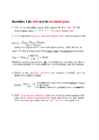
Question 14 1. Resolution 2. Offset Error 3. Gain Error 4. Monotonicity 5. Relative Accuracy Question 15 A) 5/4 = 1.25 B) 25/8 = 3.125 C) 15/8 = 1.875 Vref R f (4S2 2S1 S0 ) 5(4S2 2S1 S0 ) VOut 8R 8 Question 16 Pulse-Width Modulation (PWM) is a commonly used technique for controlling power to inertial electrical devices and DC motors. The PWM switching frequency has to be much faster than what would affect the load on the DC motors. 1. Draw the motor current and the motor voltage characteristic during the operation with a constant PWM signal of 50% duty cycle. 2. Recommend the suitable range of frequency for this PWM applied in mictrocontrollers. Analyze the advantages and disadvantages of PWM systems. Solution: 1
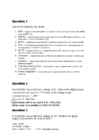
2. Offset error 3. Resolution 4. Monotonicity 5. Accurary(relative) Question 15 For the following 3-Bit DAC, analyse the circuit to verify its operation for the following input combinations. (Assume VR=5V). a)S2S1S0=0102 Output voltage = 1.25 V b)S2S1S0=1012 Output voltage = 3,125 V c)S2S1S0=0112 Output voltage = 1.875 V Question 16 Pulse-Width Modulation (PWM) is a commonly used technique for controlling power to inertial electrical devices and DC motors. The PWM switching frequency has to be much faster than what would affect the load on DC motors. 1. Draw the motor current and the motor voltage characteristic during the operation with a constant PWM signal of 50% duty cycle. 2. Recommend the suitable range of frequency for this PWM applied in microcontrollers. Analyze the advantages and disadvantages of PWM systems.
................................................................................12 5.1 Launch of spacecrafts into space from Earth.......................................................................12 5.2 Military weapons..................................................................................................................13 5.3 Fusion reaction initiations....................................................................................................14 5.3.1 How inertial confinement fusion should work............................................15 Conclusion.....................................................................................................................................16 Used materials:...............................................................................................................................17 2 Introduction
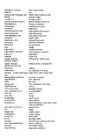
erikaal specific weight Froude arv Froude number gravitatsiooniline takistus gravity-related resistance hõõrdetakistus frictional resistance hõõrdetegur coefficient of friction koosmõju interaction hürdodonaamiline rõhk hydrodynamical pressure hüdromehaanika fluid mechanics hürdrostaatiline rõhk hydrostatical pressure inertsjõud inertial force isepoleeruv värv self-polishing paint jäätakistus residual resistance jäätakistus ice resistance kaal weight käigulained shipborne waves käigulainete interferent wave systems ineraction kaikuvus propulsion karedus roughness kasulik tõukejõu, towing force, efeectiv pull pukseerimisjõud
in Northern Estonia. In 1967, new buildings were opened by the theatre companies of Tartu and Pärnu. The actors started with small-hall and chamber-theatre. The Estonian opera was enriched by some achievements: Barbara von Tisenhusen by Eduard Tubin, and Luigelend (Swan’s Flight) by Veljo Tormis. In the Estonian film, a real breakthrough had not as yet taken place. As a film critic put it: The shallowness, illustrative postures, a certain inertial normative mediocrity is becoming even more evident... The present day and future of our film raises many questions and inquiries. It seems that one of the main questions that should be discussed is the principle of filmmaking based on original literary sources. The selection of those originals and their quite illustrative translation into the cinematic language are worrying. 1 In addition, cinema artists had to find indirect allegorical ways for achieving their intentions
 annaabi.ee