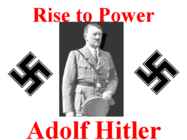
• Used popularity from failed revolution and book to seize power legally • Spoke to mass audiences about making Germany a great nation again • Nazi Party: – 1930 = 18% of vote – 1932 = 30% of vote – Hitler becomes Chancellor in 1933 Appeal of Hitler • Germany was in the midst of an economic depression with hyper-inflation • Hitler was a WW I hero who talked about bringing glory back to the “Fatherland” • He promised the rich industrialists that he would end any communist threat in Germany • Constantly blamed Jews for Germany’s problems, not the German people. • Hitler was an excellent public speaker. Strong Arm Tactics • The “Brownshirts” or SA (Stormtroopers) • SA was used to put down opposition parties • Threatened and beat up Jews and ant-Nazi voters • Wore brownshirts, pants and boots • Numbered almost 400,000 by 1932 Dictator • “Reichstag fire” gives
According to the Putin, the Front was formulated to allow "all members of youth, women's and veteran organizations, business associations and trade unions to take direct part in the decision- making process" by joining its forces (Andreeva 2011). Within this context, The United Russia has established close relations with major business organizations. For example, the party has settled an agreement in terms of cooperation with the Russian Union of Industrialists and Entrepreneurs (Peregudov 2009: 52). A strategic alliance has also been created with the country's leading trade union association, the Russian Federation of Independent Trade Unions and with the Women's Union of Russia (Ibid 2009: 52). These associations with its employers and employees may be seen as just another expression of the extensive reach of United Russia, of its commitment to put all social
recognised formally as a social class 58. Peer/ nobleman- a nobleman; a member of one of the five degrees of the British nobility (duke, marquis, earl, viscount, baron) 59. Gentry- in a restricted sense, those between the nobility and the yeomanry, the landed people – lack hereditary titles – used to exercise extensive political influence at the local level 60. Middle classes- about 50-60% of the population, include industrialists, professionals, businesspeople (white-collar; salary) and shop-owners (self-employed). 61. Working class(es)- agricultural, mine and factory workers (blue-collar; wages). 62. Lower classes- Lower class (occasionally described as working class) are those employed in low-paying wage jobs with very little economic security. The term "lower class" also refers to persons with low income. The working class is sometimes separated into those who are employed but lacking financial
And leave its odor there. Mark Twain Samuel Langhorne Clemens (November 30, 1835 April 21, 1910), better known by the pen name Mark Twain, was an American author and humorist. Twain is most noted for his novels Adventures of Huckleberry Finn, which has since been called the Great American Novel, and The Adventures of Tom Sawyer. He is extensively quoted. During his lifetime, Twain became a friend to presidents, artists, industrialists and European royalty. Twain enjoyed immense public popularity. His keen wit and incisive satire earned him praise from both critics and peers. American author William Faulkner called Twain "the father of American literature." Twain began his career writing light, humorous verse but evolved into a grim, almost profane chronicler of the vanities, hypocrisies and murderous acts of mankind. At mid-career, with Huckleberry Finn, he combined rich humor, sturdy narrative and social criticism
 annaabi.ee