Organic Future: The Case of Organic Farming by Adrian Myer Words: 1. Horticulture (aiandus)- the cultivation of a garden, orchard, or nursery; the cultivation offlowers, fruits, vegetables, or ornamental plants. 2. Caveat (hoiatus)- a warning or caution; admonition 3. Husbandry (põllundus)- the cultivation and production of edible crops or of animals for food; agriculture; farming. 4. Yield (tootma)- to give forth or produce by a natural process or in return for cultivation 5. Intuitive (vaistlik)- perceived by, resulting from, or involving intuition 6. Cognition (tunnetus)- the act or process of knowing; perception 7. Silt (setted)- earthy matter, fine sand, or the like carried by moving or running water and deposited as a sediment. 8
Col. George Washington sought cherokee help. 1762. Ostenaco->London, he met with King George the third. During American Revolution (1775-1783) 1793.-asked Spanish King for protection from American settlers. Washington-give education to Indians (Cherokeer), no violence towards Indians, paid for their.land 1789-1797.-fairly peaceful relations against Spansih land After 1800.-Cherokees began to adopt economic+political structure of Americans. They get agricultural+animal husbandry ideas-Americans. 1821.-chief sequoyah invited system of writing Nearly 100% literacy. Writtenconsitution. 1828-Cherokee newspaper White settlers demanded that cherokees moved west of Mississippi river Henry Clay, Daniel Webster+Davy Crockett spoke in defence of cherokees 1830-Pres. Andrew Jackson signed Indian Removal act 1835.-some cherokees agreed to leave 1837.- U.S Supreme Court rules in favor of cherokees. Jackson refused to accept court's decision + ordered army to round up cherokees
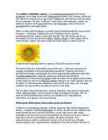
was produced. Lewis and Clark made mention in their journals of its usage by the plains Indians. It was brought back to the Old World by the early European explorers and widely cultivated there also. Today it is a common alternative crop in the Great Plains and elsewhere for food and oil production. Next time you munch down on some sunflower seeds, thank the many generations of Native Americans whose careful husbandry gave us this valuable food item. The wild cousins of those grown on the farm are still common, however, in fields, roadsides and disturbed ground throughout the Great Plains. The Common Sunflower is a typical member of the Asteraceae, one of the largest and most successful families of plants. Within the structure we think of as the "flower", it actually has two different types of flowers - ray and disk flowers.
Bear't that the opposed may beware of thee. Give every man thy ear, but few thy voice; Take each man's censure, but reserve thy judgment. Costly thy habit as thy purse can buy, But not express'd in fancy; rich, not gaudy; For the apparel oft proclaims the man, And they in France of the best rank and station Are of a most select and generous chief in that. Neither a borrower nor a lender be; For loan oft loses both itself and friend, And borrowing dulls the edge of husbandry. This above all: to thine ownself be true, And it must follow, as the night the day, Thou canst not then be false to any man. Farewell: my blessing season this in thee! LAERTES Most humbly do I take my leave, my lord. LORD POLONIUS The time invites you; go; your servants tend. LAERTES 29 Farewell, Ophelia; and remember well What I have said to you. OPHELIA 'Tis in my memory lock'd, And you yourself shall keep the key of it.
In his book "Variation of Animals and Plants Under Domestication" Charles Darwin referred briefly to a drooping eared race of cats in China. In "The Cat" by Lady Cust (1870) it states "Bosman relates that in the province of Pe-chily, in China, there are cats with long hair and drooping ears, which are in great favour with the Chinese ladies; others say this is not a cat but an animal called 'Samxces'" In his 1885 book "The Cat: Natural History, Husbandry ["Hygiene"] and Illnesses" Gaston Percheron suggested the lop-eared cat might be a hybrid between the cat and a marten: "Certain respected naturalists even claim even that the [domestic cat] mates with the marten and produces among the hybrids those like the latter in colour and fur. In this way they explain the hanging-ear cats of China [...]" but instead of being fed delicacies by its mistress, the cat has become a delicacy to be eaten, "The Chinese Cat. It has long, silky hair
ventions along the production line to reduce (Commission of the European Communities microbial contamination and is adopted by 2003). In principle, such methods include the United States and many meat-processing hygienic practices during feed production, plants in Canada and Australia. More specifi- at the farm level and during transportation cally, the USDA-FSIS has recognized and of the animals, good animal husbandry approved that one or more physical or chemi- practices, record-keeping, and traceability cal decontamination steps should be included (Commission of the European Communities in the slaughter/dressing process as critical 2003). Application of strict hygiene mea- control points under HACCP. In Canada, the sures and good slaughter practices may be use of lactic and acetic acid sprays is approved considered sufficient to avoid problems asso-
 annaabi.ee