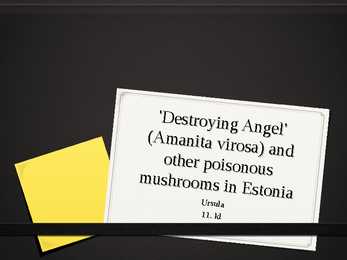
or grassy meadows near trees or shrubs. 0 Destroying Angels usually appear in July, August and September. Immature specimens of A. virosa resemble several edible species commonly consumed by humans, increasing the risk of accidental poisoning. Description of Destroying Angel 0 Caps of the Destroying Angel are 5 to 10cm in diameter, pure white, and without any marginal striations. The cap is initially egg- shaped or occasionally almost flat. Amanita virosa gills are white, free and crowded. 0 Stems of Destroying Angels are 9 to 15cm tall and often slightly curved; pure white and fibrous with fragile ring high up on the stipe. 0 Symptoms of poisoning by Amanita virosa 0 It contains the highly toxic amatoxins, as well as phallotoxins. Amatoxins initially cause gastrointestinal disorders with symptoms such as diarrhea, nausea and stomach pains occurring within five to twelve hours.
(praegu peamiselt monokiust) võrgulinast, mis on rakendatud horisontaalsetele ja vertikaalsetele nööridele (paeltele), mida nimetatakse ülemine-, alumine- ja küljeselis. 8 Contains floats (ujukid) along the top (üleval) and weights (raskused) on the bottom (all, e. põhjas) (Stands like a fence (tara) along the bottom, but can also be suspended) Fish too big to swim through the netting get caught by the gills when they try to back out Generally set perpendicular to shore (rand, kallas) and strung end to end in gangs (jada) Single net varies in depth from 6 to 20 ft (jalg = 0.305 m) and length from 100 to 400 ft. Eestis mõõted: kõrgus 0.5 m 7 m ja pikkus 30 m 70 m. United end to end to form gangs and may reach 3 to 5 miles in length Püügile minnes soritakse võrgud kastidesse, vannidesse. Võivad olla üksteise külge seotud, või võrguharkidel
on authors research and scientific publications. The aim of this study is to investigate helminthofauna of flounder in the costal waters of Western Estonia, to compare the seasonal differences and to see if study resaults coincide with existent data. The study was carried out between September 2003 April 2004. During this time 24 flounders were examined parasitologically. The fish were dissected and following organs were examined: skin and fins, eyes, gills, body cavity, liver, kidney and digestive tract. Parasites found were identified microscopically and fixed in 70 % ethanol. Samples of fish were taken mostly from commercial catches in two areas near Hiiumaa: Suuresadama and Kôrgessaare (Fig. 1, page 12) The species found in autumn are named in Table 2 (page 14); the intencity of invasion in Table 3 (page 15). The species found in spring are named in Table 4 ( Page 17) and the intencity of invasion in Table 5 ( page 19).
4A Animals page 29 6 It's almost beyond belief that 3 pets 7 welfare 1 1 feather 10 palm a man won the lottery on two 4 stuffed 8 put down 2 gills 11 beak separate occasions. 3 scales 12 arm 2 No 4 fin 13 front leg 2 1The fact that animals are kept in 3 1 the 8 have/get 14 on unnatural conditions is one of the 5 antler 14 hind leg
teeming with life. Then at some point, one of the sea creatures must have started to venture onto dry land. It would perhaps crawl a few inches at first, then exhausted by the enormous gravitational pull of the planet, it would return to the water, where gravity is almost nonexistent and where it could live with much greater ease. And then it tried again and again and again, and much later would adapt to life on land, grow feet instead of fins, develop lungs instead of gills. It seems unlikely that a species would venture into such an alien environment and undergo an evolutionary transformation unless it was compelled to do so by some crisis situation. There may have been a large sea area that got cut off from the main ocean where the water gradually receded over thousands of years, forcing fish to leave their habitat and evolve. Responding to a radical crisis that threatens our very survival – this is humanity’s challenge now
 annaabi.ee