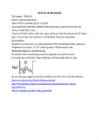
PESUVALGENDI (NaClO) CAS number: 7681-52-9 Nimetus: Naatriumhüpokloriid Valem: NaClO, molaarmassiga 74.442 g/mol Teised nimetused: Antiformin, Modifitseeritud Dakini lahus, Surgical chlorinated soda solution, Carrel-Dakin'i lahus Omadused: Rohekas kollane tahke aine, magusja lõhnaga. Sulab 18 kraadi ja keeb 101 kraadi juures Celsiuse järgi. Vees lahustuvus on 29.3g/100ml. Toimib pesuvalgendina, plekieemaldina. Tüüpiliselt on kodukasutuses pesuvalgendina lahus 3-8% naatriumhüpokloriidi sisaldusega. Veepuhastina kasutatakse 12-15% sisaldusega lahust. Veel kasutatakse seda lõhna/plekieemalduseks, disinfektsiooniks. Keskkonda sattudes moodustab püsivaid kloororgaanilisi ühendeid
The present summary is based on the book "Northern Europe’s seas. Norther Europe’s environment" by Britt Aniansson. Oceans and seas are polluted every day by different substances that reach the waters from different sources on land and at the sea. The author points out four main problems in the marine environment. One of the main problems is the chemical pollution which is caused by natural or man- made halogenated compounds, pesticides, dioxins, chlorinated organic materieals and so on. These compounds are causing deformage in marine animals and are storaged in their fatty tissues. They have also been found in organisms throughout the world oceans because they are dispersed quickly by winds and currents. Another problem that affects the marine life is excess phosphorus and nitrogen flow into the sea from towns, factories and other man-made sources which cause intense algae growth.
The shipment of crude oil has grown from 45 million tons to 175 million tons and this only by 10 years. Its condition is a challenge for the nine coastal states and their populations - there are 90 million people living in this catchment area. [1] The sources of marine pollution are municipal and industrial waste inputs directly into the sea or rivers, and atmospheric inputs mainly from traffic and farming. Originating from cellulose producing and from paper mills, large amounts of poisonous chlorinated compounds are polluting the coastal waters of Sweden and Finland. Most of this material is still present in sediments of the central Baltic Sea and can be terminated by near bottom currents. [2] Unsustainable factory farming made the Baltic Sea one of the world's most polluted seas. A really bad year was 2010 unprecedented potentially toxic algae bloom covered almost 377,000 square kilometers. This is an area larger than Germany. This
of Lycra®, with 100% horizontal / vertical unmatchable comfort. comfort and dries very quickly. elasticity), Powerskin® XP delivers Powerskin® R-EVO is the one and only X-FLAT fabric also guarantees excellent superior compression on the swimmer’s racing suit featuring the patented Arena durability in chlorinated water and body, still guaranteeing maximum freedom one-piece design which, in combination protection against ultra violet rays of movement. with an advanced thermo-bonding system, (50+ UPF). Powerskin® XP also significantly reduces allows a 100% stitch-less construction, with
production was stopped in 1977. . Emission sources Dioxins are mainly produced as unwanted byproducts of industrial processes and there is no intentional production or use. They can also to a small extent be formed naturally in forest fires or volcanic activity. Examples of activities resulting in dioxin emissions are waste incineration, burning fuels (wood, coal or oil), chlorine bleaching of pulp and paper and chlorinated pesticides manufacturing. Burning of many materials containing chlorine, such as plastics and wood treated with pentachlorophenol also produce dioxins. According to a study in the context of the Stockholm Convention, the main sources for emissions of dioxins to air in EU25 are Residential combustion (~ 30%) Open burning of waste (backyard burning) (~15%) Wood preservation (~15%) Iron and steel industry (~ 8%) Power production, nonferrous metals, chemical industry (~ 5% each)
Compounds, Pipes and Fittings for Pressure Applications AS 3690 Installation of ABS Pipe Systems AS2566.1 Buried Flexible Pipelines Part 1: Structural Design AS 2566.2 Buried Flexible Pipelines Part 2 :Installation AS 4041 Pressure Piping Code ASME B31.3 Chemical & Refinery Piping Code ISO 15493 Plastics piping systems for industrial applications -- Acrylonitrile-butadiene styrene (ABS), unplasticised poly (vinyl chloride) (PVC-U) and chlorinated poly (vinyl chloride) (PVC-C) -- Specifications for components and the system Metric series Hydraulic Analysis Darcy Weisbach friction Losses in Pipe factor Losses in fittings Hazen Williams formula Newtonian Fluids Bends and Elbows Non Newtonian Fluids Tees straight through Determine friction factor Tees branch Surface Roughness Pipe Class Reducers
microbial reduction achieved by this inter- tering (Gill 1998). vention, animal washing, is mostly accepted Other methods for reducing microbial as a means to improve visual appearance, due contamination on external animal surfaces, to removal of visible contamination of include hide-on multiple interventions with animals presented in a “dirty” state, rather chemicals, such as chlorinated water, or than to enhance the microbial quality of meat steam of subatmospheric pressure (at 75– (Bolton et al. 2002). Van Donkersgoed et al. 80°C), on shackled animals before the dehid- (1997) found poor correlation between coli- ing process (i.e., after stunning or form and E. coli counts on carcasses with the exsanguination; McEvoy et al. 2001, 2003; presentation status of animals before slaugh- Bosilevac et al. 2004b, 2005). Other exam- tering (e.g
up by choosing the wrong gear or the wrong pool. Some closing recommendations: 1. Gents, don't swim in board shorts. I tried this in Brazil and it's like swimming with a parachute behind you. Terrible. Get some Euro-style Speedos and streamline. Be cool on the beach and opt for efficiency in the water. 2. Get good goggles. I tried them all, from Speedo Vanquishers to Swedish swim goggles. In almost all tests, I needed to tighten the various straps every 100125 meters to prevent chlorinated water from blinding me. I now use nothing besides the much-acclaimed (and rightly so) Aqua Sphere Kaiman goggles, which are well sealed and can be tightened without removing them from your head. Leakage is nonexistent. These are the only goggles I'll ever need. 3. Start practicing in a pool that is short and shallow. Use a lane in the shallow end (four feet or less in depth) and opt for a pool that is no longer than 20 yards. It's easier to focus on technique in shorter pools
 annaabi.ee