A Disaster in Mellowtown Hello! This is Kairi from WLAG radio reporting you about an accident that happened with a truck carrying chickens. The accident took place in Mellowtown, at the intersection of Main Street and Broadway about 12.30. A chicken farmer was driving his chickens to a market, when by unknown reason he made an accident. Tom Phillips, the chicken farmer, said that he was driving slowly and carefully as always, but suddenly the truck started to make strange noise and he could not control it any more. Then he crashed. As a result the crates, where the chickens were held, went to pieces and chickens broke free. At the moment there is a real chaos in the middle on Mellowtown, chickens everywhere and pieces of the crates also. And
employees. The main problem is how the animals are raised, how they are slaughtered and how the meat is manufactured. Farms are controlled by big food industries. Cows are fed corn instead of grass, because corn is cheeper and makes cows obese more quickly. Because of the unhealthy environment animals are raised in, they get infected with salmonella and coliform bacteria. Salmonella and coliform bacteria infected food can lead to serious diseases and death. The chickens are raised in dark rooms, where there isn’t even room to move. They live in the middle of their own droppings and they eat each other. They are fed stuff that make them grow faster and bigger. The chickens can’t carry their own weight and fall down. Employees hit and toture them. I find horrifying how the chikens are treated as plain food not living creatures. Cows and pigs are treated in the same way. Most of the food in America is controlled and manufactured by few main companies. The
The United Kingdom of Great Britain Consist of: England, Northern Ireland, Scotland and Wales Flag of the United Kingdom of Great Britain and Northern Ireland The Union Jack It is home to many kinds of hedgehogs and red foxes. Some interesting and fun facts about the country: The world says, the sun never rises on Britain ( as it is cloudy all the time) There are over 30,000 John Smiths in Britain. Policemen are called Bobbies There are more chickens than humans in England.
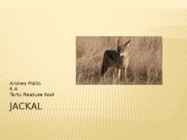
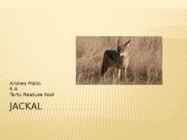
Andres Mällo 6.A Tartu Raatuse Kool JACKAL WHERE DOES IT LIVE ? ✕ Central Africa ✕ The Caucasus ✕ Southeast Asia ✕ Reeds ✕ Cracks between the stones ✕ Seasonal migrations. WHAT DOES IT EAT ? ✕ Omnivore ✕ Small mammals and birds ✕ Poisonous snakes ✕ Chickens and waterfowls ✕ Animal remains ✕ Fruits and berries JACKAL’S ENEMIES Predators Foxes Wolves Eagles Leopards Hyenas MATING ✕ Mating season ✕ 60-63 days ✕ March – May ✕ Puppies MORE ABOUT JACKAL ✕ 90-105 cm ✕ 6.8-11kg ✕ 12-14 years. ✕ 16 km an hour ✕ Excellent hunters ✕ Communicate ✕ Jackal’s live in packs JACKAL SPECIES Side-striped jackal Golden jackal Black-backed jackal
Andres Mällo 6.A Tartu Raatuse Kool JACKAL WHERE DOES IT LIVE ? Central Africa The Caucasus Southeast Asia Reeds Cracks between the stones Seasonal migrations. WHAT DOES IT EAT ? Omnivore Small mammals and birds Poisonous snakes Chickens and waterfowls Animal remains Fruits and berries JACKAL'S ENEMIES Predators Foxes Wolves Eagles Leopards Hyenas MATING Mating season 60-63 days March May Puppies MORE ABOUT JACKAL 90-105 cm 6.8-11kg 12-14 years. 16 km an hour Excellent hunters Communicate Jackal's live in packs JACKAL SPECIES Side-striped jackal Golden jackal Black-backed jackal Ethiopian wolf jackal PICTURES VIDEO USED SITES : http://et.wikipedia
Import: fuels GDP: $183,2 million Education Free Compulsory (5-15) University of the south Pacific in Avarua vast majority: literate Scholarship provided by goverment Cultural life Song and dance festivals Libary and museum in Avarua International culture Traditional ceremonies Major national day: Constituion day Tiare (Gardenia) festival 1 daily newspaper Animal and plant life Dark Purple ground orchid Tropical fruits and vegetables Palms, pandanuses Main fauna: pigs, dogs, chickens, rats, horses, goats, cats Native birds Landmarks Christian Church Anchorage island, Suwarrow Atoll Seven palms in Avarua Motuanga cave Homalium forest Wreck of the Matai Thanks for listening!
A kind of treatment designed to stimulate people who are withdrawn or uncommunicative has recently been given a new name: pet therapy. It has given difficult children, lonely old people and even anti-social prisoners a completely new outlook on life Even though pet therapy is only now being widely used, it is not a new idea. In the eighteenth century an English doctor, William Tuke, filled the grounds of a hospital for mentally disturbed people with chickens, rabbits and goats. At a time when people were usually punished for strange behavior rather than helped, this was a radical new approach to treating the mentally disturbed. Tuke's idea was that patients could learn self-control by caring for creatures weaker than themselves. This is an idea which has persisted. In New York, horses, cows, cats and dogs were recruited to heal soldiers who had been wounded during World War II. These animals
Between us, something smells. Jack: Would you like some Egyptian Pie? Jill: What's Egyptian pie? Jack: You know, the kind mummy used to make. The customer asked: "Do you serve crabs here?" "Yessir," repplied the waiter. "We'll serve just about anybody." What starts with "t" ends with "t" and is filled with "t"? A teapot. Why did the man eat at the bank? He wanted to eat rich food. What does the richest person in the world make for dinner every night? Reservations. Why don't chickens play sports? Because they hit fowl balls. What has ears but can't hear a thing? A cornfield. Where does a bat eat his dinner? On home plate, and he has a ball. What's the worst thing about being an octopus? Washing your hands before dinner. What did one knife say to the other? Look sharp! Why did the man stare at the can of orange juice? Because it said 'concentrate.' How does the man in the moon eat his food? In satellite dishes. Did you hear the joke about oatmeal? It's a lot of mush.
ANIMALS, AND THE ANIMALS ARE EATEN BY WESTERN COUNTRIES. Livestock or livestock feed occupies 1/3 of the earth’s ice-free land. References 1. Steinfeld H., Gerber P., Wassenaar T., Castel V., Rosales M., Haan C. 2006. Livestock's long shadow environmental issues and options. Food and Agriculture Organization of the United Nations. USA. 390 pp 2. Goodland R., Anhang J. Livestock and Climate change: What if the key actors in climate change are... cows, pigs and chickens? http://www. worldwatch.org/files/pdf/Livestock%20and%20Climate%20Change.pdf (15.11.2015) 3. Mekonnen M, Hoekstra A. Y. 2012. A Global Assessment of the Water Footprint of Farm Animal Products. Netherlands. pp 20. 4. Schwarzen S. 2009. Growing greenhouse gas emissions due to meat production. Elsevier. Switzerland. pp 8 5. Mekonnen M, Hoekstra A. Y. 2012. A Global Assessment of the Water Footprint of Farm Animal Products. Netherlands. pp 20. 6. Matthews C
History: · Indian society is predominantly agrarian. Diet consists mainly of fruits and vegetables, meat, cereals, dairy products and honey. Also, drinks containing different types of spices. · During the Gupta empire influenced by diet buduism and jainism. Many religious people were vegetarians. Most of the people consumed the chickens, sheep and goat meat. · Muslims also put emphasis on the development of food. Indians brought to the diet of dried fruit and flat bread. India introduced the dietary habits of the Portuguese and Chinese. · Indian diet is mixed with a variety of cultures. Etiquette: · Traditionally, meals were eaten while seated either on the floor or on very low stools or cushions. · Food is most often eaten without cutlery, instead using the right hand
But public transport is expensive and inconvenient. But English has borrowed from the Romans, the Vikings, the Saxons and the French But freight trains can't deliver goods from door to door But who can say that we will develop into civilized beings? Surely, God has the right to cut his losses! But why play the gold medalists' national anthems and why wear stars and stripes on your swimming costumes? But if you worked on a farm and your chickens were killed by foxes, you'd think differently. But if you detect more crimes, you'll still need prisons. But if you followed that line to its logical conclusion, you'd pardon all criminals. But surely, you can see what you're getting in the holiday brochure. But surely, if you raise benefits too high, people wouldn't bother to work. But surely, the canal system is much too slow for industry today 7
to get milk, meet or eggs, are living in cruel conditions and are suffering from severe maltreatment. The report also exteriorizes the main ways of ill-treatment of the farm animals. One thing is that the calves are taken away from their mothers few days after they are born. Although they should be together 9-12 months. What is more, 75% of 5,6 milliard hens are kept in so small cages that they cannot even stretch their wings. In addition, those chickens that are raised to get meat, are living in rooms that have no windows. There are even 50,000 birds together and they are usually overfed so they have heart problems and leg injuries. Furthermore, in some farms pigs in-calf are tied to the floor and kept in very small loose-boxes. Besides all that, in some countries calves are kept in ,,solitary confinement" in small cages and they are fed unnaturally with the intention to get ,,white meat".
Yet, the US is a world leader in agricultural production. The country's farms turn out as much food as the nation needs, with enough left over to export food to other countries. About a third of the world's food exports come from US farms. Beef cattle is the most valuable product of American farms. Millions of beef cattle are reared on huge ranches in Western US, also the South and Midwest. Other leading farm products, in order of value, include milk, maize, soybeans, chickens and eggs, pigs, wheat and cotton. US farms also produce large amounts of hay, tobacco, turkeys, oranges, potatoes, tomatoes, apples, peanuts and sorghum. Farmers throughout the country rear dairy cattle for milk and other products. Much of the dairy production is concentrated in a belt that extends from Minnesota to New York. Midwestern states account for much of the nation's maize, soybeans and pig production. The nation's chief wheat-growing region stretches across the Great Plains
of the nation's workers. Yet, the US is a world leader in agricultural production. The country's farms turn out as much food as the nation needs, with enough left over to export food to other countries. About a third of the world's food exports come from US farms.Beef cattle is the most valuable product of American farms. Millions of beef cattle are reared on huge ranches in Western US, also the South and Midwest.Other leading farm products, in order of value, include milk, maize, soybeans, chickens and eggs, pigs, wheat and cotton. US farms also produce large amounts of hay, tobacco, turkeys, oranges, potatoes, tomatoes, apples, peanuts and sorghum.Farmers throughout the country rear dairy cattle for milk and other products. Much of the dairy production is concentrated in a belt that extends from Minnesota to New York. Midwestern states account for much of the nation's maize, soybeans and pig production. The nation's chief wheat-growing region stretches across the Great Plains
A Modern Answer to the Commune By: Penelope Green Johanna Bronk wants to make communal vegetarian meals and keep chickens. Mariel Berger hopes for social, artistic and political collaborations. Harmony Hazard is into hula hooping, book groups and anarchism. Oh, to be a young city-dweller in search of a house share. Finding a roommate has never been easy, but for some, the endeavor has lately assumed all the urgency, emotion and extreme specificity of shopping for a life partner. Last month, just in time for leases to turn over, the housing portion of Craigslist, the
For example: My family was happy to see me. or My family were happy to see me. But the following collective nouns always take a plural verb: cattle people the police 34 Here are more collective nouns that are used for groups of people, animals or things. a brood of chickens a band of musicians Word File a school of fish Here are some more collective nouns: a bunch of keys a class of pupils a collection of books a deck of cards a fleet of ships a flock of sheep a gaggle of geese a gang of robbers a team of players a herd of cattle a litter of cubs a pod of whales a pack of wolves a pride of lions a flight of steps a set of stamps a swarm of bees a troupe of actors 35
Indochina. The Naval preparations for the successful grab were clearly indicated in the radio traffic, which went through the usual three stages that preceded major Japanese operations. First appeared a heavy flurry of messages. The Commander-in-Chief Combined Fleet busily originated traffic, talking with many commands to the south, thereby indicating the probable direction of his advance. Then came a realignment of forces. In the lingo of the tranalysis people, certain chickens (fleet units) no longer had their old mothers (fleet commanders). Call-sign NOTA 4, which usually communicated with OYO 8, now talked mostly with ORU 6. Accompanying this was a considerable confusion in the routing of messages, with frequent retransmissions caused by the regrouping: Admiral z not here; try Second Fleet. Then followed the third phase: radio silence. The task force was now under way. Messages would be addressed to it, but none would emanate from it.
(Edwards and Fung 2006). Moreover, recy- erance of visible contamination on carcasses. cling systems are needed to treat and recover However, given that such interventions are the liquid waste generated by dehairing based on visual inspection, and thus, invisi- (Edwards and Fung 2006). ble carcass contamination may be over- In contrast to cattle, pigs and chickens are looked, they should be combined with rarely skinned, as they are scalded (with hot pre- and/or post-evisceration decontamina- water that may contain wetting agents or tion treatments. alkali at up to 66°C) immediately after bleed- ing (Gill and Bryant 1992; Bolton et al. Knife-Trimming 2002). Scalding and singeing are known to cause up to 4.5 log10 CFU/cm2 reductions of As indicated, knife-trimming is required by
 annaabi.ee