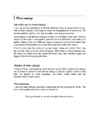
Triivõngejada taglastus Pöörleja Sööt Õngejada liin Õngekonks söödaga Toru Pöörleja Raskus 1. Demersal This is the most commonly used method for bottom fishing. Two systems have been developed, namely single and double lines. The single system is simple to operate and consists of one line with weights and buoys at either end, and weights at intervals along the main line which keep it on the seabed. The double or Spanish system is the same but it has a second, safety line. It is used in areas where strong currents and rough floors otherwise cause high gear loss. The safety line is unweighted and floats above the main line, attached at several points. This allows the main line to be retrieved even if it breaks. Figure
Most tsunamis are caused by underwater earthquakes, but not all underwater earthquakes cause tsunamis - an earthquake has to be over about magnitude 6.75 on the Richter scale for it to cause a tsunami. About 90 percent of all tsunamis occur in the Pacific Ocean. Many tsunamis could be detected before they hit land, and the loss of life could be minimized, with the use of modern technology, including seismographs (which detect earthquakes), computerized offshore buoys that can measure changes in wave height, and a system of sirens on the beach to alert people of potential tsunami danger.
Besides their location of installation and the modes of movement wave energy converters can be distinguished by geometry and orientation. Point absorbers Point absorbers have small dimensions compared to the wavelength. They are sensitive to waves coming from all directions and don’t need a homogeneous wave climate. That kind of devices can absorb energy from nearly twice of their own width. Normally they are tightly moored by an anchor on the seabed. Tethered buoys are an example of point absorbers. The maximum of power output depends besides the power of the waves (per meter in crest) linear on the wavelength and if a heaving or a surging technology is used. l Pabs,max = e * *P @Pabs,max D = Watt 2*p P : wave power per meter in crest @Pi D = Watt l : wavelength @lD = m
Mariners. The previous version remains valid if continuously updated by Notices to Mariners. New Edition A new edition is an existing chart, which has been updated with information that cannot be applied by the mariner based on Notices to Mariners. Usually a new edition is issued when new survey information has been included or very complex changes to buoys and other aids to navigation etc. have been applied. A new edition of a chart will always supersede the previous edition, which will be withdrawn. a withdrawn chart no longer meets the carriage requirements. New chart Occasionally new information will require a change of coverage or content of a chart; in this case a new chart of revised limits or scale will be issued. If the
When towing the trawl, the two boats are sailing over either sides of the fish school and not directly over it as a single trawler is doing; as a result, the fish is less disturbed (and, for instance, will not tend to swim deeper), while when the fish is close to the surface, the drag of the two vessels may have an herding effect grouping fish before the trawl opening. Regarding the rigging, for getting the correct vertical opening, groups of floats or buoys are often attached to each of the upper wings, the headline extremities and weights are hung at the extremities of the two lower wings or a few meters before them. The distance between the two pair trawlers and the towing speed are also very important element for the trawl opening. In general, a netsounder (vertical echo-sounder fixed on the trawl itself) is used to control the opening of the trawl and its position versus the surface or the bottom.
 annaabi.ee