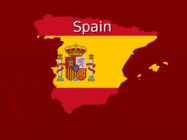
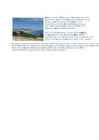
Map Location in Europe Natural conditions ► Subtropical climatic zone (2 seasons) ► Summers are hot and dry in Spain, winters are rainy ► One of the driest countries in Europe (200-300mm per year / m²) ► Mineral resources : iron-, zinc-, copper-, lead- and uranium ore and mercury Population ► As at July 2007 - more than 40 million people (80% Hispanic, the rest Galician and Basques) ► Also Portuguese and Gypsies (mainly in Andalusia) Economy ► Industrialand agricultural ► Large Viticulture and wine production in the earth, a world leader in the production of olive oil ► The biggest export article s are oranges, mandarins and other citrus fruits ► Goods are mainly exported from France, China, Germany and Italy Peculiarities ► The main religion is Roman Catholicism ► Roman Catholic - 76% (2% other faith, and 19% atheists)
Then, a number of fighting bulls are let out onto the streets. The bulls run along the narrow street to a bull ring. The runners dash along in front of the bulls, trying to avoid getting gored by their sharp horns. When the bulls finally reach the end of the street, they go into enclosure and are kept until that day they are killed in a bullfight. Flamenco: The Spanish culture is also closely related to the famous Flamenco style. This passionate form of dance first originated in Andalusia, is around 200 years old and was originally considered to be a gypsy dance. It is a colorful dance that is accompanied by the soulful tunes of the guitar and a song. Flamenco is a large part of the country's traditions and culture. Tomatina: The 'Tomatina' tomato fight is surely the world's biggest food-fight: every year around 3000 people go in the Spanish town of Buñol to throw more than 40 tons of tomatoes at each other
4) Teokraatlik - Jumal lõi maailma ja selle korralduse. 5) Marksistlik - Ühiskonna lõhenemine sotsiaalsetesse klassidesse (nt orjad ja orjapidajad. Osasid riike ei tunnustata, sest neil pole kindlat valitsemisvormi või piisavalt elanike. 3. Nimeta piirkondi maailmas, kus tahetakse luua iseseisvaid riike. Euroopas on neid piirkondi tohutult palju, kus soovitakse luua iseseisvaid riike. Kõige rohkem on neid Prantsusmaa ja Hispaania aladel, nagu näiteks Aragon, Castile, Andalusia, Leon, Normandy, Brittany. Suurbritannia alal soovib iseseisvaks saada Sotimaa. 4. Kuidas erineb demokraatlik võimu iseloom diktaatorlikust võimu iseloomust? Demokraatlik võim tähendab seda, et kõige kõrgeim võimu kandja on rahvas, kes teostab seda läbi vabade ja regulaarsete valimiste. Diktaatorlikus võimus on võim ühe isiku või institutsiooni käes. Ebademokraatlik valitsemine. Riigivõimul võib olla täielik kontroll kodaike kõigi eluvaldkondade üle. 5
inhabitants (against 76,000 in 1991, 64,000 in 1981, 45,000 in 1971, and 38,000 in 1961). However, two years later, this figure jumped to 108,000 (Govern de les Illes Balears - IBAE 2004). This discrepancy stems from the amnesty which incorporated a number of unregistered foreign migrants. In terms of origin, about 55 per cent of island residents were born in Ibiza, 35 per cent are immigrants from mainland Spain (mostly working-class families from Andalusia, and the remainder from Catalonia, Valencia and Castilla), and the about remaining 10 to 15 per cent are foreign, dual and multi-national citizens of the EU and abroad (Govern de les Illes Balears - IBAE 1996). In decreasing order, foreigners are Germans, British, Latin Americans, Moroccans, French, Italians, Dutch, in addition to a myriad of other nationalities. This mosaic reflects the fluidity of foreigners living and moving
64,000 in 1981, 45,000 in 1971, and 38,000 in 1961). Howev er, two year s later, this figure jump e d to 108,000 (Gov ern de les Illes Balears IBAE 2004). This discr e p a n c y ste m s from the amn e sty which incorporate d a numb e r of unregister e d foreign migrants. In terms of origin, about 55 per cent of island resid e nts were born in Ibiza, 35 per cent are immigrants from mainland Spain (mo stly working clas s families from Andalusia, and the rem aind er from Catalonia, Valencia and Castilla), and the about rem aining 10 to 15 per cent are foreign, dual and multinational citizens of the EU and abroad (Gov ern de les Illes Balears IBAE 1996). In decr e a sin g order, foreign er s are Ger m a n s , British, Latin American s, Moroc c a n s , French, Italians, Dutch, in addition to a myriad of other nationalities. This
Slovakia Sweden United Kingdom[61] Russia Serbia Switzerland Brazil S America Uruguay[62] Venezuela Andalusia, Spain Assam, India Extremadura, Spain Hong Kong, China Subnational Kerala, India Massachusetts, United States[63] Misiones, Argentina Munich, Bavaria, Germany[64] Paraná, Brazil
 annaabi.ee