Maailma keelte iseseisev töö Arapaho keel Põhja-Ameerika üheks suurimaks keeleliseks liiduks on algonkini(Algonquian, Algonkian) keelkond. See hõlmab peaaegu et tervet Ida- ka Kesk-Kanadat, The Great Lakes regiooni, mis võtab enda alla nii Ameerika Ühendriike kui ka Kanadat, ning USA Atlandi ranniku põhja-osa. Algonkini keelkonna kõnelejaid on maailmas üle 190 tuhande, kusjuures Ameerika Ühendriikides see arv langeb, Kanadas aga järjekindlalt tõuseb. Algonkini keelkonda kuulub 43 keelt ning keelkond jaguneb omakorda 10 haruks, millest üks on arapaho keele haru, mille hulka
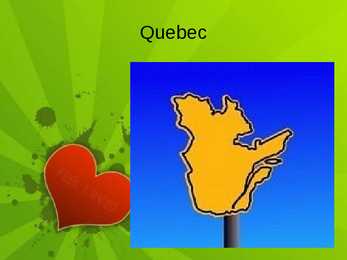
Brunswick. South the U.S.A. Geography 90% of Quebec's territory lies within the Canadian Shield The Eastern Canadian forests cover the Appalachian Mountains Climate Most of central Quebec has a subarctic climate. Winters are long, very cold, and snowy. Summers are warm but very short. History At the time of first European contact and later colonization, Algonquian, Iroquoian and Inuit tribes were the peoples who inhabited what is now Quebec. Hélène Desportes, born July 7, 1620, to the French habitants (settlers) Pierre Desportes and his wife Françoise Langlois, was the first child of European descent born in Quebec. The Quiet Revolution from 1944 to 1959 was a period of dramatic social and political change Population In 2006 the population of Quebec was 7,546,131 people Canadian 4,474,115 people60.1%
Its capital is Ottowa and other main cities are Toronto, Montreal and Vancouver. Almost 75 % of canadians lives within 300 kilometer of the USA border, because the climate is softer in the South. 89 % of Canada is almost unhabited. Its official languages are English and French, but many other languages are spoken too. Like Italian, Chinese, German, Polish, Ukrainian, Dutch and Creek. There are also many native languages such as Algonquian. Most of the canadian's speak English (67 %), but French is very largely spoken too (26 % of the canadians). Canada is based on recognizing the cultural diversity of different nations living in Canada. All the communities living on the country are encouraged to remember their origins and hold their own ethnic events and national festivals. Cultural diversity makes Canada even more interesting. There are many native peoples throughout Canadalike the Crees, Mohawks,
States. The capital of Canada is Ottawa. Other large cities are Montreal, Toronto, Vancouver, Winnipeg and Quebec. Canada has two official languages English and French. It's interesting to know that about 61% of Canadians name English and 24% French their mother tongue. There are also many other languages spoken in Canada such as: Italian, Chinese, German, Polish, Ukrainian, Greek and Dutch. There are also many native languages such as Algonquian. The British and the French as the main settlers from Europe fought for hundreds of years before they managed to build up a country which was based on recognizing the cultural diversity of different nations in Canada. All the communities living in the country are encouraged to remember their origins and hold their own ethnic events and national festivals. Cultural diversity makes Canada even more interesting. In spite of this,
by Christian Kent Nelson in his home laboratory in 1920. Nelson got his inspiration for the invention of Eskimo Pie when a boy in his confectionery store could not decide whether to buy ice cream or a chocolate bar. In 1921, Nelson secured an agreement with local chocolate producer Russell C. Stover to mass-produce them under the new trademarked name Eskimo Pie. The name was suggested by Stover’s wife. The word Eskimo comes from 1580s, probably from an Algonquian word, such as Abenaki askimo and Ojibwa ashkimeq, traditionally said to mean literally “eaters of raw meat”. filibuster – Today, the term filibuster refers to act of delay action in Congress or another law- making group by making very long speeches. However, the term filibutor “pirate” was first used in 1580s and was probably derived from the Dutch vrijbuiter “freebooter”, which in turn was
The capital of Canada is Ottawa. Other large cities are Montreal, Toronto, Vancouver, Winnipeg and Quebec. Canada has two official languages English and French. It's interesting to know that about 61% of Canadians name English and 24% french their mother tongue. There are also many other languages spoken in Canada such as: Italian, Chinese, German, Polish, Ukrainian, Greek and Dutch. There are also many native languages such as Algonquian. The British and the French as the main settlers from Europe fought for hundreds of years before they managed to build up a country which was based on recognizing the cultural diversity of different nations in Canada. All the communities living in the country are encouraged to remember their origins and hold their own ethnic events and national festivals. Cultural diversity makes Canada even more interesting. In spite of this, in recent years there
 annaabi.ee