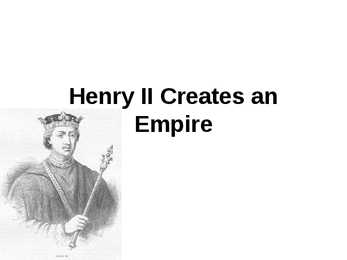
Henry II Creates an Empire Henry's claims by blood and marriage · Henry's father, Geoffrey Plantagenet, held rich lands as a vassal. · Henry received the claim to the English throne. · Henry's marriage to Eleanor of Aquitaine placed him firmly in the ascendancy. · Henry was the most powerful vassal in France. Taking the English Throne · It was 1147 when Henry had accompanied his mother on an invasion of England. · On 22 May 1149 he was knighted by King David I of Scotland. · Within the year he secured his right to the throne. · On 19 December 1154 he was crowned in Westminster Abbey. Lordship over Ireland · Shortly after his coronation, Henry sent a group of clerics to invade Ireland. · In 1171, Henry arrived from France, declaring himself Lord of Ireland.
Who were serfs and freemen? There was a very distinctive social class system during the Middle Ages. Most Medieval people were peasants, over 90%, but the divide between peasants and nobility was very clear-cut. The people were divided into royalty (kings, queens), nobility, hereditary nobility (dukes, barons), non-hereditary nobility (knights, peasants, freemen, slaves.) Serfs had no political power and were not allowed having control of property. They lived on the property of a noble vassal, and, in order to repay the vassal for letting the serf live on his property, the serf worked the land and was at the disposal of the vassal. Serfs were slaves in all but name. Freemen were poor farmers who had control of small portions of land. Freeman usually made just enough money to live on. They sold their crops and may have worked with a trade. 9.What do you remember about the Tower of London and Westminster Abbey?
Civic democracy was called feudalism. It comes from the Latin word feodum or feudum. It is a structure in society, which includes higher ups that had land or could afford protection for themselves and fo those, who could not afford it and people working for them in a way that benefits everyone in the society. It is similar to a pyramid scheme. The 3 main classes that held this structure together were lords, vassals and fiefs. There is a common saying from that time period as well - my vassals vassal is not my vassal. It meant that the vassal was only responsible for the person working directly under them and not for the person working under their worker. Then into the play also came division of labour and how to produce more than you can consume, so to gain profit. Corporations inside the cities were made and guilds were formed. It also had a key structure: Father who was head of the corporation and his family
The Man of Law (est: Õigusnõunik): How is he described? Is he entirely truthful about his life? A successful lawyer commissioned by the king. He upholds justice in matters large and small and knows every statute of England's law by heart. The Franklin (est: MAAHÄRRA): Describe his appearance and dress ? What were his interests in life? In Chaucer's society, a franklin was neither a vassal serving a lord nor a member of the nobility. This particular franklin is a connoisseur of food and wine, so much so that his table remains laid and ready for food all day. The five Guildsmen: Carpenter (est: PUUSEPP) , Haberdasher( est: PUDUKAUPMEES), Dyer (est: VÄRVAL), Weaver (est: KANGUR), Carpet maker (est: VAIBAMEISTER): how were they dressed? What has been said about their wives?
o Arthur ‘high, noble’ o Donald ‘proud chief’ o Mac ‘son of’ (Scottish) o O’ ‘son of’ (Irish) O’Connor Breton through French: bijou, dolmen, menhir. Celtic before Gaelic, Welsh, Breton, and Cornish, and through Latin, French, and Old English: ambassador/embassy, bannock, bard, bracket, breeches, car/carry/ career/carriage/cargo/carpenter/charge, crag, druid, minion, peat, piece, vassal/valet/varlet. Cornish: porbeagle, wrasse. Gaelic, general: bog, cairn, clarsach, ceilidh, coronach, crag, crannog, gab/gob, galore, skene, usquebaugh/whisk(e)y; Irish: banshee, blarney, brogue, colleen, hooligan, leprechaun, lough, macushla, mavourneen, poteen, shamrock, shebeen, shillelagh, smithereens, spalpeen, Tory; Scottish: caber, cailleach, cairngorm, clachan, clan, claymore, corrie, glen, loch, lochan, pibroch, plaid, ptarmigan,
successors. *Feudalism and the manor system Manorialism, otherwise known as the Manorial System, is the political, economic, and social system by which peasants of medieval Europe were made dependent on their land and on their lord. The manorial system was the most convenient device for organizing the estates of the aristocracy and the clergy in the European Middle Ages. Feudalism is a hierarchical system in which a lord or king gives a gift or land to a vassal in exchange for protection. The decline of feudalism can be marked by the crusades. *Edward the Confessor was an Anglo-Saxon King of England and the last of the House of Wessex. His reign marked the continuing disintegration of royal power in England and the enlargement of the great territorial counts. Edward was canonized and is regarded as the patron saint of kings, difficult marriages, and separated spouses and the Royal Family. Edward's reign was marked by peace and prosperity
Scotland and made John Balliol the king Edward began active interference in affairs, legal cases, keeping taxes John rebelled against him, Edward went to punitive expedition in Scotland, they were defetaed in the battle of Bannockburn The treaty of Northampton 1348 John Balliol When Margaret died there were 12 claims to the throne, JohnBalliol was made a king by Edward I, who undermined his authority Edward treated Scotland as a vassal state and humiliated the king Scotland remained without a true king until Robert Bruce took the crown William Wallace A patriot and national hero of Scotland. Wallace led the Scottish rebellion against Edward I In 1297 he defeated The English at Stirlin Bridge A year after scots were defetead 1305 Wallace was captured and executed in London Robert Bruce The king of Scotland He supported Wallace´s uprising againts
В каждой деревне они задавали всевозможные вопросы и записывали ответы. Сколько имелось земли? Сколько она стоила? Кто ею владел? Сколько имелось семей, плугов, овец? И т. д. Вильгельм хотел знать точно, сколько земли и крестьян имел каждый из его вассалов (vassal). Эти сведения были нужны, чтобы планировать налоги и королевские доходы, а также для планирования экономики королевства. Это была первая опись такого рода в Европе. Ее материалы существуют до сих пор. 54 UNIT 7 THE STORY OF ENGLISH Pre-reading questions
 annaabi.ee