Heavyweight title Nicknamed "The Greatest", Ali was involved in several historic boxing matches. Notable among these are three with rival Joe Frazier and one with George Foreman, whom he beat by knockout to win the world heavyweight title for the second time. He suffered only five losses (four decisions and one TKO by retirement from the bout) with no draws in his career, while amassing 56 wins (37 knockouts and 19 decisions). How he became e cultural icon? Ali was well known for his unorthodox fighting style, which he described as "float like a butterfly, sting like a bee", and employing techniques such as the rope-a- dope. He was also known for his pre-match hype, where he would "trash talk" opponents on television and in person some time before the match, often with rhymes. These personality quips and idioms, along with an unorthodox fighting technique, made him a cultural icon. Later In later life, Ali developed Parkinson's disease.
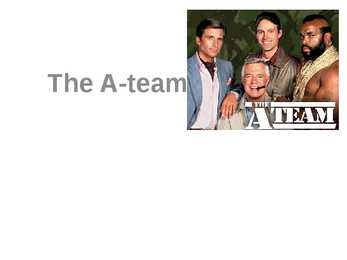
together,"[3] "Hannibal's on the jazz," and "I ain't gettin' on no plane!" have also made their way onto T-shirts and other merchandise. The show's name comes from the "A-Teams," the nickname coined for U.S. Special Forces' Operational Detachments Alpha (ODA) during the Vietnam War,[4] although this connection was never referenced on-screen. Characters Their leader is Lieutenant-Colonel/Colonel John "Hannibal" Smith (George Peppard), whose plans tend to be unorthodox but effective. Characters Lieutenant Templeton "Face" Peck (Dirk Benedict; appeared as Templeton Peck in the pilot), usually called "Face," is a smooth-talking con-man who serves as the team's appropriator of vehicles and other useful items Characters The team's pilot is Captain H.M. "Howling Mad" Murdock (Dwight Schultz), who has been declared insane and lives in a Veterans Administration mental institution for the show's first four seasons.
what he was doing worked. As his popularity increased he took more liberties with filming. Movies such as his 1925 hit, "The Gold Rush", demanded unending reworking of scenes and rebuilding of sets. Chaplin typically improvised his story in front of the camera with only a basic framework of a script. He shot and printed hundreds of takes when making a movie, each one a little experimental variation. While this method was unorthodox, because of the expense and inefficiency, it provided lively and spontaneous footage. Taking what he learned from the footage, Chaplin would often completely reorganize a scene. It was not uncommon for him to decide half-way through a film that an actor wasn't working and start over with someone new. Many actors found the constant takes and uncertainty grueling, but always went along because they knew they were working for a master.
Short- term limit 4. Age limit 5. Credit limit 6. City limits Ex3. 1. C 2. B 3. D 4. A Ex3. 1. F 2. H 3. A 5. D 6. G 7. E 8. C METHOD LOOK Ex1. 1. Adopt 2. Work 3. Used 4. Fails 5. Devised Ex1. 1. Seen 2. Gave 3. Tell 4. Spoil 5. Like 6. 6. Recommend Has Ex2. 1. Traditional 2. infallible 3. Popular 4. Ex2. 1. B 2. D 3. E 4. F 5. G 6. A 7. C 8. H Reliable 5. Unorthodox 6. Practical 7. Effective Ex3. 1. Had 2. Took 3. Get 4. Sneaked Ex3. 1. Transport 2. Teaching 3. Earthquakes 4. Ex4. 1. Distant 2. Vacant 3.wild 4. Filthy 5. Crowd control 5. Payment 6. Pain control 7. Birth Curious 6. Hurt control 8. Reaching agreement LUCK MIND Ex1. 1. Had 2. Bring 3. Believe 4. Ran out of 5. Ex1. 1. Made up 2. Change 3. Clear 4. Train 5. Trust 6. Wished 7
Simon Edwards - The executive services officer of Biggin Hill Airport south of London. Edwards is accustomed to fulfilling the every desire of the very rich, as the airport serves the private business community. Bezu Fache - The captain of the French Judicial Police. Nicknamed "the Bull," Fache is strong, strong-willed, and religious. He has great faith in the use of technology in his work, which sometimes leads him down the wrong road. Fache's policing methods are a bit unorthodox, but he is good at heart. The name Fache is very similar to fâché, which is French for "angry." Jonas Faukman - Langdon's editor. He is a classic New York publishing type. Faukman is eager to make money, but he is also a cultured and classy man. Pamela Gettum - The religious librarian at Kings College. A kindly soul, Gettum is willing to help Sophie and Langdon in their search. Claude Grouard - A security warden at the Louvre. Grouard is a good man who was a friend of Saunière's.
concentration. Some become more aggressive others, on the contrary very calm. Alcohol also causes dehydration and behaves as a very destructive element to various human body organs liver, heart, kidneys. It destroys brain cells more actively and stimulates accumulation of fat cells. There are minor positive effects. Wine, for instance, improves blood circulation and some alcoholic drinks made from herbs are used in some unorthodox medical treatments among various nations with long established traditions. Kasutatud kirjandus: 1. Viro, A. ja Volver, A. Alkohol. Kuidas säästa end tulevikus. Tartu, 2004, 190 lk. 2. Karu, K. Alkoholism halb harjumus või haigus. Valgus, Tallinn, 1973, 51 lk. 3. Eesti Nõukogude Entsüklopeedia. Tallinn, Valgus,1985, 703 lk. Interneti allikad : *http://www.mv.werro.ee/failid/tervis/tdoc/mikk_sander_sven_9c_VKG.pdf *http://www.tps.edu
deal of trouble for our people. The use of these cars in Africa is obscene – in a continent where the average per capita income and the standard of living are the lowest, you have the so-called nouveau riche displaying their flagrant spending with these cars. So much of this money could have been used for curing starvation on the continent instead of purchasing these nebulous products. There is a major and intelligent sense in the Rev. Al Sharpton unorthodox madness: he understands that unless Black newspapers receive advertisements from major companies, they will die out and the people will be voiceless. Millions of other Africans have to understand the same madness which is driving Rev. Al Sharpton to target Madison Avenue to convince the companies they represent to stop the handouts of social advertising the occasionally do in Black newspapers, and advertise on the basis that we use their products as much as other communities
for Columbine and Fahrenheit 9/11, this outstanding documentary explores steroid use in the biggest, strongest, fastest country in the world: America. The cast of characters ranges from Carl Lewis and MDs to Louis Simmons of Westside Barbell. It has an astounding 96% positive rating on rottentomatoes.com. Medibolics (www.medibolics.com) This site, published by Michael Mooney, provides a wealth of information on the medical use of anabolic steroids, growth hormone, and unorthodox supplementation for the prevention of lean-tissue loss in persons with muscle-wasting diseases, including HIV. Anabolics, 9th ed. (www.fourhourbody.com/anabolics) This 800-page book is the #1 bestselling anabolic reference guide worldwide. It features: reviews of nearly 200 pharmaceutical compounds, detailed explanations of the real risks of anabolics, prevention and harm reduction strategies, steroid cycling and stacking sections to take the guesswork out of
For the past few years, the film that young people were most interested in talking about was Pulp Fiction.They wanted to know how on earth the structure o f the Hero's Journey could be found in that film. Its defiance of the conventions of structure, content, framing, dialogue, and editing intrigued them. T h e y enjoyed its passionate intensity and sardonic humor. Some people were offended by its vulgarity and flashes of violence, but most admired the film for proving that unorthodox subject matter and uncompromising style can be both entertaining a n d highly successful. However, despite its innovative qualities, Pulp Fiction can be interpreted with the reliable o l d tools of the mythic Hero's Journey. Seen this way, the film in fact presents at least three distinct journeys for three different heroes; Vincent, Jules, and Butch. THE POST-MODERN MIRROR Young people may have responded to Pulp Fiction because it reflects the post-modern
 annaabi.ee