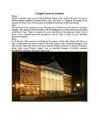
city and the Town Hall is the best-preserved Medieval town hall in Northern Europe. Tartu The university town, museum-rich and Hanseatic city of Tartu lies on the banks of the River Emajõgi. The capital of sothern Estonia is the second largest city in the country and the oldest in the Baltic States. Tartu is a modern city with a rich historical heritage and culture. One of Tartu ´s most important historical monuments is the St. John´s Church with it´s thousand terracotta sculptures. Narva As In the past, Narva remains a melting pot for nations, periods and cultures, old and new. This is what makes the town so special. The 13th century castle, a beautiful baroque Town Hall, the best preserved system of historic defence building (bastions) in Europe, Krenholm textile plant (once Europe's largest, and an excellent example of British industrial architecture), waterfalls, and much, much more. Ivar Vipper, 9c
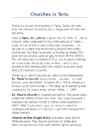
Churches in Tartu There are about 29 churches in Tartu. Some of them look like modern churches, but a large part of them are old ones. Here is Tartu St. John’s or Jaani church. Tartu St. John's Church, which was built in the 14th century in Gothic style, is one of the oldest in Estonia; moreover, it is unique in Europe due to its many original terracotta sculptures. Numbering around a thousand, these 700- year old sculptures were largely hidden till the 1950's. The entrance to the church is free, but if you're looking for more than old sculptures, a view, then it costs. Access to the viewing platform costs 2 euro per adult and 1.50 euro per student. Rivalling St. John's Church as Tartu's most impressive, St. Peter's church, located over the river, is a red- bricked, pseudo-Gothic. It was built in 1884, allowing it to seat up to 3,000 people
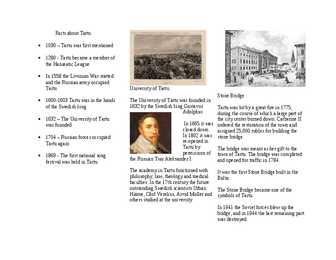
known by it`s sculptures. 2005 Both the interior and Jaani church was re-consecrated. 2009 the exterior of the church are covered References with numerous decorative details. http://www.tartu.ee All of those are http://www.wikipedia.org made of terracotta. Originally, there must have been more http://www.visittartu.com http://www.ut.ee Tartu`s than a thousand of those, and even though History many of them have been destroyed over the ages, the number of the retained ones is still impressive. 1323
· http://izismile.com otsing: china · http://news.softpedia.com/news/9-Things-You-Did-not-Know-About-Chinese-and-Mongoloid-Race- · http://webcache.googleusercontent.com/search?q=cache:4-R4PX1iECwJ:www.foodreactions.org/ · http://www.dummies.com/how-to/content/ten-things-never-to-do-in-china.html · http://www.mapsofworld.com/china/china-facts.html · http://www.charlesdarwinresearch.org/Race_Evolution_Behavior.pdf · http://heritage-key.com/china/top-10-interesting-facts-about-terracotta-warriors · http://www.time.com/time/photogallery/0,29307,1975397,00.html · http://www.benzinga.com/41010/ordos-china-s-empty-city · http://www.neatorama.com/2010/07/07/the-bygone-practice-of-foot-binding-in-china/ · http://www.angelfire.com/ca/beekeeper/foot.html · http://www.gowealthy.com/gowealthy/wcms/en/home/articles/travel/culture/Communism- In-china-WBBDG6ZFB4.html · http://www.wsu.edu/~dee/MODCHINA/COMM.HTM · http://ancientstandard
Sculptures and monuments St. John's Lutheran Church St John's Church was probably built in the first third of the 14th century. There is no other brick church decorated with so much terracotta plastic in Europe Eduard Tubin Monument The Eduard Tubin monument, marking the 100th birthday of the composer, was dedicated in 2005. The authors of the statue are sculptor Aili Vahtrapuu, architect Veronika Valk, with sound installations by Louis Dandrel.Eduard Tubin (1905-1982) was a versatile composer and conductor, one of the most recognized symphonists throughout history. He served as concert master and conductor at the Vanemuise Theatre. In 1944, when the theatre was destroyed, he
*The Bayeux Tapestry It is a 50 cm by 70 m long cloth which explains the events leading up to the Norman invasion of England as well as the events of the invasion itself. The Tapestry is annotated in Latin. It is presently exhibited in a special museum in France. According to the legend, the tapestry was created by Queen Matilda, William the Conqueror's wife. The Bayeux tapestry is embroidered in wool yarn using two differeent methods of stitching. The main yarn colours are terracotta, blue-green, dull gold, olive green, and blue. Later repairs are worked in light yellow, orange, and light greens. *The Domesday Book It is one of Medieval England's greatest treasures. The Domesday Book is closely linked with William the Conqueror's attempt to dominate Medieval England. That book was to give William huge authority in England. William I ordered that a book be made containing information on who owned what throughout the country. This book would
 annaabi.ee