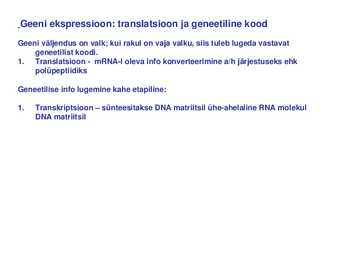
3. Elongatsioon aminoatsüül tRNA sidumine ribosoomiga Peptiidsideme moodustumine a/h vahel Ribosoomi liikumine järgmisele koodonile 1. Terminatsioon tRNA aktiveerimine(aminoatsüleerimine) 1. A/h ühineb tRNAs aminoatsüültRNA süntetaasi abil 2. Kasutab ATP energiat. 3. 20 erinvat different aminoatsüültRNA syntetaasi (igal a/h oma) 4. tRNAs on ensüümi spetsiifiline sait ATP and amino acid bind to aminoacyltRNA synthetase, to form aminoacylAMP + 2 phosphates. tRNA binds to aminoacylAMP. Amino acid transfers to tRNA, displacing AMP. Amino acid always is attached to adenine on 3' end of tRNA by its carboxyl group forming aminoacyltRNA. Initsiatsioon: 1. mRNA 2. Ribosoom 3. Initsiator tRNA (fMet tRNA prokarüootides) 4. 3 Initsiatsiooni faktorit (IF1, IF2, IF3) 5. Mg2+ 6. GTP (guanosiin trifosfaat) Elongatsioon: 1
Moon, C.D., Miles, C.O., Jarlfors, U. & Schardl, C.L. 2002. The evolutionary origins of three new Neotyphodium endophyte species from grasses indigenous to the Southern Hemisphere. Mycologia 94: 694–711. Moon, C.D., Scott, B., Schardl, C.L., & Christensen, M.J. 2000. Evolutionary origins of Epichloë endophytes from annual ryegrasses. Mycologia 92: 1103–18. Penalva, M.A., Moya, A., Dopazo, J. & Ramon, D. 1990. Sequences of isopenicillin N synthetase genes suggest horizontal gene transfer from prokaryotes to eukaryotes. Proceedings of the Royal Society of London, B 241: 164-169. Papa, K.E. 1979. Genetics of Aspergillus flavus: complementation and mapping of aflatoxin mutants. Genetical Research 34: 1–9. 89 Ramirez Carillo, R. & Leal Lara, H. Breeding of Pleurotus and Lentinula hybrids by pairing of neohaplonts for commercial cultivation. In: IMC7 Book of
mitochondrial plasmid suggest a relationship to introns and mobile elements. Cell 38: 441-453. Nishida, H., Blanz, P.A. & Sugiyama, J. 1993. The higher fungus Protomyces inouyei has two group I introns in the 18S rRNA gene. Journal of Molecular Evolution 37: 25-28. Oliver, R. & Schweizer, M. (eds) 1999. Molecular fungal biology. Cambridge University Press, 377 pp. Penalva, M.A., Moya, A., Dopazo, J. & Ramon, D. 1990. Sequences of isopenicillin N synthetase genes suggest horizontal gene transfer from prokaryotes to eukaryotes. Proceedings of the Royal Society of London, B 241: 164-169. Race, H.L., Hermann, R.G. & Martin, W. 1999. Way have organelles retained genomes? Trends in Genetics 15: 364-370. Saville, B.J., Kohli, Y. & Anderson, J.B. 1998. mtDNA recombination in a natural population. Proceedings of the National Academy of Sciences, USA 95: 1331-1335. Zolan, M.E. 1995. Chromosome-length polymorphism in fungi
ogy, and two different sets of fluorescent formed using constructs containing sequences beads are cross-linked to the specific oligo- from the Cauliflower Mosaic Virus (CaMV, nucleotide probes previously amplified and i.e., 35S promoter [P-35S] and/or 35S termi- labeled by polymerase chain reaction (PCR) nator [T-35S]) or from Agrobacterium tume- in the presence of a biotinylated nucleotide. faciens (i.e., nopaline synthetase terminator However, an important aspect that must [T-nos]). Screening methodologies have also be considered prior to routine use of these traditionally used selectable marker genes techniques in food analysis is the validation that encode proteins that confer herbicide of their performance through use by the sci- or antibiotic resistance (Draper and Scout entific community as has occurred with the 1991; Flavell et al. 1992; Kok et al. 1994; real-time PCR methods
 annaabi.ee