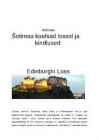
for Scotland" Crookstoni Loss Crookstoni loss asub edela Glasgows. Crookstoni lossi ümbritseb kaitsev ringkraav, mis ulatub 12. sajandisse, kui Sir Robert de Croc, ehitas selle koha peale puidust lossi. On leitud tõendeid, et selle koha peal on veel varemgi olnud kindlus. Crookstoni maad ostis Sir Alan Stewart aastal 1330, ning pärandas selle Sir John Stewartile, kellest sai esimene Lord Darnley, aastal 1361. Lord Darnley Stewarts asendas varasemalt puidust lossi kivilossiks ümber aastal 1400. Aastal 1489 hakkas krahv Stewart Lennox vastu kuningas James neljandale ning kuningas lasi kahuritel hävitada lossi läänepoolse osa ning nõudis kiiret allaandmist. Aastal 1544 vallutasid lossi krahv Arran ja kardinal Beaton, kui lossi pärija krahv Lennox oli kaitsmas Glasgow lossi. Loss läbis mitmeid omanikke, kuni aastal 1757 müüdi see Grahami hertsogi poolt perekond Maxwellidele
White Cart Water.Crookston is surrounded by a defensive ring-ditch that dates back to the 12th century when Sir Robert de Croc, built a timber and earth castle. Remains of a chapel founded by de Croc in 1180 have been uncovered. Evidence of an even earlier fortification on the same site has also been found. The lands of Crookston were bought by Sir Alan Stewart in 1330, and passed to Sir John Stewart, 1st Lord Darnley, in 1361. The Darnley Stewarts replaced the early castle with the present stone structure around 1400.In 1489 the Stewart Earl of Lennox rebelled against James IV. James responded by bringing the cannon Mons Meg from Edinburgh, and bombarding the castle, virtually destroying its western end, and ensuring a quick surrender. In 1544 the castle was besieged and taken by the Earl of Arran and Cardinal Beaton, while the then Earl of Lennox was defending Glasgow Castle.Charles, the Earl of Lennox
War with England continued for several decades, and a civil war between the Bruce dynasty and their long-term Comyn-Balliol rivals, the flashpoint of which could be traced to the slaying in a Dumfries church of John 'the Red' Comyn of Badenoch by Bruce and his supporters, lasted until the middle of the 14th century. Although the Bruce dynasty was successful, David II's lack of an heir allowed his nephew Robert II to come to the throne and establish the Stewart Dynasty. The Stewarts ruled Scotland for the remainder of the Middle Ages. The country they ruled experienced greater prosperity from the end of the 14th century through the Scottish Renaissance to the Reformation. This was despite continual warfare with England, the increasing division between Highlands and Lowlands, and a large number of royal minorities. Modern history In 1603, James VI King of Scots inherited the throne of the Kingdom of England, and became King James I of England,
In search of a better life and work, and due to the shortage of land, huge numbers of Estonians emigrated to Russia and America. In 1917, one fifth of Estonians lived outside Estonia (250 000); 50 000 of them lived in Petrograd (the Russian capital was renamed Petrograd in 1914). Altogether 40% of university-educated Estonians worked in Russia, they made excellent careers as becoming university professors, generals and estate Stewarts. From the point of view of the defence of Petrograd, the Baltic countries had especially important place in Russian military planning. Before the First World War, numerous military installations were erected in Estonia: the Russian Baltic navy port and the shipyards in Tallinn; the grand fortified naval base on the Northern coast bearing the name of Peter I. When the war broke out, the Estonian economy was totally subjected to the needs of the Russian war machine
The second important reason was competition for supremacy in trade and sea power. The Armada anchored at the coastal border area between France and the Spanish Netherlands. While awaiting communications from Parma's army, it was driven from the bay by an English fire ship attack. The English fleet followed them and the fleet sailed into the Atlantic, past Ireland. 50 vessels failed to make it back to Spain. *The House of Stuart (kings, centuries) Founded by Robert II of Scotland, the Stewarts first became monarchs of the Kingdom of Scotland during the late 14th century. During the reign of the Stewarts, Scotland developed from a poor and backwards country into a more prosperous one. There were five Stuart monarchs who ruled both England and Scotland as well as Ireland: James I, Charles I, Charles II, James II, William III and Mary, Anne, Anne of Great Britain died without an heire and all the crown passed to the House of Hanover.
 annaabi.ee