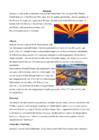
It borders with New Mexiko, Utah, Nevada, California, and Mexico, and one point in common with the southwestern corner of Colorado. Climate Southern Arizona is known for its desert climate, with very hot summers and mild winters. Northern Arizonafeatures forests of pine, Douglas fir, and spruce trees; the Colorado Plateau; some mountain ranges (such as the San Francisco Mountains); as well as large, deep canyons, with much more moderate summer temperatures and significant winter snowfalls. There are ski resorts in the areas of Flagstaff, Alpine, and Tucson. In addition to the Grand Canyon National Park, there are several national forest, national parks, and nation monuments. About midway through February, the temperatures start to rise again, with warm days, and cool, breezy nights. The summer months of June through September bring a dry heat ranging from 90120 °F (3249 °C), with occasional high temperatures exceeding 125 °F having been observed in the desert area
Cook Strait, 20 kilometers wide at its narrowest point, separates the North and South Islands. The climate throughout the country is mild and temperate, mainly maritime, with temperatures rarely falling below 0 'C or rising above 30 'C in populated areas. its isolation from continental (influences and exposure to cold southerly winds and ocean currents) give(s) the climate a much milder character. In winter the South Island mountains and central North Island have heavy snowfalls. New Zealand has about 4,3 million people. The population is unevenly distributed. Three fourths of New Zealanders live on warmer North Island and about 84 per cent of the people live in urban areas and about half of these in the four largest cities. The largest centre with over 1 million inhabitants is Auckland. .....................................................................................................................................................
Fortunately, as Britain does not experience extreme weather conditions, it is never very cold or very hot. The temperature rarely rises above 32°C in summer, or falls below -10°C in winter. Summers are generally cool, but due to global warming they are starting to get drier and hotter. Hot weather causes terrible congestion on the roads as Britons rush to the coastal resorts. Winters are generally mild, with the most frequent and prolonged snowfalls in the Scottish Highlands, where it is possible to go skiing. If it does snow heavily in other parts of Britain, the country often comes to a standstill. Trains, buses and planes are late. Contrary to popular opinion, it doesn't rain all the time. There is certainly steady rainfall throughout most of the year, but the months from September to January are the wettest. Thanks to the rain Britain has a richly fertile countryside which is famous for its deep green colour. History
daylight lasts sometimes only six hours. Being on the Baltic Sea the country is subjected to sea breezes and humidity. Estonia has a temperate climate, with four seasons of near-equal length. Summer is warm, while spring and autumn can be mild. Winter, which lasts from November to middel March, 4 can be very cold. The cold winter does not necessarily mean constant snow; in fact snowfalls are few and far between. When it falls it stays though, and there tends to be a layer of snow on the ground constantly. The deepest snow cover is usually in the south-eastern part of Estonia. Temperatures range from a summer average of 30°C to an average in winter of -8°C.The coldest month is considered to be February and the hottest July. There are about 160 to 181 rainy days a year. Rainfall is distributed throughout the year with the heaviest rainfall in August. Nature Waterbodies
(over 6,250 mm (246.1 in) per year) in Portugal, according to Instituto de Meteorologia (English: Portuguese Meteorological Institute). In some areas, such as the Guadiana basin, annual average temperatures can be as high as 20 °C (68 °F), but summer highest temperatures may be over 45 °C (113 °F) . The record high of 47.4 °C (117.3 °F) was recorded in Amareleja, although this might not be the hottest spot in summer, according to satellite readings. Snowfalls occur regularly in the interior North and Center of the country in particular in the districts of Vila Real, Bragança, Viseu and Guarda. In winter temperatures may drop below -10 °C (14.0 °F) in particular in Serra da Estrela, Serra do Gerês and Serra de Montesinho. In these places snow can fall any time from October to May. In the south of the country snowfalls are rare but still occur in the highest elevations.
 annaabi.ee