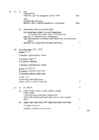
2 Nerve ending impulse transmission to muscle cells 1 3 Muscle cell surface action potential 4 T-system transmission 3 2 5 Coupling to sarcoplasmic 3 reticulum 4 6 Ca 2+ release from sarco- plasmic reticulum 5 7 Activation of contractile proteins 8 Calcium reaccumulation by sarcoplasmic reticulum
(contraction) pulls on radius; flexor (muscle)/bends arm/pulls lower arm up; 2 max triceps; (contraction) pulls on end of ulna; extensor (muscle)/straightens arm/pulls lower arm down; 2 max 3 max [9] 2+ 45. (calcium ions/Ca ) released from sarcoplasmic reticulum; bind to troponin; troponin changes shape; troponin/tropomyosin, moves; myosin binding site exposed; myosin head binds (to actin); 3 max [3] 46. (Alzheimer’s) 1 reduced uptake of isotope/less positrons emitted/less glucose in brain 2 cells;
tem muscle (range of 65–80%). Within the nized cells in the animal body and perform a muscle, it is the primary component of extra- varied array of mechanical functions. They cellular fluid. Within the muscle cell, water are required for the movement of limbs, is the primary component of sarcoplasmic for locomotion and other gross movements, (cytoplasmic) fluid. It is important in thermo- and they must also perform finer tasks regulation; as a medium for many cellular such as maintaining balance and coordina- processes; and for transport of nutrients tion. Muscle movement and metabolism
"It's just water weight." This dismissive comment is common in the lifting and diet worlds. Now, carrying so much subcutaneous water that your head looks like a Cabbage Patch Kid is bad. However, purposefully putting more uid and substrate in speci c parts of muscle tissue can be incredibly useful. There are two di erent types of muscular growth that you can use to your advantage with a bit of inside knowledge. The names of both sound complicated--myo brillar and sarcoplasmic--but the di erence is really very simple. Let's start with a basic primer on muscle fibers. Every muscle ber has two main parts: myo brils, which are cylinder- shaped laments that contract to create movement, and the sarcoplasm, which is the uid surrounding the myo brils that contains glycogen stores and mitochondria to provide energy (ATP). Myofibrillar hypertrophy20 can be thought of as growth for maximal strength. The myo brils
 annaabi.ee