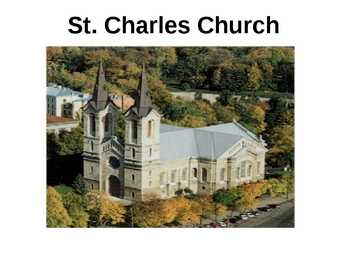
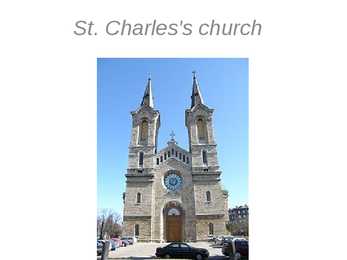
St. Charles Church Basic Information Built in pseudo-Romanesque style Architects: O.P.Hippius and R.von Bernhard Limestone church Built in 1862-1882 Area 1197 m2 Biggest church in Tallinn The Costruction of the Church The Altar Come to me- painted by Johann Köler It was ready in the 23 of juli in 1879 The bottom altarpieces are painted by Sally von Kügelgen in 1889 The Church Bells The North Tower The South Tower The Organ
St. Charles's church Is a Romanesque style church in Tallinn. First time mentioned a a church in 1458 Probably built in the 13th Conquest century Chapel was destroyed, probably during the Livonian War. Was consecrated in the 1870th year, although construction began eight years earlier The Church was designed by the Baltic German architect Otto Pius Hippius Johann Köler painted the altarpiece of the church, and it took him ten days time. St. Charles Church also decorates the work of Sally von Kügelgen The organ was completed in 1923 which was made of by German organist Friedrich Eberhard-Walker Thank You for watching Tauri Einberg
Flag The location of Prague in the Czech Republic Name The name Prague is derived from an old Slavic root, praga, which means "ford", referring to the city's origin at a crossing point of the Vltava river. The native name of the city, Praha, is also related to the modern Czech word práh which means threshold. History The area of Prague was settled as early as the Paleolithic age. By the year 800 there was a simple fort fortified with wooden buildings. It was founded during the Romanesque era c. 885 and flourished in the Gothic and Renaissance eras. Prague flourished during the reign of Charles IV. Charles IV founded the first university in MiddleEurope Charles University Prague seen from satellite View of Prague from Petri hill The front view of St. Vitus Cathedral with its rose window The astronomical clock of Prague The National Museum Zizkov Television Tower Charles University in Prague Old Town Square Old Town Square during Christmas Charles Bridge
värvigamma, koloriit-colour, coulouring ? 24. (joonistamis)süsi-charcoal 25. käsitöö-handicraft 26. keraamika ja pottsepatöö-pottery 27. tikkimine, tikkimistöö-embroidery 28. linna(kujutav) maal- ? 29. akvarellid, vesivärvid-watercolours 30. guass-gouache 31. grafiit, grafiitpliiats-graphite, black lead ? 32. zanr, zanrimaal-genre ? 33. vaikelu, natüürmort-still-life 34. Romaani stiil-Romanesque 35. Gooti stiil-Gothic 36. graafika-graphic art, graphics 37. toomkirik, katedraal-cathedral 38. emailimaal-enamel painting 39. estamp(tõmme puu-või vasegravüürist või linoollõikest graafilisele paberile)-proof, print impression 40. eelkavand, skitseering- sketch, preliminary shape 41. barokkstiil- Baroque 42. ateljee- studio, workshop 43. akt, aktimaal- nude 44. abstraktne kunst-abstract art 45. viimistelema- to elaborate; peenelt, hästi viimistletud-elaborate 46
Architecture Early Anglo-Saxon buildings in Britain were generally simple, constructed mainly using timber with thatch for roofing. The Anglo-Saxons built small towns near their centres of agriculture. In each town, a main hall was in the centre. The architectural character of Anglo- Saxon ecclesiastical buildings range from Coptic influenced architecture in the early period; basilica influenced Romanesque architecture; and in the later Anglo-Saxon period, an architecture characterised by pilaster-strips, blank arcading, baluster shafts and triangular headed openings. There are few remains of Anglo-Saxon architecture, with no secular work remaining above ground. All surviving churches, except one timber church, are built of stone or brick and in some cases show evidence of re-used Roman work. Art Anglo-Saxon art is mainly known today through illuminated manuscripts. Although they are
mining technologies spread across the world. Canterbury Cathedral, St Augustine's Abbey and St Martin's Church in Kent Designated a World Heritage Site in 1988. Canterbury Cathedral was founded in AD597 (that's over 1,400 years ago!) and is the Mother Church of the Anglican Communion. It has a perpendicular nave, 12th-century Gothic choir, stunning stained glass windows that fill the church with colour and a Romanesque crypt. Another important church is the Church of St Martin just outside the city's medieval wall, half of which survives today. Probably built as a Roman church in the 4th century, St Martin is the oldest church in England that's still in use as a parish church. Another not to miss is St Augustine's Abbey. The ruins of this once great abbey are an impressive sight. Jurassic Coast Designated a World Heritage Site in 2001.
Romaanika ja gootika 1. Missugust perioodi ajaloos loetakse keskajaks? 5-15.sajandit loetakse keskajaks. 2. Mis ajastu kunsti peetakse romaani stiili kuuluvaks? Romaani stiil oli keskajal levinud üle kogu Lääne-Euroopa ja seega esimene suuremat piirkonda hõlmav kunstistiil pärast Vana-Rooma kunsti. 3. Kust tuleb nimi romaani stiil? Esimest korda kasutas keskaegse ümarkaar stiili kohta sõna romanesque prantsuse õpetlane Charles de Gerville. Romaani stiil oli esimene ühtne kunstistiil Lääne-Euroopas. See valitses X-XII sajandil eelkõige Itaalias, Prantsusmaal, Saksamaal ja Inglismaal. Ehkki romaani stiilis on palju antiigi elemente ja mõjutusi, on see täiesti iseseisev kunstistiil. 4. Mida tähendavad mõisted: portaal - rikkalikult dekoreeritud pea sissekäik hoonesse pikihoone - kirikuhoone osa, mis on määratud kogudusele, moodustab tavaliselt kirikuhoone
as hideous little monstrosities, and the Rococo wall clock is a jumble of leafy branches. In general, Rococo is an entirely interior style, because the wealthy and aristocratic moved back to Paris from Versailles. Paris was already built up and so rather than engaging in major architectural additions, they simply renovated the interiors of the existing buildings. Gothic art Gothic art was a Medieval art movement that developed in France out of Romanesque art in the mid-12th century, led by the concurrent development of Gothic architecture. It spread to all of Western Europe, but took over art more completely north of the Alps, never quite effacing more classical styles in Italy. In the late 14th century, the sophisticated court style of International Gothic developed, which continued to evolve until the late 15th century. In many areas, especially Germany, Late Gothic art continued well into the 16th century, before being subsumed
uk/MEDedward.htm http://www.historylearningsite.co.uk/edward_the_confessor.htm http://www.bbc.co.uk/history/historic_figures/edward_confessor.shtml http://www.sacred-destinations.com/england/images/london/westminster-abbey/isaac-newton-tomb- paradox.jpg (third picture) http://cache.eb.com/eb/image?id=97433&rendTypeId=4 (second picture) Westminster Abbey Around 1045-1065, Edward the Confessor built a church for the Benedictine monks in the Norman form of Romanesque. He intended it to be his burial place. The Westminster Abbey is located near the Houses of Parliament. It is more a historical site than a religious site. Since 1066, every royal coronation, with the exception of Edward V and Eward VIII has taken place in Westminster Abbey. The abbey also serves as the burial ground for numerous politicians, sovereigns and artists. It is also a final resting place of seventeen monarchs.The abbey is stuffed with graves, statues and monuments. Many
 annaabi.ee