So people should stop dropping garbage into the lakes or near them. And walking pets near the lakes is also not such a good idea. It's not very nice to find some animal's body wastes while going to swim. Secondly, think about how much water you use. A few simple steps could save your money and help protect the environment. For example you should prefer shower to bath or you should turn the water off while brushing your teeth. Finally, people who work in agriculture, should start collecting rainwater to water their fields and gardens. It's much cheaper and naturefriendly. So don't just sit there! We can all do our bit from keeping our lakes clean to collecting rainwater. If everybody does a little bit, then perhaps together we can make a difference.
tuuma elektrijaam • 1997ndal aastal peatati Dodewaard’i tuumaelektrijaamas tegevus. • Borssele jaam toimib tänaseni. Kasutatud kirjandus • ENE 3, Tallinn kirjastus “Valgus” 1988, lk 457- 458 • ENE 3 Tallinn kirjastus “Valgus” 1988, lk 458- 459 • Pere atlas Varrak 2008, lk 42-43 • http://en.wikipedia.org/wiki/Dodewaard_nuclear_power_plant • http://www.environmental-expert.com/companies/keyword-rainwater-tanks-3497/location- netherlands-antilles/industry-served-forestry-wood • http://et.wikipedia.org/wiki/Kasutaja:Nikitoooooo/Hollandi_rahvastik • http://fish.mongabay.com/data/Netherlands.htm • http://ec.europa.eu/fisheries/cfp/international/index_et.htm • http://faostat.fao.org/site/666/default.aspx • http://ec.europa.eu/fisheries/cfp/aquaculture/index_et.htm • http://www.fao.org/fishery/facp/NLD/en#CountrySector-Overview • http://et.wikipedia.org/wiki/Holland
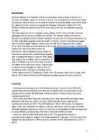
morning the thermometer might read 12ºC and by afternoon it may already be 10ºC. Although it doesn't always snow in winter, there tends to be about 10 cm of snow on the ground consistently from late December through to the beginning of March. The sky over Estonia is cloudy for about half the year, and the hilly southeast region experiences up to 750 mm of precipitation due to Estonia's maritime climate. Nature While seven thousand rivers and streams carry rainwater to the sea, bogs and wooded swamplands of different types cover over one fifth of the country -- a world index topped only by the northern neighbour, Finland. Various kinds of forests comprise slightly under half of Estonia's territory. Wetlands, together with primeval forests, represent preserved communities which have for the most part been destroyed in Europe. More than 1000 lakes (5 per cent of the Estonian territory) dot the
The wood bore samples taken during the study revealed that 69% of the buildings showed wood rot decay. 27% of the samples taken from the lower logs of the external wall, roof rafters and floor beams were damaged by the wood rotting fungi. 10% of the buildings had some damage from wood rotting fungi in the bottom beam of the external wall. The load- bearing structures of two buildings were damaged by dry rot (Serpula Lacrymans). Envelope structures such as siding, exterior window sills, rainwater drainage, and roof covering often need renovation to protect the load-bearing structures from further damage. The main causes of damage and flaws in the foundations were the uneven subsidence of the foundation, the empty spaces between bricks where the mortar had fallen out, foundations that were too low (or ground elevation of the surrounding area) and the failure to protect the edge of the foundation from rain water, or the decay of the slope made of mortar for that purpose.
 annaabi.ee