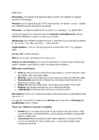
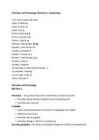
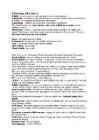
əᴜ - houm, load aᴜ - loud, grown, house Triphthongs are sounds consisting of 3 vowels. They form when adding schwa to the 5 closing diphthongs. A stop consonant aka a plosive is a consonant articulation which stops the airflow completely – air can’t escape through the mouth. When the blockage is released a burst of air is released with a sound (plosion). Plosives divide into: Bilabial – the stop is made by two contracting lips Alveolar- the stop is made by the tongue touching the alveolar ridge Velar – the stop is made with the velum aka soft palate Fortis – aspirated consonants Lenis – not aspirated Plosives of English: Bilabial Alveolar Velar Fortis p t k
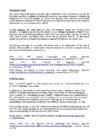
Available at https://www.msu.edu/course/lin/401/fs03-s2/phonetics-lecture2.pdf, accessed January 19, 2016. FORTIS CONSONANTS A fortis consonant is a “strong” consonant produced by increased tension in the vocal apparatus. These strong consonants tend to be long, voiceless, aspirated, and high. With fortis consonants, following thumb rules stay true: articulation with more muscular effort and greater breath force, voiceless in all positions, fortis plosives are aspirated in syllable-initial position, vowels are shortened before a fortis consonant. Example: voiceless [bb ] is "lenis", whereas [p] is "fortis". Lenis plosives have less intraoral pressure than fortis ones. The difference is easily noticed in the English pair "touched" vs. "judged" (said in isolation). The final consonants are pronounced without vocal fold vibration in both cases. But the
Closing diphthongs end with a closed vowel, the glide is towards ý and . English vowels: a vowel is longest in an open syllable and in monosyllabic words (sea, speed) a vowel is next longest in a syllable closed with a voiced consonant and in two-syllable words (seed, speedy) a vowel is shortest in a syllable closed with an unvoiced consonant and in words with more than two syllables (seat; speedily). Stop Consonants (Plosives). A stop (or plosive) - is a consonant articulation which stops the airflow in the vocal tract completely, the air cannot escape through the mouth. When the articulators come apart, the airstream will be released in a small burst of sound. Aspiration a period of voicelessness after the release of an articulation, e.g. pie [paý] NB! K, p, t are unvoiced/aspirated consonants and g, b, d are unaspirated/voiced consonants. These unvoiced stops are completely unaspirated (spy, sty, sky),
There are also problems in how to analyse - as a phoneme or allophone, and many others. The second area of difficulty can be called the problem of assignment. There may be found many cases where it is difficult to assign a particular speech sound to a particular phoneme. We use the term neutralisation for cases where contrasts between phonemes which exist in other places in the language disappear in particular contexts. A clearer case of neutralisation can be found in the case of plosives following s in syllable-initial position. Words like 'spill', 'still', 'skill' are usually represented with the phonemes p, t, k following the s. But, as many writers have pointed out, it would be quite reasonable to transcribe them with b, d, g instead, because b, d, g are unaspirated while p, t, k in syllable- initial position are usually aspirated; but in sp, st, sk we find an unaspirated plosive. Although we dont transcribe
Frik / f/v / s/z / ç/ x/ / / h/
Afrik pf ts/dz
t/d
Later l L
Trem r R
P-vok w j eesti h?
(Muud)
3.1.2. Liigitus moodustusviisi järgi (vt tabeli horisontaalread):
1) klusiilid ehk sulghäälikud (ingl plosives, stops, vn )
2) nasaalid ehk ninahäälikud (ingl nasals, vn )
3) frikatiivid ehk hõõrdhäälikud (vn `mürahäälikud')
4) poolvokaalid (semivocales) ehk aproksimandid
See jaotus rajaneb kõnetrakti neljal põhiasendil: 1) sulg; 2) sulg koos avatud ninakäiguga; 3) kitsas
läbipääs (ahtus), kus hõõrduva õhuvooluga kaasnevad mürad (
 annaabi.ee