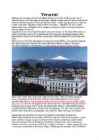
means the presence of oil.Today that oil fuels a billon-dollar industry, second only to manufacturing.Mexico is the leading oil producer in Latin Ametica, with the world's eighth largest reserves.Yet even the gargantuan oil industry has been vulnerable during the country's economic crisis.To raise cash to service the national debt, Mexico's stateowned petroleum company,Petroleos Mexicanos, or Pemex, has been hanging `'For sale" signs on plants that produce petrochemicals for photographic film,antifreeze, nylon stockings, nd fertilizers. Sharing the Gulf with Pemex oil tankers in Veracruz's fishing fleet, the largest in Mexico.Each day before sunrise some 11,600 boats pull out to harvest shrimp,clams, oysters, crabs, and fish- enough to supply 12 percent of the country's commercial seafood needs. The grit and grime of the oil industry and the frantic sorting of fish this is what many
in WWI because it was under the rule of British empire. Canada also took parti in WWII, because the government made it's own decision. Economy Most of Canada's manufacturing industry is in Ontario and Québec, where motor vehicle production comprises the largest sector within this industry. Other important manufacturing sectors include food and beverages, paper and allied products, primary metals, fabricated metals, petrochemicals and chemicals. The Atlantic, Prairie and Pacific regions of Canada have more natural resource-based economies. The Atlantic provinces focus on fishing, forestry and mining, while Prairie provinces are dependent on agriculture and mineral fuels. British Columbia's primary sectors are forestry and mining, as well as tourism. Major Exports: automobile vehicles and parts, machinery and equipment, high- technology products, oil, natural gas, metals, and forest and farm products.
indoors in specially designed barns in southern Alberta, then migrating north during the summer into the Peace River valley where the season is short but the working days are long for honeybees to produce honey from clover and fireweed. Industry Alberta is the largest producer of conventional crude oil, synthetic crude, natural gas and gas products in the country. Alberta is the world's 2nd largest exporter of natural gas and the 4th largest producer. Two of the largest producers of petrochemicals in North America are located in central and north central Alberta. In both Red Deer and Edmonton, world class polyethylene and vinyl manufacturers produce products shipped all over the world, and Edmonton's oil refineries provide the raw materials for a large petrochemical industry to the east of Edmonton. The Athabasca Oil Sands (sometimes known as the Athabasca Tar Sands) have estimated unconventional oil reserves approximately equal to the conventional oil reserves of the rest of the
their choice of the cream. Since people’s interest in natural products has increased, users also have to be informed more thoroughly of different certificates related to natural cosmetics. According to the questionnaire, 17.19% of the respondents purchase their face cream from supermarkets. On the basis of the analysis taken from 131 face creams sold at supermarkets, 45.80% contain parabens, 34.35% petrochemicals and 55.73% silicones. Only one-fourth of the creams are free of such substances. The questionnaire has also indicated that the awareness of respondents of the harmfulness of parabens and sulphates is high. More than half of the respondents have classified methylparaben as a harmful substance and over 40% 3 Eesti Esimene Erakosmeetikakool Kristiina Meentalo Rahvusvaheline CIDESCO-kool 52
Lubricants (produces light machine oils, motor oils, and greases, adding viscosity stabilizers as required). Wax, used in the packaging of frozen foods, among others. Sulfur or Sulfuric acid. These are a useful industrial materials. Sulfuric acid is usually prepared as the acid precursor oleum, a byproduct of sulfur removal from fuels. Bulk tar. Asphalt Petroleum coke, used in speciality carbon products or as solid fuel. Paraffin wax Aromatic petrochemicals to be used as precursors in other chemical production. Agriculture Since the 1940s, agricultural productivity has increased dramatically, due largely to the increased use of energy-intensive mechanization, fertilizers and pesticides. Nearly all pesticides and many fertilizers are made from oil. Consumption According to the US Energy Information Administration (EIA) estimate for 2011, the world consumes 87.421 million barrels of oil each day.
 annaabi.ee