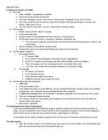
Background of Beowulf: · primitive and harsh environment · great importance · wars - life brief, fate ruled over human beings · Beowulf - sense of fatal doom, dark and sombre tone · fate and fame - vital ideas in the literature of Anglo-Saxon period · Beowulf - monsters slaying in Scandinavia = struggles between good and evil Christian Poetry · 55 B.C. Julius Ceasar - christianity to British Isles · 449 A.D Anglo-Saxons - pagans = christianity declined · 597 A.D. St. Augustine - within 100 years all country into christianity Caedmon and Alfred the Great Ceadmon · first religious poet of British literature · "the father of English song" · Hymn of Creation - between 658 and 680 - the oldest preserved · turned the Bible stories into verse from = poetic paraphrase Alfred the Great · first notable written literature in Anglo-Saxon · Anglo-Saxon Chronicles, 892 The Chronicle
Norway. Christmas Celebrations In Norway While there are many customs and traditions linked to Christmas in Norway, there is one long- standing and very popular tradition that includes a little gnome Nisse, who guards the farm animals. It is believed that he plays tricks on children, if they forget to serve him a bowl of special porridge. The gnome is known as Julebukk or `Christmas buck,' and his looks are similar to those of a goat. Julebukk is associated with the Viking times, when the pagans worshipped Thor and his goat. The idea of Julebukk is very old and still, very dear to the Norwegians, especially around Christmas. During the Viking period, a person used to dress in a goat skin and carry a goat head on the Christmas Day. He would join the party and die during the course of the evening, to return to life. In the early Christian era, the goat came to be associated with the devil and would appear in the party while merry making and celebrations were on
for Halloween. Traditional halloween decoration Click to edit Master text styles Second level Third level Fourth level Fifth level The Pagan holiday Samhain, that the All Saints holy day replaced, was also known as the Day of the Dead. Many Wiccans and modern Pagans celebrate the Day of the Dead. This is a happy holiday (even though it celebrates 'Death'). It is the day that the souls of dead people come back to Earth. Therefore, in Pagan religions it is not about scary things. It is about remembering family or friends who have died. Many Lutheran churches celebrate a holiday on October 31st called The Reformation. This holiday celebrates the day that Martin Luther put The NinetyFive Theses on a church door
Old Tallinn Old Town, a medieval walled city filled with old buildings and fortifications. The sheltered bay and the easily defended Toompea Hill made it a natural place to settle. Sometime about 1050 A.D. a fortress was built atop the hill, the first of many. In 1219 the Danes showed up as part of the Northern Crusade to subjugate the Baltics and convert the local pagans to Christianity whether they wanted to or not. The Danes improved the fortifications and expanded the town, which became part of the Hanseatic League, a trading organization of a hundred northern cities. The Danes sold Tallinn to the Livonan Order, a branch of the Teutonic Knights, in 1346. The Swedes came next in 1561. Tallinn weathered plague and the Great Northern War and became part of Russia in 1710. In 1918, Estonia declared
Click icon to add picture Estonian crusade · One of the last corners of medieval Europe to be christianized. · Against pagans in Estonia. · Estonian commander Lembitu was killed. · Ancient Estonian fight for independence. http://wapedia.mobi/thumb/4176501/en/fixed/470/376
o 122 AD- Hadrian's Wall; 138 AD- Antonine Wall o Druids(celtic priests) were banned and Britain was influenced by christianity 3) The Germanic Invasions I. The Anglo-Saxons o 5th century- 1066 o From Southern Denmark(angles); Germany(saxons); Jutland(jutes) o By the 7th c kingdoms had emerged and later KING ALFRED united the kingdoms o They were pagans and very rural people, built in wood rather than stone o It was the saxon farmstead that laid the foundations of the English village II. The Vikings o 8th century- 11th century o From Denmark, Norway o They were ship builders and sailors o In 886 the Danelaw peace treaty was made 4) The Normans/ the final conquest o 1066-1154
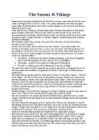
and during the 9th & 10th centuries Western Europe was attacked by new barbarians who came from the North Norway, Sweden & Denmark and were called Northmen. In different countries they were known as the Vikings, the Normans, the Danes. As England was more often raided from Denmark, the new invaders came to be known in English history as the Danes, the Norwegians invaded Ireland & Scotland. The Danes were of the same Germanic race as the Anglo-Saxons, but they still lived in tribes, were pagans. The Danes were well armed with long swords, spears, daggers, axes, bows, iron helmets & chain armour. Their ships were sailing-boats, but they were also provided wiht oars. The sails were often red & blue & green. At the prow of the ship there was usually a carved dragon's head which rose high out of the water. The Danes were bold & skilful seamen. The word ,,Vikings" probably means ,,pirates" or ,,the people of the sea inlets". At first they only raided & plundered
whereas France displayed a white cross, first on a red, then on a blue flag. From this practice and time emerged the famous and significant cross flags, such as St. George's Cross (red cross on white), the Cross of St. Denis (a white cross on red) and the cross flag of the Teutonic Knights (black cross on white). The Crusader flag displaying a white cross on red, was originally used by Christians against the European `pagans', and later became the flag employed by the Holy Roman Empire in battle. The influence of heraldry on modern flags has been substantial, and the effectiveness of the symbolism has been reproduced due to the simplicity, distinctiveness and originality of heraldic colours and designs. The first cross flags indicated primarily that the military operations of the crusaders were sanctioned by the Pope. However, it is clear that these flags gained territorial associations as time went by. 1
 annaabi.ee