Denmark Facts Mountainious country Total area of 385,000 square kilometres Population of 5 million 12 peaks over 2000m Mountains Galdhøpiggen - highest mountain 2496m Glittertind second highest mountains - 2,465 m Citys Oslo, the capital, the largest city. Bergen, second largest, birthplace of many known Black Metal bands. Bergen Religion and immigrantism Pagan norwegians worshipped Odin and Thor Christianization around 1000AD reason of church burning in 90's Immigrantism and muslims reason of 2011 Norway attacks Espedal Small village Birthplace of Kristian Eivind Espeda(or Gaahl) the vocalist of a band Gorgoroth Thank you for listening
STUDY QUESTIONS ON CHAPTER 3 · Battle of Stamford Bridge 1066- Battle, that took place on Stamford Bridge between Norwegians who were led by Harald and England (king Harold Godwinson). During the battle many Norwegian leaders were killed. Norwegians lost the battle, and it is very often taken to mark the end of the Viking Age. · Battle of Hastings 1066- Occurred on 14th October 1066 during the Norman conquest of England, between the Norman-French army of William the Conqueror and the English army under king Harold II. During the battle Harold was killed and the Normans won. It was the end of Anglo-Saxon era. · Bayeux Tapestry- Embroidered cloth nearly 70m long, which depicts the
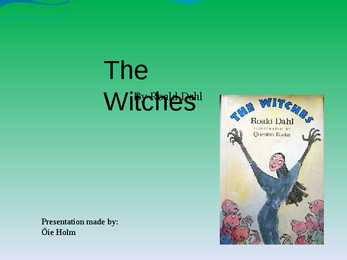
their unexpected endings, and his children's books for their unsentimental, often very dark humour. Some of his better-known works include James and the Giant Peach, Charlie and the Chocolate Factory, Matilda and The Witches. About the book My book tells about a little boy whos parents died at a car axedent and he went to live at hes grandmothers. The grandmother was the boys only living relative, they got along very well and the boy was very happy. The grandmoher was Norwegian and Norwegians knew everything about witches. She was a wonderful story - teller but the storys she telled about witches were all true. She told her grandson how to spot them from a crowd and told him what ugly and bad creatures they are. One day the boy met a witch, and got out alive luckily. The boy and hes granmother went to live to England. One day they went to a hotel just to relax and have some fun. The boy happend on a RSPCC meeting- The Royal Society For The Prevention Of Cruelty To Children
standing and very popular tradition that includes a little gnome Nisse, who guards the farm animals. It is believed that he plays tricks on children, if they forget to serve him a bowl of special porridge. The gnome is known as Julebukk or `Christmas buck,' and his looks are similar to those of a goat. Julebukk is associated with the Viking times, when the pagans worshipped Thor and his goat. The idea of Julebukk is very old and still, very dear to the Norwegians, especially around Christmas. During the Viking period, a person used to dress in a goat skin and carry a goat head on the Christmas Day. He would join the party and die during the course of the evening, to return to life. In the early Christian era, the goat came to be associated with the devil and would appear in the party while merry making and celebrations were on. This game was forbidden by the church and the state by the end of the middle age
660 only Sussex & the Isle of Wight had not accepted the new faith. Latin became the language of the Church. From the end of the 8th cent. and during the 9th & 10th centuries Western Europe was attacked by new barbarians who came from the North Norway, Sweden & Denmark and were called Northmen. In different countries they were known as the Vikings, the Normans, the Danes. As England was more often raided from Denmark, the new invaders came to be known in English history as the Danes, the Norwegians invaded Ireland & Scotland. The Danes were of the same Germanic race as the Anglo-Saxons, but they still lived in tribes, were pagans. The Danes were well armed with long swords, spears, daggers, axes, bows, iron helmets & chain armour. Their ships were sailing-boats, but they were also provided wiht oars. The sails were often red & blue & green. At the prow of the ship there was usually a carved dragon's head which rose high out of the water. The Danes were bold & skilful seamen.
traders and crafters started marketing First English king who worte books More learned laity Danelaw, Viking territories in the British Isles During 9th C all Scottish Islands and the Isdle of Man went to the Vikings The Danes invaded East Anglia, Northumbria, Mercia and established their kingdom- Danelaw Even being christianized, they retained their systems of manorial organization, land measurement, law and social differentiations. Norwegians captured Dublin and established ther kingdom, which lasted 35 years Ethelred the Unready and Danegeld Ethelred was the king of England Notorious for payments for attacking Vikings- danegeld, based on the angient method of assessing land in hides, so much per hide An inefficial ruler, failed to prevent England being ran over by the Danes Ordered a massacre for Danes Danish king Swein conquered England and Ethelred was sent to exile in Normandy, he
began as early as the 1930s, with the cats being exhibited in Oslo before the Second World War. In 1963 it was shown under the name Skogkatt. The breed was revived in the early 1970s; in 1972 it was formally recognised in its home country, serious breeding began in 1973. Many of the foundation cats came from near the Swedish border. Swedish breeders declared that the breed belonged to Sweden as much as to Norway. But the Norwegians disputed this and it was agreed that foundation cats must come "straight from the Norwegian forests". While single Skogkatts might cross the Swedish/Danish border while hunting in the woods no entire (unneutered) registered cats were allowed out of Norway until the breed was recognised. It was eventually allowed to be exported and was recognised in Europe in 1977 and became popular in the USA during 1985 and Britain in 1987. Siberian and other Russian Longhairs
 annaabi.ee