· suggesting the possible involvement of these wheat SNARE genes in · response to leaf rust infection. Similarly, a Qc-SNARE domain containing plant specific SNARE in wheat TaSPY71 was differentially...... · · induced in response to Puccinia striiformis f. sp. tritici during both compatible and incompatible interactions . · Secretory processes are thought to help in defense response in plant-pathogen interaction. Site- specific, localized increase of an antimicrobial secondary metabolite (phytoalexin) was found in the apoplast of S. bicolor in response to the fungal pathogen · Colletotrichum graminicola. The accumulation of phytoalexin starts with the occurrence of spherical cytoplasmic inclusions of about 1 m in diameter that merge to form a large entity of ~ 20 m diameter. · Similarly, during barley-powdery mildew interaction the deposition of H2O2 containing vacuole struc tures were observed.
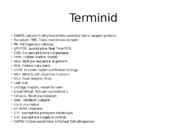
others are beneficial sources of antibiotics. Stretomyces - Over 500 species of Streptomyces bacteria have been described. As with the other Actinobacteria, streptomycetes are Gram-positive, and have genomes with high GC content. Found predominantly in soil and decaying vegetation, most streptomycetes produce spores, and are noted for their distinct "earthy" odor that results from production of a volatile metabolite, geosmin. Algae - any of numerous groups of chlorophyll-containing, mainly aquatic eukaryotic organisms ranging from microscopic single-celled forms to multicellular forms 100 feet (30 meters) or more long, distinguished from plants by the absence of true roots, stems, and leaves and by a lack of nonreproductive cells in the reproductive structures. Today, algae are used by humans in many ways; for example, as fertilizers, soil conditioners and livestock feed
98. preservation of, organisms / environments ; that are at risk from human activity ; requires management ; creation of new habitats ; may need reclamation ; conservation requires vigilance ; resolving conflicts ; A suitable alternatives 2 max [2] 99. (i) (penicillin) secondary metabolite ; produced at start of / during stationary phase / end of growth phase ; A log phase ref to production (at maximum) when kept short of nutrients / nutrients depleting / factors limiting growth ; continuous culture maintains in, log / rapid growth, phase ; 2 max (ii) to provide respiratory substrate / energy ; A for respiration to maintain culture / keep culture alive / prevent (premature) death of
Vernozy-Rozand et al. environment and able to compete with con- (1996) reported enterotoxin E as the most taminant bacteria. frequent enterotoxin found in S. equorum and In the process of selection and choice of S. xylosus, though Martin et al. (2006) a starter culture, the safety aspects such as reported that the occurrence of staphylococ- antibiotic resistance, virulence genes, and cal enterotoxin genes in CNS from slightly undesirable metabolite formation should not fermented sausages was rare, detecting only be overlooked. entC in S. epidermidis. The coagulase-posi- tive species, S. intermedius and S. aureus, have been more frequently related to staphy- References lococcal intoxication to date. Moreover, S. Aarestrup, F., Y. Agersø, P. Ahrens, J. Ø. Jørgensen, M. intermedius are opportunistic pathogens in Madsen, and L. B. Jensen. 2000. Antimicrobial sus-
 annaabi.ee