Theatres in Estonia Native Estonian theatre, born in 1870 with the plays of the patriotic poetess Lydia Koidula, came into being on the crest of national awakening. Its tastes were at first pretty simple, the favourite genres being folk comedy and romantic melodrama, although both also transmitted halfhidden social and political attitudes. In less than forty years, in 1906, the leading amateur companies, the "Vanemuine" in the university town Tartu and the "Estonia" in Tallinn, could become professional, and in 1911 the "Endla" of P ärnu joined them. Theatre became especially popular amongst Estonians in the second half of the 19th century. Before that time,
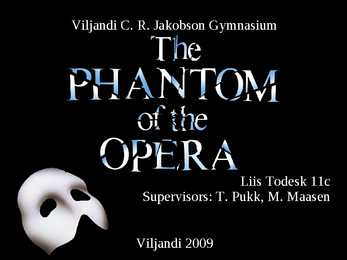
theatres. REVIEWS "It's fantastic, fabulous and phantasmagorical! From the eerily flickering lights that greet you outside Her Majesty's Theatre to the last, glorious curtain call, Andrew Lloyd Webber's long-awaited new musical, Phantom of the Opera, is a triumph." John Blake, Daily Mirror, 10th October, 1986 "Four words sum up the unstoppable success of Andrew Lloyd Webber's triumphant re-working of this vintage spine-tingling melodrama. Stars, spectacle, score and story." Jack Tinker, Daily Mail, 10th October, 1986 AWARDS Over 50 awards 3 Olivier Awards 7 Tony Awards 7 Drama Desk Awards 3 Outer Critic Circle Awards Evening Standard Award ON BROADWAY 26th January, 1988 Rebecca Pitcher and Howard McGillin Gross benefit US $715 million Longest-running musical A real Broadway experience CONCLUSION
Zac Efron Birth name: Zachary David Alexander Efron Age: 22 Date of birth: 18 October 1987, San Luis Obispo, California, USA Life so far: Born in San Luis Obispo, California. American actor and singer. Efron had a self-described "normal childhood" in a middle class family. Efron is of Jewish ancestry and is an agnostic, having never been religious. He subsequently appeared in theatre productions at his high school, worked in a theatre called The Great American Melodrama and Vaudeville, and at age 11began taking singing lessons. He began acting professionally in the early 2000s. Efron was referred to an agent in Los Angeles by one of his drama coaches, and scored his first television appearance in 2002 with an appearance on Joss Whedon's sci-fi series Firefly. He was later signed to the Creative Artists Agency. A junior in high school, Efron's favourite sports include golf, skiing, rock climbing, and snowboarding
European film industryin ruins due to the war after world war 1: 80% to0& market shares in many countries The struggle for feature length People believed that cinema is a short film. If you have a long film then have a longer time with the stars. Griffith believed in long films. 24 minute film, 48 minute film, 3 hours. People went to see it. The manipulation of history through film Optimistic film isn't possible The birth of a nation. Is based on a novel ,,the clansman", melodrama. Mixes historical events with characters. Racism. The political implications: black people are with shoepolish in the movie as actors. First propaganda film. Had agenda, that white people are good, ku klux klan is good. Membership of kkk baceme high. Lot of people joined kkk. Intolerance 1916 1)the siege of babylon 2)the story of jesus 3)the assassination of the huguenots in France in the 16th century 4)modern day, story of a couple facing the vice of the city Expressionism
nation. The ghost of enslavement for the blacks. American Drama 08.05.2013 Quite late to emarge in America. Puritans thought that drama was dirty. Most themes were taken directly from european plays. Copyright laws. Gradually things started to change and in the 19c the majority of plays was mostly sentimental comedy and romantic tragedy and the war of independent, alot of political satire. Soon comedy of manners became quite prominent. Things got more interesting when melodrama became important. Melodrama depicts a simplyfying moral universe in which good and evil are clear cut and so we have a hero and a villain. There is often struggle for dominance between the hero and villain. The struggle is violent and sensational. Usually good wins. American melodrama in the 19c centers on innocent and vulnerable female character who faces all kinds of sexual threats. She is rescued by the hero and often married him. The play based on a novel ,,uncle tom's cabin". The play
Realists strove (1) to understand what exists, determined to learn the truth; an exploration of reality, i.e. everyday life. Represents life with all its faults, documenting facts and details accurately. Realist authors (2) avoid poetic language, exaggerations, emotions and melodrama. They (3) oppose all idealisation in art, writing instead about the average and common. The common man, heroes of working class origin with no special talents. Charles Dickens, William Makepeace Thackeray, George Eliot (actually a woman), Elizabeth Gaskell and also the Bronte
peopled by "noble savages", similar to the philosophical theory of Rousseau, exemplified by Uncas, from The Last of the Mohicans. There are picturesque "local color" elements in Washington Irving's essays and especially his travel books. Edgar Allan Poe's tales of the macabre and his balladic poetry were more influential in France than at home, but the romantic American novel developed fully with the atmosphere and melodrama of Nathaniel Hawthorne's The Scarlet Letter (1850). Later Transcendentalist writers such as Henry David Thoreau and Ralph Waldo Emerson still show elements of its influence and imagination, as does the romantic realism of Walt Whitman. The poetry of Emily Dickinson--nearly unread in her own time--and Herman Melville's novel MobyDick can be taken as epitomes of American Romantic literature. By the 1880s, however, psychological and social realism was competing with romanticism in the novel.
T H E W R I T E R ' S JOURNEY ~ T H I R D EDITION Christopher Vogler Second, it was a period piece, set in the obscure time before W o r l d W a r I, and everyone knows period pieces are expensive and often unpopular because they are not "relevant" to modern audiences. Third, the structure of the script was considered as flawed as the design of the Titanic, forcing audiences to endure an hour and half of melodrama, the length of a normal movie, before delivering the iceberg and the action. It had a tragic ending, which is usually death at the box office. At over three hours long, it was almost twice the ideal picture length from the point of view of theatre owners, who could schedule fewer screenings per day. And finally, its featured players were not considered big stars at that time. Twentieth Century Fox executives, who had put up most of the money in
stock company. Radio plays and public radio events were quickly introduced. Felix Moor (1904-1958) became a very popular radio actor. Estonian cinema was very active in the years 1920-1932, producing newsreels, educational films and commercials and experimenting with feature films. The first full- length feature film Mineviku varjud (Shadows of the Past, 1924), directed by Konstanin Märska (1896-1951), is a historical melodrama about the ancient Estonians’ fight against invasion. The best theatre actors were engaged: Paul Pinna, Ants Lauter, Benno Hansen, among others. The first full-length documentary Filmikaameraga läbi Eesti (With Film Camera through Estonia, 1924) gained international recognition. Märska is considered one of the founders of the Estonian film industry, most of the production in the Twenties was due to his creative energy. Theodor Luts (1896-1980) was another
tale and making the hero an unwilling intellectual who wanted only to serve in the trenches overseas. The result was Rendez- vous, starring William Powell, Rosalind Russell, Binnie Barnes, Cesar Romero, and Lionel Atwill. Yardley was retained by MGM on a generous contract as technical advisor and became friendly with Powell. The film premiered at New York's Capitol Theatre on October 25, 1935. The New York Times reviewed it as a "lively and amusing melodrama." In 1938, after a brief and unsuccessful fling at real-estate speculation in Queens, New York, Yardley was hired by Chiang Kai-shek at about $10,000 a year to solve the messages of the Japanese armies then invading China. In Chungking, he at first passed himself off as an exporter of hides, but no one in the small and tight-knit foreign colony there was fooled for very long. He seems to have enjoyed some success in solving the Japanese ciphers, which appear to have been columnar
 annaabi.ee