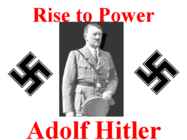
job at all. Military Record • Was awarded the Iron Cross twice. (5 medals overall) • Highest military honor in German Army. • Single handedly captured 4 French soldiers. • Blinded by gas attack towards end of war. German Loss in WW I • Hitler was devastated when he heard the news of the German surrender. • He was appalled at the anti-war sentiment among the German civilians. • Believed there was an anti-war conspiracy that involved the Jews and Marxists. • Also, felt that the German military did not lose the war, but that the politicians (mostly Jews) at home were responsible for the defeat. Life after WW I • Hitler was depressed after WW I. • Still in the army, he became an undercover agent whose job was to root out Marxists • Also, lectured about the dangers of Communism and Jews German Worker’s Party • Hitler was sent to investigate this group in Munich in 1919. • He went to a meeting
Vanasti oli ikka parem - inimesed tootsid enda jaoks, ilma turu vahenduseta, olid meistrid oma alal. Veidi ülepingutatud? Sest lõppeks nägi ka Marx ette, et eesmärgiks on asjade tootmine oma vajaduste rahuldamiseks, kogu maailma kasutamine loovalt. 8. Millisena näevad tarbijat ja tarbimisühiskonda Frankfurti koolkond? Mis probleeme tõstatab sellest tulenevalt Herbert Marcuse? The Frankfurt School gathered together dissident Marxists, severe critics of capitalism who believed that some of Marx's followers had come to parrot a narrow selection of Marx's ideas, usually in defense of orthodox Communist or Social-Democratic parties. Influenced especially by the failure of working-class revolutions in Western Europe after World War I and by the rise of Nazism in an economically and technologically advanced nation (Germany), they took up the task of choosing what parts of Marx's
of Frankfurt am Main in Germany when Max Horkheimer became the Institute's director in 1930. The term "Frankfurt School" is an informal term used to designate the thinkers affiliated with the Institute for Social Research or who were influenced by it. It is not the title of any institution, and the main thinkers of the Frankfurt School did not use the term to describe themselves. The Frankfurt School gathered together dissident Marxists, severe critics of capitalism who believed that some of Marx's followers had come to parrot a narrow selection of Marx's ideas, usually in defense of orthodox Communist or Social-Democratic parties. Influenced especially by the failure of working-class revolutions in Western Europe after World War I and by the rise of Nazism in an economically and technologically advanced nation (Germany), they took up the task of choosing what parts of Marx's
 annaabi.ee