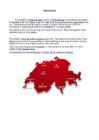
Schwitzerland Switzerland is a landlocked alpine country in Western Europe . Switzerland is surrounded by Germany to the north, France to the west, Italy to the south and Austria and Liechtenstein to the east. Switzerland is one of the smallest countries in Europe. With an area of 41285 km² Switzerland is smaller than Estonia, but the population is 7,6 million people. Switzerland is well known for the Alps in the south of the country . Most of the population lives north from Alps, on Swiss plateau
Van Gogh collections in the world. · Hollanders usually have a bunch of flowers in their living rooms. · The landscape of Holland is dotted with windmills, which have become its hallmark. · The country has over 4,400 km of navigable rivers, canals and lakes. · The kapital of Neatherland is Amsterdam. There are no more bridges than any other city in the world. · Neatherland`s national flowers are tulips. LUKSEMBURG/ Luxembourg · Luxembourg is a small landlocked country, located in Western Europe · It is one of the smallest countries in Europe as well as the world. · Victor Hugo, the renowned French writer, stayed in Luxembourg in a picturesque town that lies close to the German border. The house where he lived has now been turned into a museum, which is very popular among the French and Dutch tourists. · The national flower is rose. · The national bird is Goldcrest (Regulus regulus) BELGIA/ Belgium
Bohemia, to the west, consists of a basin drained by the Elbe (Czech: Labe) and the Vltava (or Moldau) rivers, surrounded by mostly low mountains, such as the Krkonose range of the Sudetes. The highest point in the country, Snzka at 1,602 m (5,256 ft), is located here. Moravia, the eastern part of the country, is also quite hilly. It is drained mainly by the Morava River, but it also contains the source of the Oder River (Czech: Odra). Water from the landlocked Czech Republic flows to three different seas: the North Sea, Baltic Sea and Black Sea. The Czech Republic also leases the Moldauhafen, a 30,000-square-metre (7.4-acre) lot in the middle of the Hamburg Docks, which was awarded to Czechoslovakia by Article 363 of the Treaty of Versailles, to allow the landlocked country a place where goods transported down river could be transferred to seagoing ships. Phytogeographically, the Czech Republic belongs to the Central European province of the
Then power would be shifted back to the engine. 8 3. Research advances so far 3.1 A functional 32 MJ railgun weapon In 2009 BAE Systems delivered a functional, 32 megajoule Electromagnetic Laboratory Rail Gun (32/MJ LRG) to the U.S. Naval Surface Warfare Center. The U.S. Navy's experimental railgun is getting new upgrades to make it fire more powerful shots, and fire them faster. It's the latest bit of progress on this still-landlocked weapon, but when and where it actually would be installed on a warship is not clear. The goal, according to Tom Beutner, head of Naval Air Warfare and Weapons for the ONR, is ten shots per minute at 32 megajoules. One way of looking at it is that a .22 bullet has 1,000 foot- pounds aka 1356(Nm) of force at the muzzle. A 32 megajoule railgun shot: 23,601,988 foot- pounds aka 3.200000e(plus)7(Nm). The existing railgun works by using extremely high electrical currents to generate magnetic
questions. - Difference between pilot and captain: pilots are provided for unusual places of navigation, not permanent member of the crew. Provided by the port to get into the port, etc. From the other hand, the law of the sea covers: Delimitation of marine boundaries, legal status of different marine zones, nationality of the ships, legal status of civil and military ships, freedoms of high seas, marine scientific research; rights of landlocked states; question of piracy. When talking about PIL, we are talking about law of the sea. Here, all measurements are done in nautical miles: 1853,6 m = 1nm. Also known as sea mile, geographical mile, admiralty mile. For information: 1609 m = 1 lm, land mile, English mile, statute mile. All measurements to make delimitation of boundaries are taken from base lines. The seashore is a normal base line, so you measure the necessary NM from the base line, e.g. territorial sea is 12
 annaabi.ee