http://en.wikipedia.org/wiki/Newfoundland_and_Labrador#/me dia/File:Newfoundland_and_Labrador_in_Canada.svg FLAG http://en.wikipedia.org/wiki/List_of_premiers_of_Newfoundland_and_Labrador POPULATION · In 2013 526 702 people · 92 % of population on the Newfoundland · 40% on population in St. John's city · 97.6% of residents reporting English as their mother tongue · In Labrador local dialects of Innu-aimun and Inuktitut are also spoken. CULTURE · Folk musical heritage based on the Irish, English and Scottish traditions · Much of the region's music focuses on the strong seafaring tradition · Ice Hockey · Soccer, rugby http://www.stjohnsicecaps.com/team/ LANDSCAPE / http://www.nlreda.ca SOURCES · http:// en.wikipedia.org/wiki/Newfoundland_and_ Labrador · http://www.newfoundlandlabrador.com/ · http://www.nlreda.ca/ · http:// en.wikipedia
Teine tase Kolmas tase Neljas tase Viies tase Muutke teksti laade Teine tase Kolmas tase Neljas tase Viies tase About 83% of the people living there are Inuit. Inuit, French, and English are the official languages. About 70% of the people speaks inuktitut and only 27% English. Inuit man Muutke teksti laade Teine tase Kolmas tase Neljas tase Viies tase Muutke teksti laade Teine tase Kolmas tase Neljas tase Viies tase Music Inuit throat singing Drumled dancing Thanks for listening!
to learn more about traditional Inuit ways of life, and how Inuit culture has been changed over the past century. Geography Inuit communities are found in the Arctic, in the Northwest Territories, Labrador and Quebec in Canada, above tree line in Alaska (where people are called the Inupiat and Yupik), and in Russia (where people are called the Yupik people). In some areas, Inuit people are called "Eskimos" however many Inuit find this term offensive. The word "Inuit" means "the people" in the Inuktitut language. Inuit Homes In the tundra, where Inuit communities are found, there are not many building materials. No trees grow in the tundra so houses can not be made from wood unless it is transported from elsewhere. However, during a large part of the year, the cold part, there is a lot of snow in the tundra. And it turns out that snow can be a very good construction material. In the winter, Inuit lived in round houses made from blocks of snow called "igloos"
Other provinces have no official languages as such, but French is used as a language of instruction, in courts, and for other government services in addition to English. Manitoba, Ontario and Quebec allow for both English and French to be spoken in the provincial legislatures, and laws are enacted in both languages. In Ontario, French has some legal status but is not fully co-official. Several aboriginal languages have official status in Northwest Territories. Inuktitut is the majority language in Nunavut, and one of three official languages in the territory. Non-official languages are important in Canada, with 5,202,245 people listing one as a first language Some significant non-official first languages include Chinese (853,745 first- language speakers), Italian (469,485), German (438,080), and Punjabi (271,220). The population clock counts are based on Preliminary Postcensal Estimates as of July 1st, 2007
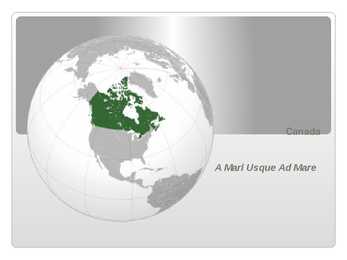
Canada A Mari Usque Ad Mare Official language(s) English, French Inuktitut, Inuinnaqtun, Cree, Recognised regional languages Dëne Sliné, Gwich'in, Inuvialuktun, Slavey, Tlch Yatiì Languages in Canada North American country consisting of ten provinces and three territories located in the northern part of the continent, it extends from the Atlantic Ocean in the east to the Pacific Ocean in the west, and northward into the Arctic Ocean spanning over 9
Indians in everyday conversation. They are still legally categorized by the Canadian Government under the Indian Act as Status Indians. Those who have lost their legal status are called Non-Status Indians. Prime Minister Pierre Trudeau tried to get rid of the Indian Act, but First Nations political groups insisted on keeping it, because it defines their special status. The Inuit are the people who originally lived in the Arctic. Their language is Inuktitut, but it has several dialects the differ considerably from place to place. The Métis, are the group of people who resulted from the mixing of European and Native men and women. The Métis developed a unique culture that included elements of both European and Native ways and artifacts (clothes, tools, means of travel, etc.). They pride themselves on their distinctiveness from both the cultures from which they are descended. 3. From where have the Indians come to Canada? When?
Inuvik, in the Mackenzie delta, can be reached by road, and every community is served by air. Most have electricity, stores and health services. North of the mainland is a maze of islands separated by convoluted straits and sounds, the most famous of which link together to form the fabled Northwest Passage, the route to the Orient sought by so many early explorers. Reflecting a growing autonomy, the Inuit (formerly known as Eskimos) are gradually changing place names into their language, Inuktitut. For example, the people of Frobisher Bay on Baffin Island, Nunavut, decided to rename their community Iqualuit, which means "place of fish." Used materials: http://www.nationsencyclopedia.com/economies/Americas/Canada.html http://www.google.ee/#hl=et&q=Canada+relief&lr=&aq=f&oq=Canada+relief&fp=9d88 a292ff611cf4 http://www.members.shaw.ca/kcic1/geographic.html http://www.nationsencyclopedia.com/economies/Americas/Canada.html (I also used the
 annaabi.ee