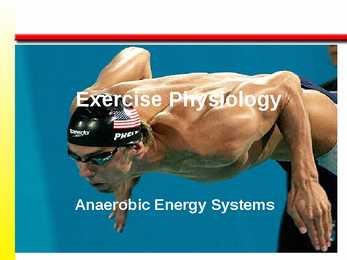
Exercise Physiology Anaerobic Energy Systems Anaerobic Pathways · Anaerobic Glycolysis (lactate system) 10 s to 2 minutes. · ATP-PCr (phosphate system) Less than 10 s · 200 m Sprint (50-100 m Sprint swimming) Men's WR:19.32 s - Michael Johnson (37.3 km/h) Women's WR: 21.34s - Flo Griffith-Joyner (34 km/h · Energy system: The lactate system · Fuel: Carbohydrate only Anaerobic Glycolysis · Breakdown of glucose or glycogen via special glycolytic enzymes. · First glucose or glycogen must be converted to Glucose 6-phosphate. Glucose to glucose 6-phosphate costs 1 ATP · Glycolysis produces pyruvic acid, without oxygen pyruvic acid is converted to lactic acid. · Net gain 3 moles of ATP (glucose = 2 ATP) Anaerobic Glycolysis · Reserve fuel activated when a person accelerates during race, during the last 200 m of a mile run, or performs
välja paistavad. Vastavalt oma laisale loomusele, on marmorrail madal vere hapniku sisaldus ning pulss (10-15 lööki minutis). Liik suudab isegi ellu jääda tingimustes kus hapniku tase vees on väga madal, nt mõõna ajal olevates lompides. Rai lõpetab täielikult hingamise kui hapniku osarõhk langeb alla 10-15 Torri, ja ta saab elus olla sellises seisundis vähemalt 5 tundi. It deals with extreme hypoxia by coupling anaerobic glycolysis to additional energy-producing pathways in its mitochondria, which serves to slow down the accumulation of potentially harmful lactate within its cells. Nagu ka teised liigid tema perekonnas, suudab ka marmorrai toota tugevat elektrilaengut läbi ühe paari elektriorganite, ründeks ja kaitseks. Iga organ koosneb 400-600 vertikaalsest sambast, igas sambas on hoidla milles on umbkaudu 400 tarretise laadset "elektroplaati" mis põhimõtteliselt töötab nagu üks patarei
eco+b2097 Drosophila melanogaster: http://www.kegg.com/dbget-bin/www_bget?dme+Dmel_CG6058 Homo sapiens: http://www.kegg.com/dbget-bin/www_bget?hsa+226 Püruvaatkinaas : Escherichia coli K12 MG1655: http://www.kegg.com/dbget-bin/www_bget?eco+b1676 Drosophila melanogaster: http://www.kegg.com/dbget-bin/www_bget?dme+Dmel_CG7069 Homo sapiens: http://www.kegg.com/dbget-bin/www_bget?hsa+5313 c. Leida, milliste teiste metaboolsete radadega antud ensüümid on seotud. Aldolaas: Glycolysis / Gluconeogenesis http://www.kegg.com/dbget-bin/show_pathway?map00010+4.1.2.13 Pentose phosphate pathway http://www.kegg.com/dbget-bin/show_pathway?map00030+4.1.2.13 Inositol metabolism http://www.kegg.com/dbget-bin/show_pathway?map00031+4.1.2.13 Fructose and mannose metabolism http://www.kegg.com/dbget-bin/show_pathway?map00051+4.1.2.13 Carbon fixation http://www.kegg.com/dbget-bin/show_pathway?map00710+4.1.2.13 Püruvaatkinaas: Glycolysis / Gluconeogenesis http://www.kegg
phosphocreatine, glycogen, glucose lactate, reversible and phosphocreatine supplies free fatty acids, and triglycerides. Glucose can be readily restored when ATP demand and glycogen are the preferred substrates for is low. In living muscle, when activity is muscle metabolism and can be utilized either intense, this system can be advantageous, as aerobically (oxidative phosphorylation) or it consumes H+ and thus can reduce the anaerobically (anaearobic glycolysis). Lipid muscle cell acidosis that is associated with and lactate utilization require oxygen. Lipids anaerobic glycolysis. Another advantage of are a very energy-dense storage system and the system is that the catalyzing enzyme is are very efficient with respect to the high located very close to the actomyosin ATPase amount of ATP that can be generated per unit and also at the sarcoplasmic reticulum (where of substrate
 annaabi.ee