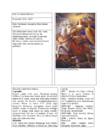
astumist Louis VII nime all tuntakse. Eleanor oli 1147-1149 - Teine ristisõda, Edessa abielludes vaid 15-aastane. Paar elas Prantsusmaal tagasivallutamiseks ning neil sündis kaks tütart. 1159 - Lübecki linnas sai alguse Ristisõda Hansa Liit 1147. aastal läks Eleanor abikaasaga koos sõdima 1162 - sündis Genghis Khan, Teise ristisõtta. Võitlustes ei läinud neil hästi ning Mongolite impeeriumi rajaja ka paari omavahelised suhted üha halvenesid. 1163 - paika pandi esimene Suurimaks tülipõhjustajaks oli Eleanori onu, keda nurgakivi Notre Dame’i kiriku jaoks sõjateel kohati. Eleanori ja onu kohta hakkasid 1170 - Canterbury peapiiskop liikuma kuulujutud, mis Louis’i armukadedaks Thomas Becketi mõrv muutsid
Originaal Kunstniku poolt tehtud teos. Näiteks: Leonardo da Vinci ,,Mona Lisa" , asub Louvres. Sixtuse kabeli laemaal, Michelangelo. Köler ,,Ketraja" Monument on mälestussammas,ausammas ehk mälestusmärk mis on mingi ajaloolise sündmuse või isiku , kes on olululine ühele või mitmele sotsiaalsele grupile , mälestuse jäädvustamiseks loodud skulpturaalne kunstiteos. Maailma tuntuimad monumendid: Genghis Khani monument Mongoolias Vabadusesammas New Yorkis Peeter 1se monument Peterburis Väike Merineitsi Taanis Eestis olevad monumendid: Vabadussammas Vabaduse väljakul Russalka Pirita tee alguses Kindral Laidoneri Mälestussammas Juhan Smuuli monument Muhus Marinist meremaalimisega tegelev kunstnik. N: Aivazovski (Vene), William Turner(Inglise) Koopia on täpne jäljend kunstiteosest ,mis vastab originaalile nii sisult kui ka vormilt. Kuid ka kunstnik ise võib teha oma tööst koopia
period of time. The standard distinction between serial killing and multiple murders is that serial killers murder three or more people within the time frame of one month (3). A serial killer will murder 12 people over the course of 4 months or so; a mass murderer 1 will do so in the matter of moments. II. Serial killing history Looking back in history we can easily see mass murderers - from Hitler to Genghis Khan, the most notorious criminal murderers were generally warmongers. However, serial killers before the 1900s are much less publicized. One of the earliest known serial killers was Gilles de Rais, who terrorized his community in the 15th century. The man "raped, mutilated, and murdered an estimated 150 children (though some estimates put that number over 800)" over the course of about 20 years (4). He was executed in 1440 as perhaps one of the world's earliest serial killers.
Meanwhile the power that finally led to the creation of the Mongol Empire arose in Asia. Many of the Mongol standards displayed a device, a `flaming trident', reproducing the blades of a trident with flames surrounding them. The flag of the Khan himself consisted of nine yak-tails hanging from a rack of crossbars. After the conquest of China lateral flags were used, still with the horsetail and the flaming trident. The use of flags by the forces of Genghis Khan (ca 1155-1227) was significant for the development of a world-wide flag tradition in that a special flag, actually called `banner', came to be connected with each regiment. It reads: "White are our deeds, black our fields of battle; our pastures are green, but our swords are red with the blood of the enemy ". A banner refers to a cloth stretched between two anchor points bearing a slogan or a flag with heraldic arms, or a flag carried by a military unit. (Brown, 1994)
The sufferers of bulimia will often make themselves vomit so they can continue eating. Their mind is hungry, not their body. This eating disorder would become healed if the sufferers, instead of being identified with their mind, could get in touch with their body and so feel the true needs of the body rather than the pseudo- needs of the egoic mind. Some egos know what they want and pursue their aim with grim and ruthless determination – Genghis Khan, Stalin, Hitler, to give just a few larger-than-life examples. The energy behind their wanting, however, creates an opposing energy of equal intensity that in the end leads to their downfall. in the meantime, they make themselves and many others unhappy, or, in the larger-than-life examples, create hell on earth. Most egos have conflicting wants. They want different things at different times or may not even know what they want except that they don't want what is: the present moment.
campaign, he subsequently lost the battle of Leipzig, which led to his being exiled to the island of Elba. And finally, he lost at the battle of Waterloo due to a series of miscommunications with his field generals. It is often forgotten that he won many other battles, small and large, and is considered to be one of the three greatest military ge- niuses of history. (Alexander the Great and Genghis Khan were the other two.) Napoleon had developed a quality that helped him to achieve victory, which you also can develop. It is called extrapolatory thinking. This is the ability to think and plan several moves ahead in whatever you are doing. This way of thinking involves your consid- ering every possible event that could occur, and then making provi- sions for them, well in advance.
explain how he is able to become the monstrous, more-than-half-machine that is D a r t h Vader. T h e complex chronology of the films places the watcher of the prequels in a curious position. On the one hand, young Anakin seems to be doing the archetypal job of the hero, as the primary active character and someone whose fate we should care about. But it's very difficult to identify fully with a character who we know will turn out to be a science fiction equivalent of Hitler or Genghis Khan, even if we know he will be ultimately redeemed. T h o u g h the prequel films performed extremely well at the box office, the dramatic experience of watching them was necessarily muted by the knowledge that their principal hero is fated to be a despicable villain. M a n y people watched the prequel films with a certain detachment, unable to get behind the hero's struggles as they had with Luke Skywalker's in Episodes IV-VL
 annaabi.ee