French 7.What was the role of church in the middle ages? Back during the Middle Ages religion played a major role in the daily life of the Europeans. The major religion that ruled Europe during this time was Christianity. The only church that existed during the Middle Ages was the Catholic Church. The Catholic Church had a great control over the European people. The church was very powerful and could even control the kings of the land. 8.What was the social system like? Who were serfs and freemen? There was a very distinctive social class system during the Middle Ages. Most Medieval people were peasants, over 90%, but the divide between peasants and nobility was very clear-cut. The people were divided into royalty (kings, queens), nobility, hereditary nobility (dukes, barons), non-hereditary nobility (knights, peasants, freemen, slaves.) Serfs had no political power and were not allowed having control of property. They lived on the property of
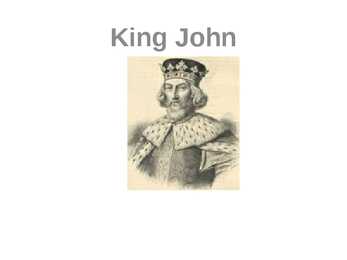
John died in October 1216 His brother was King Richard I King John nick-name was John Lackland. He had intelligence, administrative ability and he was good at planning military campaigns. The Magna Carta I, King John, accept that I have to govern according to the law. So I agree: 1. Not to imprison nobles without trial 2. That trials must be in courts; not held in secret by me 3. To have fair taxation for the nobles 4. To let freemen travel wherever they like 5. Not to interfere in Church matters... Rule King John ruled 1199 to 1216. He faced the following problems. Problems 1. John raised taxes in England to pay for the wars. This upset his BARONS! He ordered them to pay far more tax than earlier kings had done! 2. John went to war twice against the French king. His army was badly beaten both times
It was made up of barons, bishops and abbots as usual, but also included 2 knights from every hire and 2 burgesses from every borough. Many nobles didn't support Simon de Montfort, a civil war broke out. De Montfort was defeated and killed. In 1295 Henry III's son Edward I brought together the ,,represantive institution", ,,Model Parliament", the 1st to include nobles, clergy & commoners. It was a mixture of ,,gentry" knights & wealthy freemen from the shires & merchants from the towns. He divided Parliament into 2 parts the nobles formed the House of Lords, the other part was called the House of Commons (middle class). Edward I became king at the age of 35. He was a fine warrior & won the respect of his subjects. He was very tall & strong and his nickname ,,Longshanks" referred to his long legs. He was married twice. From his 1st marriage (Eleanor
Africa, citing the countries of Senegal and Mali. In these areas, it is believed that in the 11th century is when Creolism began. In search of new lands, ideas, riches, knowledge and to dispute the philosophers and historians, men became brave explorers. It is through their discoveries that these varying cultures co-existed in harmony to form the structure of Creolism. It is documented in the records of history that Creoles of Senegal, whether as freemen or as slaves, traveled directly from Senegal and Mali to Louisiana. People The term Creole and its cognates in other languages -- such as crioulo, criollo, créole, kriolu, criol, kreyol, kriulo, kriol, krio, kreol, etc. -- have been applied to people in different countries and epochs, with rather different meanings. Those terms are almost always used in the general area of present or former colonies in other continents, and originally referred to locally born people with foreign origin.
And where is that band who so vauntingly swore That the havoc of war and the battle's confusion A home and a country should leave us no more? Their blood has washed out their foul footsteps' pollution. No refuge could save the hireling and slave From the terror of flight, or the gloom of the grave: And the star-spangled banner in triumph doth wave O'er the land of the free and the home of the brave! 22 Oh! thus be it ever, when freemen shall stand Between their loved homes and the war's desolation! Blest with victory and peace, may the Heaven-rescued land Praise the Power that hath made and preserved us a nation. Then conquer we must, for our cause it is just, And this be our motto: "In God is our trust." And the star-spangled banner in triumph shall wave O'er the land of the free and the home of the brave! 23
They were freeman farmers who rented landlords’ land and bit by bit added to their holdings, and gentleman farmers or landed gentry, that is the knights who devoted themselves to farming. Kings Need Money By the late thirteenth century the king could only raise most of his income by taxation. And taxes could be raised with the agreement of those wealthy enough to be taxed – the merchants in towns and the landed gentry and other wealthy freemen in the country. These were the two classes of people who produced and controlled England’s wealth. There was an increasing necessity in a representative institution whose members chosen by the shires and towns would link the king with these classes. The Great Charter In 1215, King John2 was forced by the powerful barons to sign Magna Carta, the Great Charter, which promised all freemen protection from his officers and the right
 annaabi.ee