Description The eastern border of Livonia was mainly formed already in the first half of the 13th century and the first belt of fortresses here was probably ready by the end of the 13th century. The first fortresses were not built on the border but further inland. The first decades of the 14th century brought no changes in the situation. Early in 1340 the relationship with Russians deteriorated again. Provincial master Burchard von Dreileben planned a campaign against Pskov and demanded the help of Tartu bishopric. The provincial master began to build another belt of border fortresses. On the Annunciation Day, March 25, 1342, the building of fortresses in Marienburg and Vastseliina began
Firstly I Would like to recomend to visit Old Town, it is wery beautiful, interesting and ancient. You can taste national food and buy souvenirs. In my opinion the best time for visiting is winter, because of chistmas spirit and fair. Secondly I would like to recomend to visit Estonia theater and opera house. There is a variety of plays, operas and balley. The building is outstanding and miracoulus appearences. Thirdly I would like to recomend to visit acient fortresses like castles : Narva and Rakvere In Rakvere you can ride a horse, make crossbow fhooting, made a coin, see historicas swords, visit wine cellar and tortuure chamber. Also I would like to recomend Georg Otsa SPA Hotel, Because Saaremaa( Kuressaare) is outstanding, the air is clean, beautiful beach and warm water. SPA procidures are gate and hotel wonderful. I would not recomend to visit suborbs, because there is boring and nothing to look at. If you
· Both sides of the · West: The Hindu river thrived. rainfall. Kush provide protection from enemies. People Cities Achievements · Population grew · Harrapa · Wells and indoor in the Indus plumbing River Valley. · Mohenjo Daro · Pottery, cotton · Growth came as · Fortresses for clothing, jewelry irrigation and defense against farming enemies · India's first writing techniques system · Wellplanned improved. public areas · Cities were built as surplus food was produced. · Place in society based on · Sutras (guides) listed all
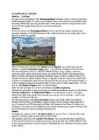
After that will will spent a lot of time in the famous Londons Aquarium. Certainly we would like to have an overview of London and therefore we will visit the British Airways London Eye or Millennium Wheel, as it is also known which is the largest observation wheel in the world. On a clear day you can see as far as 25 miles which is far enough to see the sea in the east. We will end our day in the Tower of London which is one of the world's most famous fortresses and has been a royal palace, a prison, a place of execution,an armory and even a zoo. Constructed over 900 years ago by William the Conqueror, the Tower of London has a rich history. This fortress was expanded by many medieval kings and is a grand structure used by Royals through the years as a refuge and powerbase. Sunday On sunday we will go at first to St. James's Park. St. James's Park is both the oldest and smallest of London's parks, built by Henry VIII in 1536.
escalators, this is one of the most accessible theatres in Britain today. Tower of London The ancient stones reverberate with dark secrets, priceless jewels glint in fortified vaults and ravens strut the grounds. The Tower of London, founded by William the Conquerer in 1066-7, is one of the world´s most famous fortresses, and one of Britain ´s most visited historic sites. Despite a grim reputation for a place of torture and death, there are so many more stories to be told about the Tower. This powerful and enduring symbol of the Norman Conquest has been enjoyed as a royal palace,
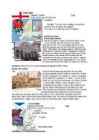
Town, which were separated by a dividing wall since medieval times. The elevated area of Toompea Hill with its castle was occupied by the residences of Tallinn's rulers and gentry. The Lower Old Town meanwhile developed as an autonomous merchantile centre, flourishing during the 13th-16th centuries, when the city enjoyed membership of the powerful Hanseatic Trading League. Generally speaking these two districts are now collectively referred as the Old Town. The Town wall and towers Medieval fortresses, which emerged during the development of the medieval town at the end of the 13th century, surrounded the city centre as a closed defence zone. By the 16th century, Tallinn's defence system was one of the most powerful in Northern Europe. The city wall was three meters thick, sixteen meters high, and four kilometres long, completely encircling the city with 46 defence towers. The portion of the wall that has survived is two kilometres long, encompassing 26 of the original towers.
Since successive monarchs have modified it and added to it, most of the architectural styles popular over the centuries can be found within The Tower's walls. The Tower has been used as fortress, a palace, and a prison. It has housed the Royal Mint, the Public Records, and the Royal Observatory. And from the 13th century until 1834 it housed the Royal Menagerie. For centuries it was the arsenal for arms and armour. And, since it is one of the strongest fortresses in England, it has guarded and continues to guard the crown jewels. The Tower was occupied as a palace by all the Kings and Queens down to James I. It was customary for each monarch to lodge in the Tower before his coronation and to ride in procession to Westminster through the city of London from the Tower. John Stow wrote during the reign of Elizabeth I, The Tower of London was "...a citadel to defend or command the
Thanks to the mediation of Nicolaes Witsen, mayor of Amsterdam and expert on Russia, the Tsar was given the opportunity to gain practical experience in the largest shipyard in the world, belonging to the Dutch East India Company, for a period of four months. The Tsar helped with the construction of an East Indiaman especially laid down for him: Peter and Paul. During his stay the Tsar engaged many skilled workers such as builders of locks, fortresses, shipwrights, and seamen--including Cornelis Cruys, a vice-admiral who became, under Franz Lefort, the Tsar's advisor in maritime affairs. Peter later put his knowledge of shipbuilding to use in helping build Russia's navy. Peter paid a visit to Frederik Ruysch, who taught him how to draw teeth and catch butterflies. Ludolf Bakhuysen, a painter of seascapes. Jan van der Heyden, the inventor of the fire hose, received Peter, who was keen to learn and pass on his knowledge to his countrymen
unfamiliar with it, continued using the old system. And their work was made almost mechanical when the headquarters of a Russian guard detachment that was being joined to the 8th Army compromised the new system by a message in clear. A great hubbub arose in the 8th Army; a new code was instituted; this one cryptanalysts solved without much trouble. By then they were reading up to 70 Russian dispatches a day. The German solutions seem to have been made in the radio stations of the various fortresses, to which Deubner communicated the keys as he solved them. Some of the Austrian cryptanalysis was done at Ronge's Austro-Nord Penkala under the command of Captain Karl Boldeskul. Later in the war, when Pokorny was promoted to head of the whole Kriegschiffregruppe, the Russian subsection of the Dechiffrierdietist at headquarters was taken over by von Marchesetti; in 1918 Rudolf Lippmann succeeded him. On November 6, 1916, the Russian Army of the Danube suppressed the radio use of cipher No
Whichof the castles Dunnotar Castle 1 was usedto hidesth precious? past. theScottish . cliffs. exciting CrownJewels . the strongest . lodgingsr stables 2 hasa specialstone? fortresses G-] o storehouses . oooular 3 isassociatedwith a famousfilm star? l p l Blarney Castle withbirdwatchers touristattroction. isa famous 4
Whichof the castles Dunnotar Castle 1 was usedto hidesth precious? past. theScottish . cliffs. exciting CrownJewels . the strongest . lodgingsr stables 2 hasa specialstone? fortresses G-] o storehouses . oooular 3 isassociatedwith a famousfilm star? l p l Blarney Castle withbirdwatchers touristattroction. isa famous 4
Whichof the castles Dunnotar Castle 1 was usedto hidesth precious? past. theScottish . cliffs. exciting CrownJewels . the strongest . lodgingsr stables 2 hasa specialstone? fortresses G-] o storehouses . oooular 3 isassociatedwith a famousfilm star? l p l Blarney Castle withbirdwatchers touristattroction. isa famous 4
Whichof the castles Dunnotar Castle 1 was usedto hidesth precious? past. theScottish . cliffs. exciting CrownJewels . the strongest . lodgingsr stables 2 hasa specialstone? fortresses G-] o storehouses . oooular 3 isassociatedwith a famousfilm star? l p l Blarney Castle withbirdwatchers touristattroction. isa famous 4
 annaabi.ee