American Art Revision Materials Colonial Period Portraiture. The first typically American paintings were illustrated maps but painting remained scarce during C17. There were 4 reasons: settlers came from backgrounds where art was unusual, Protestant attitudes was averse to imagery and painting, the English were not yet distinguished in visual arts and religious art was non-existent. The colonial period is almost entirely limited to portraiture (deemed as `useful' by settlers). These first paintings were made by limners and artisans without formal training and were based on what was popular in England during the Tudors. The paintings are technically unskilled, strongly patterned, flat and linear. Spanish painting in America was mostly religious. In C18, painting was a luxury and necessitated wealth that had by then become available. Portraitures remained at the forefront because the rich could thusly display their status and becaus...
American Art Revision Materials Colonial Period Portraiture. The first typically American paintings were illustrated maps but painting remained scarce during C17. There were 4 reasons: settlers came from backgrounds where art was unusual, Protestant attitudes was averse to imagery and painting, the English were not yet distinguished in visual arts and religious art was non-existent. The colonial period is almost entirely limited to portraiture (deemed as `useful' by settlers). These first paintings were made by limners and artisans without formal training and were based on what was popular in England during the Tudors. The paintings are technically unskilled, strongly patterned, flat and linear. Spanish painting in America was mostly religious. In C18, painting was a luxury and necessitated wealth that had by then become available. Portraitures remained at the forefront because the rich could thusly display their status and becaus...
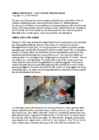
AMBER AND RUSSET - LATE COLOUR CHANGE GENES Copyright 2014, Sarah Hartwell The ancestors of the domestic cat were nondescript black/brown striped tabbies. Over the centuries, mutation produced a wide array of colours based on 2 different pigments. Eumelanin gives the blacks, browns and blues while phaeomelanin gives the reds, fawns and creams. A few other genes give further variations on those colours such silvers, colourpoints and solids/selfs. Mutations continue to occur and unexpected colours also turn up due to inbreeding where recessive genes, hidden for generations, start showing up. AMBER AND LIGHT AMBER During the 1990s, some purebred Norwegian Forest Cats in Sweden produced chocolate/lilac and cinnamon/fawn offspring. However, those colours are not found in the purebred Norwegian Forest Cat gene pool. Had the gene pool become polluted by someone, perhaps generations ago, breeding their Norwegian Forest Cat to another breed? ...
Maturita Solutions Advanced Workbook Key stand bananas and coffee! It's a bit 3 1 to 8 of Unit 1 uncanny really. Is it something she's 2 about 9 century passed on to me genetically, or is it 3 like 10 assumed / 1A Memories page 3 learned behaviour? Who knows? 4 of thought / 1 See exercise 2 2 5 6 any ...
 annaabi.ee