‘Spiegel im spiegel’ saksa keelest otse tõlgituna tähendab “Peegel peeglis”, viidates paralleelselt seisvatesse peeglitesse tekkivate kujundite lõpmatusele. Teoses viitavad sellisele efektile kolmkõlad, mis korduvad lõputult väikeste variatsioonidega, peegeldudes edasitagasi. Kohata võib teda välismaistes filmides nagu näiteks “About time”, “The east”, “Mother night”, “Elegy”, “Burning man”, “The way he looks”. Teatris võib kuulda seda taustaks mängimas etendustele “Eurydice” ning balletile “After the rain”. Tintinnabul on eksisteerinud vaid veidi üle veerandsajandi ning see on kogunud juba hulgaliselt tuntust ning leiab aasta aastalt üha laiahaardelisemalt kasutust. Helilooja Arvo Pärt on oma
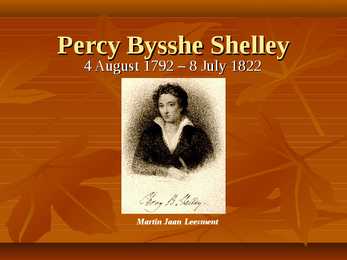
In the autumn of 1815 he wrote Alastor, or The Spirit of Solitude Shelley's estranged wife Harriet drowned herself and custody of the children was given to foster parents Contact with Byron encouraged Shelley to write again (Julian and Maddalo) The Shelleys travelled around various Italian cities Spent the summer of 1819 writing a tragedy, The Cenci, in Livorno Inspired by the death of Keats, in 1821 Shelley wrote the elegy Adonais Shelley, Byron and Hunt wanted to establish a journal, that would be called The Liberal On 8 July 1822 Shelley drowned A mass of evidence that Shelley may have been murdered Was cremated on the beach near Viareggio After his death The Courier gloated: "Shelley, the writer of some infidel poetry, has been drowned, now he knows whether there is a God or not." Shelley's heart was later buried with the body of Sir Percy Florence Shelley, his son
to Catherine--why he continues to swear his love even after Catherine insists that he stop playing. In his fondness for Catherine, Henry reveals a vulnerability usually hidden by his stoicism and masculinity. The quality of the language that Henry uses to describe Catherine's hair and her presence in bed testifies to the genuine depth of his feelings for her. Furthermore, because he allows Henry to narrate the book, Hemingway is able to suffuse the entire novel with the power and pathos of an elegy: A Farewell to Arms, which Henry narrates after Catherine's death, confirms his love and his loss. Catherine Barkley - Much has been written regarding Hemingway's portrayal of female characters. With the advent of feminist criticism, readers have become more vocal about their dissatisfaction with Hemingway's depictions of women, which, according to critics such as Leslie A. Fiedler, tend to fall into one of two categories: overly dominant shrews,
It was written in response to his friend Thomas Love Peacock's article The Four Ages of Poetry, where Peacock claimed that poetry though beautiful is utterly useless. Shelley argues that poetry brings about moral good, exercises and expands the imagination, and the imagination is the source of sympathy, compassion, and love, which rest on the ability to project oneself into the position of another person. 1822 The triumph of Life an elegy, unfinished, published in 1824 after Shelley died. Characteristics of Shelley's poetry: Themes: beauty, the passions, nature, political liberty, creativity, and the sanctity of the imagination Idealism belief in the goodness of mankind Revolutionary ides about politics, marriage, women Atheism Philosophical relationships Metaphorical language Sensuous aestheticism John Keats was one of the principal poets of the English Romantic movement. During his short life, his work received
her family as the only sensible and rational woman. The sensibility of Marianne and Mrs. Dashwood manifests itself in their excessive mourning over the deaths of the two men, in contrast to Elinor's more silent grief. Not only are they overcome by sadness at the loss of first Old Mr. Dashwood and then Henry, but they then carry on dramatically about having to leave Norland and move to the smaller cottage. Before departing, Marianne wanders the grounds of Norland uttering a histrionic elegy: "Dear, dear Norland... Oh! happy house... And you, ye well-known trees!" Elinor, however, experiences a far more subdued depression--though she is leaving behind not just her home but also a man she has grown to deeply care for and admire. The early chapters also display the wry irony for which Austen is so famous as a novelist. She is unsparingly critical of the characters she dislikes, but conveys her criticism with a pointed subtlety, which makes it all the more forceful. For example,
About the profound areas of experience: love (romantic and sexual), man’s relationship with God. Brief but intense meditations, striking use of wit, irony and wordplay. John Donne: passionate feeling and logical argument are mixed, play of intellect, conceits (extended metaphors), wit, huge range of ideas with startling connections between them, analyses love with different moods (cynicism and profound dedication) The First Anniversary. An Anatomy of the World; The Flea; Love’s Alchemy; Elegy XIX To His Mistress Going To Bed; Holy Sonnets (9, X, XIV); Hymn To God My God, in My Sickness. Francis Quarles: emblem poems Canticle George Herbert: courtly urbanity of language, certain neatness and point, his wit „homely” (simple), sometimes queer, conceits in title. The Dawning; The Altar; The Collar; The Pilgrimage Richard Crashaw: paradoxes, sensuous warmth, conceit as isolated ornament rather than integral part of poem’s meaning
Emerson hailed his work as `the most extraordinary piece of wit and wisdom that an American has yet contributed'. However, other literary critics and the reading public were unimpressed. The Civil War years During the Civil War, Whitman served as a volunteer nurse in military hospitals and as a correspondent for The New York Times. His experience among the wounded inspired him to write two collections of poems: Drum Taps (1865) and Sequel (1865-66), which includes his famous elegy to Abraham Lincoln, `O Captain! My Captain!' Last years He spent the rest of his life working on the subsequent editions of Leaves of Grass, which grew to include 400 poems. His literary achievements were largely disregarded by the public of his day, which was shocked by his frankness in sexual matters and his rough working man image. He held a series of minor posts in Washington and struggled to survive on a meagre income. In 1873 he suffered a paralysing stroke
1 With his last symphonies, Sumera turned into an epic-elegiac-dramatic poly- colourist. Such a style is flexible but the colours cannot replace fixed schematic images. The composer impresses the listener more through the general presentation of the whole. His music is less informative, more cognitive. The Fifth Symphony (1995), commissioned by the Malmö Symphony Orchestra and its chief conductor Paavo Järvi (b. 1962), proceeds with dominating static. A certain sorrow, elegy and mourning mood is prominent. Just at the beginning a question by the heavy brass (F-E-D-E-F-E) is shouted. As an unanswered question, it appears, but vanishes soon without remarkable results. The work is rich in aleatory technique. The three last works of Sumera are introvert and sensitive contemplations and might be called tone poems, sound canvases, musical landscapes. What has been retained from symphony genre principles are the polarities: activity and meditation. 2 In 1
 annaabi.ee