Clash of Civilizations
Clash of Civilizations
The
Clash of Civilizations(
COC) is a hypothesis that
people’s cultural and religi
ousidentitieswill be thepri-
mary source of conflict in the post
-ColdWarworld. It
wasproposedb
ypoliticalscientistSamuelP.Huntingtonin a 1992
lecture[1]
at
t
he
American
EnterpriseInstitute,
whichwasthendevelopedina199
3
ForeignAffairsarti-
cletitled“TheClashofCivilizations?",[2]
in
responseto
hisformerstude
ntFrancis
Fukuyama's
1992
book,
TheEndofHistory and the Last Man.
Huntington later ex- panded his thesis in a 1996
book
The ClashofCiviliza-tions and the
RemakingofWorldOrder.
The phrase itself was earlier usedb
yAlbert Camusin
1946,[3]
and
b
yBernardLewisinanarticleintheSeptem-
ber1990issueo
f
TheAtlanticMonthlytitled“TheRoots
ofMuslimRage”.[4]
Even
earlier,thephraseappearsina
1926bookregardingtheMiddleEastbyBasilMathews:
YoungIsl
amonTrek:AStudyintheClashofCivilizations(p.196).
Thisexpression derivesfromclash of cultures, already
usedduringthecolonialperiodandth
eBelleÉpoque.[5]
1 Overview
Huntington began his thinkingbysurveying thediverse
theories about the nature of global politics in the post- ColdWarperiod.
Sometheoristsandwritersarguedtha
thumanrights,liberaldemocrac
y,andcapitalistfreemar-keteconomy had become the only
remaining ideologi- cal alternativefornations in the
post-ColdWarworld.
Specificall
y,FrancisFukuyamaarguedthattheworldhad
reachedthe
'endofhistory'in
aHegeliansense.
Huntingtonbelievedthat while the age
ofideologyhad
ended, the world had only reverted to a normal state
ofa airs
ffairs
characterizedbyculturalconflict.Inhisthesis,he
arguedthattheprimaryaxisofconflictinthefuturewill be along
cultural and religiouslines.[6]
As an extension, he posits that the concept
ofdi eren
t
ffairs
civilizations,asthehighestrankofculturalidentity,wil
l becomeincreasinglyusefulinanalyzingthepotentialforconflict.
In the 1993
Foreign Affairsarticle, Huntington
writes:
It ismyhypothesis that the fundamental
sourceofconflictinthisnewworldwillnotbe primarily
ideological or primarily economic.
Thegreatdivisionsamonghumankindandthe
dominatingsourceofconflictwillbecultural.
Nation states will remain the
mostpowerfulactors in worlda airs,
ffairs
but the
principal
con-
flictsofglobalpoliticswilloccurbetweenna-
tionsandgroupsofdi erent
ffairs
civilizations.
The
clashofcivilizationswilldominateglobalpol-
itics.Thefaultlines between civilizationswil be
the battle lines of thefuture.[2]
In the end of the article, he writes:
This is not to advocate the desirability of
conflictsbetweencivilizations.Itistosetforthdescripti
ve hypothesis as to what the future may
belike.[2]
Inaddition,theclashofcivilizations,forHuntington,rep-
resentsadevelopmentofhistory.Intheoldtime,thehis-
toryofinternationalsystemwasmainlyaboutthestrug- gles
between monarchs, nations and ideologies. Those
conflictswereprimarilyseenwithinWesterncivilization.
Butaftertheendofth
ecoldwar,worldpoliticshadbeenmovedintoan
ewaspectinwhichnon-Westernciviliza- tions were no more the
exploited recipients ofWesterncivilization but become
another important actorjoining theWestto shape
andmovethe worldhistory.[7]
2 Majorcivilizationsaccording to
Huntington
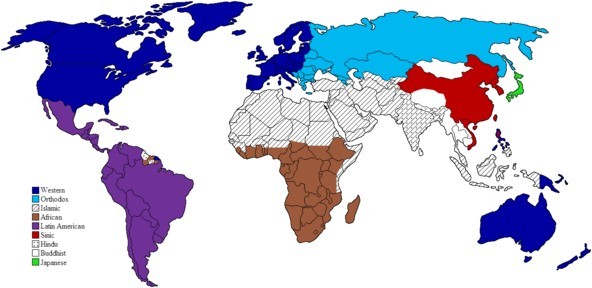
TheclashofcivilizationsaccordingtoHuntington(1996),aspre-
sented in thebook.[8]
Huntington divided the world into the “major civiliza-
tions” in his thesis as such:
•
Westerncivilization, comprising the United States
andCanada,WesternandCentralEurope,Australia
1
2
3HUNTINGTON’S THESISOFCIVILIZATIONALCLASH
and Oceania. Whether Latin America and thefor-
mermemberstatesoftheSovietUnionareincluded, or are instead
their own separate civilizations,will be an important future
considerationforthose re- gions, according to
Huntington. The traditionalWesternviewpoint
identifiedWesternCivilization
with
t
heWesternChristian(Catholic-Protestant)
countries andculture.[9]
•
Latin American. Includes Central America, South
America(excludin
gGuyana,Surinamean
dFrenchGuian
a),Cuba,th
eDominicanRepublic,andMex- ico. May be
considered a part ofWesternciviliza- tion. Many
people
of
t
heSouthern
ConeregardthemselvesasfullmembersoftheWesternc
iviliza- tion.
•
TheOrthodoxworldoftheforme
rSovietUnion,theforme
rY
ugoslavia(excep
tCroatiaandSlovenia),Bulgaria,Cy
prus,GreeceandRomania.
• Countries with a non-Orthodoxmajorityare
usuallyexcluded(Shia
Musli
mAzerbaijan,Sunni
Musli
mAlbaniaand most
ofCentralAsia,
Roman
Catholi
cSloveniaandCroatia,
Protestant and Catholi
cBaltic states). How-
ever
,Armeniais included, despite its domi-
nantfaith,t
heArmenian Apostolic Church,
beingaparto
fOrientalOrthodoxyratherthan
th
eEastern OrthodoxChurch.
•
TheEastern worldis the mix of
t
heBuddhist,Chinese,Hindu, andJaponiccivilizations.
•
TheBuddhistareas
ofBhutan,Cambodia,Laos,Mongolia,Myanm
ar,Sri
Lanka,
a
ndThailandareidentifiedasseparatefromother
civilizations,butHuntingtonbelievesthattheydo not
constitute amajorcivilization in the sense of
internationala airs.
ffairs
•
TheSinic
civilizationof
China,
t
heKoreas,Singapore,Taiwan,a
ndVietnam.
Thisgroup
alsoincludesth
eChinesediaspora,especially in relation
to SoutheastAsia.
• Hindu civilization, locatedchieflyin
India
,BhutanandNepal, and culturally
adhered tobythe globa
lIndiandiaspora.
• Japan,consideredasasocietyandcivilization unique
toitself.
•
TheMuslimworldofth
eGreaterMiddleEast(ex-
cludin
gArmenia,Cyprus,Ethiopia,Georgia,Israel,MaltaandS
outh
Sudan),
norther
nWestAfrica,Albania,Bangladesh,Brunei,Com
oros,Indonesia,Malaysia,Pakistan, andMaldives.
• The civilization
ofSub-SaharanAfricalocated in
SouthernAfrica,MiddleAfrica(excluding Chad),
EastAfrica(excludin
gEthiopia,theComoros,Mau-
ritius,andth
eSwahilicoastofKenyaandTanzania),
CapeVerde,Ghana, t
heIvory Coast,Liberia,
a
ndSierraLeone.Consideredasapossible8thciviliza-
tionbyHuntington.
• Instead of belonging to one of the“major”civi-
lizati
ons,EthiopiaandHaitiare labeled as“Lone”
countries
.Israelcouldbeconsideredauniquestate
withitsowncivilization,Huntingtonwrites,butone
whichisextremelysimilartotheWest.Huntington
alsobelievesthat t
heAnglophone Caribbean,for-
merBritishcoloniesintheCaribbean,constitutesa
distinctentity.
• There are also others which are
considered“cleftcountries”becausetheycontainverylargegrou
psof peopleidentifyingwith separate civilizations. Ex-
amplesincludeIndia(“cleft”betweenitsHinduma-
jorityandlargeMuslimminority)
,Ukraine(“cleft”betwee
nit
sEasternRiteCatholic-dominatedwest- ern section
and
it
sOrthodox-dominated
east),
France(cleftbetween Latin America, in the case
ofFrench
Guiana;
and
theWest)
,Benin,Chad,Kenya,Nigeria,Tanzania,
a
ndTogo(allcleftbe- tween Islam and Sub-
SaharanAfrica)
,Guyanaan
dSuriname(cleftbetween
Hindu
and
Sub-Saharan
African)
,China(cleftbetween Sinic andBuddhist, in the
case o
fTibet; and theWest,in the case
ofHong
KongandMacau),
and
t
hePhilippines(cleftbetweenIslam,inthecaseo
fMindana
o;Sinic,and theWest)
.Sudanwas also included
as“cleft”be- tween Islam and Sub-
SaharanAfrica;thisdivisionbecameaformalsplitinJuly2
011followinganover-
whelmingvoteforindependenceb
ySouthSudanin
aJanuary 2011referendum.
3
Huntington’sthesisofciviliza-
tional clash
Russia and India are what Huntington terms 'swingciv-
ilizations’ and mayfavoreither side. Russia,forex-
ample, clashes with the many Muslim ethnic groups on
its southern border (such a
sChechnya) but—according
to Huntington—cooperates with Iran toavoidfurther
Muslim-Orthodox violence in Southern Russia, and to
help continue theflowof oil. Huntington argues that a
“Sino-Islamic connection” is emerging in which China
willcooperatemorecloselywit
hIran,Pakistan,andother states to
augment its internationalposition.
Huntington also argues that civilizational conflicts are
“particularlyprevalentbetween Muslims and non-
Muslims”,identifyingthe “bloody borders” betweenIs-
lamic and non-Islamic civilizations. This conflict dates back asfaras the
initial thrust of Islam into Europe, its
eventualexpulsionin t
heIberian reconquestand the at-
tacks of t
heOttoman Turkson Eastern Europe and Vi-
enna.Huntingtona l s o believest h a t s o m e o f t h e fac-
3.2 TheWestversustheRest
3
torscontributingtothisconflictarethatbothChristianity
(whichhasinfluencedWesterncivilization)andIslamare:
• Missionaryreligions,seekingconversionofothers
• Universal, “all-or-nothing” religions, in the sense
that it isbelieved bybothsidesthat only theirfaithis
the correctone
•
Teleologicalreligions, that is, that their values
andbeliefsrepresentthegoalsofexistenceandpurpose in
humanexistence.
• Religions thatperceiveirreligious people whovio-
late the base principles of thosereligionsto befur-
theringtheirownpointlessaims,whichleadstovi-
olentinteractions.
More recentfactorscontributing to a Western-Islamic
clash,Huntingtonwrote,areth
eIslamicResurgenceand
demographicexplosioninIslam,coupledwiththevalues
ofWesternuniversalism—that is, theviewthat all civi-
lizationsshouldadoptWesternvalues—thatinfuriateIs- lamic
fundamentalists. All these historical and
modernfactorscombined, Huntington wrotebrieflyin
his
For-eignAffairsarticle and in much more detail
in his 1996 book, would lead to a bloody clash
between theIslamic andWesterncivilizations. The political
part
yHizb ut-TahriralsoreiterateHuntington’sviewsintheirpublished
book,
The InevitabilityofClashofCivilisation.[10]
3.1 Why CivilizationswillClash
Huntingtono ers
ffairs six explanationsforwhycivilizations
will clash:
1. Di erences
ffairs
amongcivilizationsaretoobasicinthat civilizations
aredi erentiated
ffairs
fromeach
otherbyhistory,
language, culture, tradition, and, most im-
portant,religion.Thesefundamentaldi erences
ffairs
are the
product of centuries, so they will not soon dis- appear.
2. Theworldisbecomingasmallerplace.Asaresult,
theinteractionsacrosstheworldareincreasing,and
theyintensifycivilizationconsciousnessandaware-
ness
ofdi erences
ffairs
between civilizations and com-
monalities withincivilizations.
3. Due to the economic modernization ands o c i a l
c h a n g e , peopleareseparatedfromlongstandinglo-
calidentities.Instead,religionhasreplacedthisgap,
whichprovidesabasisforidentityandcommitment
thattranscendsnationalboundariesandunitescivi- lizations.
4. The growth of civilization-consciousness is en-
hancedbythe dual role of theWest.On the one
hand, theWestis at a peak of power.Atthes a m e
time,areturn-to-the-rootsphenomenonisoccurring among non-Western
civilizations. AWestat the peak of itspower
confrontsnon-Western
countries
thatincreasinglyhavethedesire,thewillandthere-
sourcestoshapetheworldinnon-Westernways.
5. Culturalcharacteristicsanddi erences
ffairs
arelessmu- table
and hence less easily compromised and re- solved than
political and economicones.
6. Economic regionalism is increasing. Successful
economic regionalism willreinforcecivilization-
consciousness.Economicregionalismmaysucceed
onlywhenitisrootedinacommoncivilization.
3.2 TheWestversustheRest
Huntingtonsuggeststhatinthefuturethecentralaxisof world
politics tends to be the conflict betweenWesternand non-
Western civilizations, i
nKishore Mahbubani's
phrase,theconflictbetween“theWestandtheRest.”Heo ers
ffairs thr
eeformsof general actions that non-Western
civilizationcantakeinresponsetoWesterncountries.[11]
1. Non-Westerncountriescanattempttoachieveisola-
tioninordertopreservetheirownvaluesandprotectthemselvesfrom
Western invasion. However,Hunt- ington argues that the costs
of this action are high and only afewstates can pursueit.
2. According to the theory of
"band-wagoning" non-
WesterncountriescanjoinandacceptWesternval- ues.
3. Non-Western countries canmakeane ort
ffairs to bal-
anceWestern powerthrough modernization. They
candevelopeconomic, militarypowerand coop-
erate with other non-Western countries
againsttheWestwhilestillpreservingtheirownvaluesandin-
stitutions.
Huntingtonbelievesthat
the
increasingpowerofnon-
Westerncivilizationsininternational
societywillmaketheWestbegintodevelopabetter
understanding of the cultural fundamentals under- lying
other
civilizations.Therefore,
Westerncivi-
lizationwillceasetoberegardedas“universal”butdi erent
ffairs
civilizations will learn to coexist and join to shape
the futureworld.
3.3 Core state andfaultlineconflicts
In Huntington’s view, intercivilizational conflict mani-
festsitselfintwoforms:faultlineconflictsandcorestate conflicts.
Fault line conflictsare on a localleveland occur
be- tweenadjacentstates belonging todi erent
ffairs
civilizations
orwithinstatesthatarehometopopulationsfromdi er-
ffairs
entcivilizations.
4
5CRITICISM
Corestateconflictsareonagloballevelbetweenthemajorstates
ofdi erent
ffairs
civilizations. Core state conflicts can arise
out offaultline conflicts when core states become
involved.[12]
Theseconflictsmayresultfromanumberofcauses,such
as:relativeinfluence orpower(military or economic),
discrimination against peoplefromadi erent
ffairs
civiliza-
tion, intervention to protect kinsmen in adi erent
ffairs
civi-
lization,ordi erent
ffairs
valuesandculture,particularlywhen
onecivilizationattemptstoimposeitsvaluesonpeopleof
adi erent
ffairs
civilization.[12]
4 Modernization,
westernization,and
“torncountries”
CriticsofHuntington’sideasoftenextendtheircriticisms
t
otraditionalculturesand internalreformerswho wish to
modernize without adopting the values and attitudes
ofWesternculture. These critics sometimes claim that
tomodernizeitisnecessarytobecomeWesternizedtoa
verylargeextent,sothatsourcesoftensionwiththeWestwill
bereduced.
Japan,Chinaandth
eEastAsianTigershavemodernized
inmanyrespectswhilemaintainingtraditionalorauthor- itarian societies
which
distinguish
themfromtheWest.Someofthesecountrieshaveclashedwitht
heWestand somehavenot.
Perhaps the ultimate example of non-Western modern-
izationisRussia,thecorestateoftheOrthodoxciviliza- tion.
Huntington argues that Russia is primarily a non-
Westernstatealthoughheseemstoagreethatitsharesaconsider
ableamountofculturalancestrywiththemodernWest.AccordingtoHuntin
gton,theWestisdistinguishedfromOrthodox
Christian
countriesbythe
experienceof
th
eRenaissance,Reformation,t
heEnlightenment,over-
sea
scolonialismrather than contiguous expansion and
colonialism,andarecentre-infusiono
fClassicalculture
throug
hancientGreeceratherthanthroughthecontinu-
oustrajectoryof t
heByzantineEmpire.
Huntingtonrefersto countries that are seeking to a li-
ffili-
atewithanothercivilizationas“torncountries.
”Turkey,whose
political leadership has systematically tried to
Westernize the country since the 1920s, is hischiefex-
ample.Turkey’shistory, culture, and traditions are de-
rivedfromIslamiccivilization,butTurkey’selite,begin-
ningwit
hMustafaKemalAtatürkwhotookpowerasfirstPresident
of the Republic ofTurkeyin 1923, imposed
westerninstitutionsanddress,embracedth
eLatinalpha-bet,
joine
dNATO,and is seeking to join t
heEuropeanUnion.
Mexico and Russia are also considered to be
tornbyHuntington. He alsogivesthe example of
Australia as acountrytornbetweenitsWesterncivilizationalheritage
anditsgrowingeconomicengagementwithAsia.
AccordingtoHuntington,atorncountrymustmeetthree
requirementstoredefineitscivilizationalidentity.Itspo- litical and economic
elite
must
support
themove.Sec-
ond,thepublicmustbewillingtoaccepttheredefinition.
Third,theelitesofthecivilizationthatthetorncountryis trying to join
must accept thecountry.
Thebookclaimsthattodatenotorncountryhassuccess-
fullyredefineditscivilizationalidentity,thismostlydue to the
elites of the 'host' civilizationrefusingto accept
thetorncountry,thoughifTurkeygainedmembershipin
th
eEuropeanUnion,it has been noted that many of its
people would support Westernization, as in thefollow-
ing quotebyEU Minister Egemen Bağış: “This is what
Europe needs to do: they need to say that whenTurkey
fulfillsallrequirements,Turkeywillbecomeamemberof
theEUondateX.Then,wewillregaintheTukishpublic opinion support
in one day.”.[13]If this were to happen,
itwould,accordingtoHuntington,bethefirsttoredefine
its
civilizationalidentity.
5 Criticism
Huntington hasfallenunder the stern critique of vari-
ous academic writers, whohaveeither empirically, his-
torically,logically,orideologicallychallengedhisclaims
(Fox,2005;MungiuPippidi&Mindruta,2002;Hender-
son&Tucker,2001;Russett,Oneal,&Cox,2000;Har-
vey,2000).[14][15][16][17]In an articleexplicitly referringto
Huntington, schola
rAmartya Sen(1999) argues that
“diversityisafeatureofmostculturesintheworld.West-ern
civilization is noexception.The practice of democ-
racythathaswonoutinthemodernWestislargelyaresult
ofaconsensusthathasemergedsinceth
eEnlightenmentandth
eIndustri
alRevolution,andparticularlyinthelast
centuryorso.Toreadinthisahistoricalcommitmentof theWest—
overthe millennia—to democracy, and then to contrast
it with non-Western traditions (treatingeach
asmonolithic)wouldbeagreatmistake”(p.16).[18]
In
his
2003
book
Terrorand
Liberalism
,PaulBermanargues that distinct cultural
boundaries do not exist in the present day. He argues
there is no “Islamic civi- lization” nor a “Western
civilization”, and that the ev- idencefora civilization
clash is not convincing, espe-ciallywhen considering
relationships
such
as
that
be-
tweentheUnitedStatesan
dSaudiArabia.Inaddition,he
citesthefactthatmanyIslamicextremistsspentasignif-
icantamountoftimelivingand/orstudyingintheWest-
ernworld.AccordingtoBerman,conflictarisesbecause
o
fphilosophicalbeliefsvarious groups share (or do not
share),regardlessofculturalorreligiousidentity.[19]
EdwardSaidissuedaresponsetoHuntington’sthesisin his 2001
article,
"The Clash of Ignorance".[20]Said ar-
guesthatHuntington’scategorizationoftheworld’sfixed“civilizations”
omits the dynamic interdependency and interaction of
culture. A longtime critic of theHunting-
5.2IntermediateRegion
5
tonian paradigm, and an outspoken proponent of Arab
issues,EdwardSaid(2004)alsoarguesthattheclashof
civilizationsthesisisanexampleof“thepurestinvidious
racism,asortofparodyofHitleriansciencedirectedto-
day
against Arabs and Muslims” (p.293).[21]
Noam Chomskyhas criticized the concept of the clash
of civilizations as just being anewjustificationforthe
UnitedStates“foranyatrocitiesthattheywantedtocarry
out”,whichwasrequiredafterth
eColdWarasth
eSovietUnionwas no
longer a viablethreat.[22]
5.1 Opposingconcepts
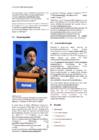
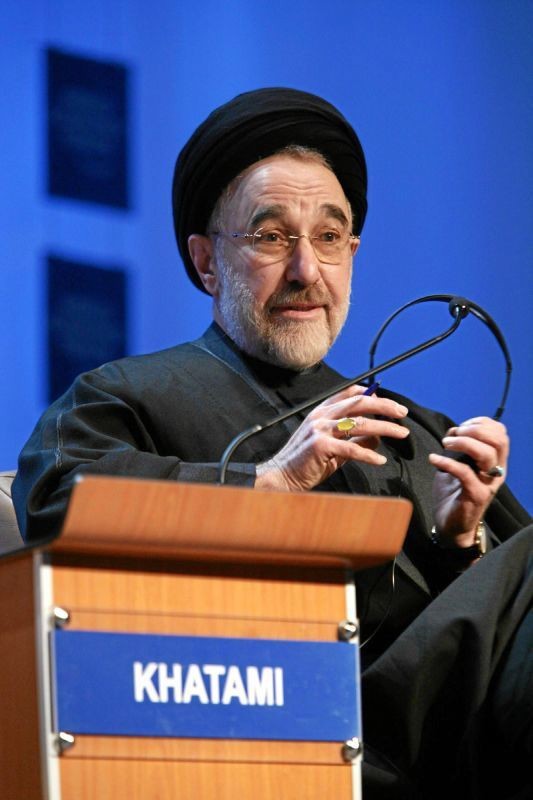
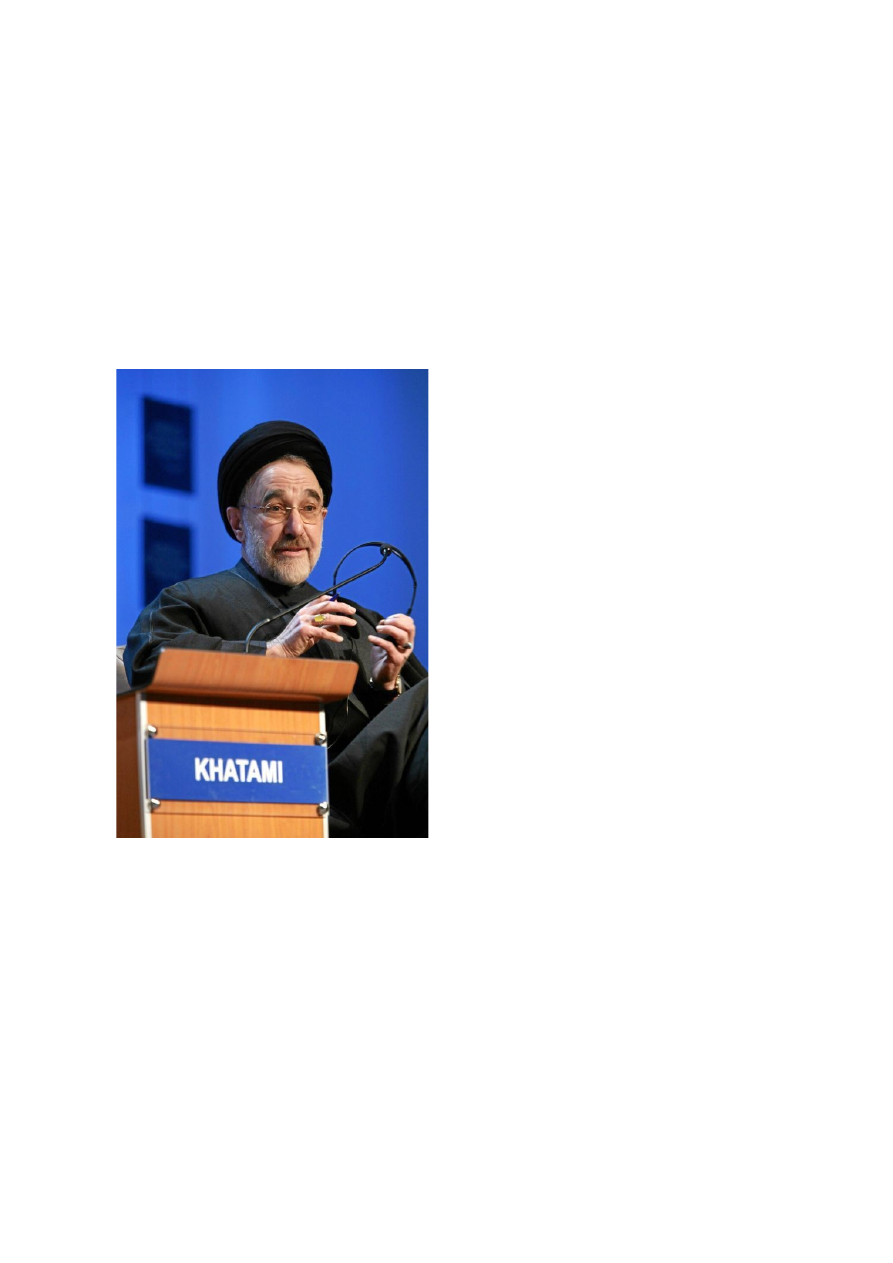
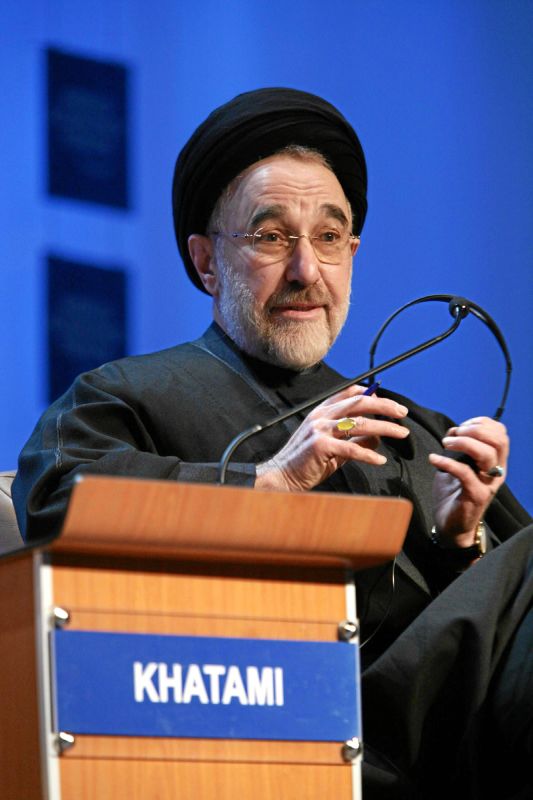
Mohammad
Khatami,reformistpresidento
fIran(inoffice1997–
2005),introducedthetheoryofDialogueAmongCivi-
lizations
as a response to Huntington’stheory.
In recent years, the theory
ofDialogue Among Civi-
lizations, a response to Huntington’s Clash of Civiliza-
tions, has become the center of some international at-
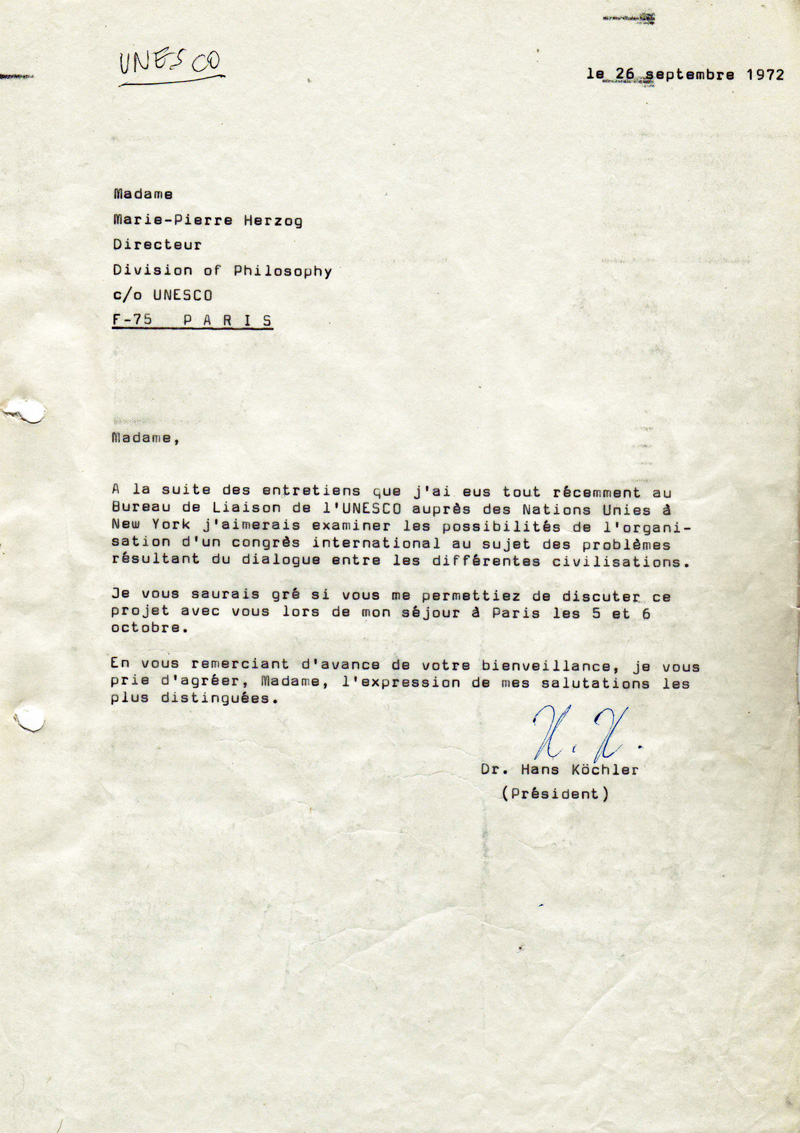
tention. The concept was originally coinedbyAustrian
philosophe
rHans Köchlerin an essay on cultural iden-
tity (1972).[23]In a letter t
oUNESCO, Köchler hadear-
lierproposedthattheculturalorganizationoftheUnited
Nationsshouldtakeuptheissueofa“dialoguebetweendi erent
ffairs
civilizations”
(
dialogue
entre
lesdifférentescivilisations).[24]In
2001,
Iranianpresiden
tMohammadKhatamiintroduced
the
concept
at
the
globallevel.Athisinitiative,the“dialogueamongcivilizations”
wasthe basisforUnitedNations’resolutiontonametheyear2001
as theYearof Dialogue among Civilizations.[25][26]The
year2001wasproclaimedasthe“UnitedNationsYearof
Dialogue
amongCivilizations”.[27]
TheAlliance of Civilizations(AOC)initiativewas pro-
posed at the 59t
hGeneral Assembly of the United Na-
tionsin 2005bythePresidentof the Spanish Govern-
ment
,JoséLuisRodríguezZapateroandco-
sponsoredbytheTurkishPrimeMiniste
rRecepTayyipErdoğan.Th
einitiativeisintendedtogalvanizecollectiveactionacross
diversesocietiestocomba
textremism,toovercomecul-
turalandsocialbarriersbetweenmainlytheWesternand
predominantlyMuslimworlds,andtoreducethetensions and polarization
between societies whichdi er
ffairs in reli- gious and culturalvalues.
5.2 IntermediateRegion
Huntington’s geopolitical model, especially the
structuresforNorthAfricaand Eurasia, islargely
derivedfromthe
"IntermediateRegion"geopoliticalmodelfirstform
u-latedb
yDimitri Kitsikisand published in 1978.[28]The
Intermediate Region, which spans the Adriatic Sea and t
heIndusRiver,is
neither western nor eastern (at least,
withrespecttotheFarEast)butisconsidereddistinct.
Concerningthisregion,HuntingtondepartsfromKitsikis contending that a
civilizationalfaultline
existsbetween
the
two
dominantyetdi ering
religions
ffairs
(Eastern
Ortho-
doxyan
dSunniIslam),henceadynamicofexternalcon-
flict.However,Kitsikis establishes an integrated civi-
lization comprising these two peoples along with those
belongingtothelessdominantreligionso
fShiiteIslam,Alevi
sm,an
dJudaism.Theyhaveasetofmutualcultural, social, economic and
politicalviewsand
norms
which
radicallydi erfrom
ffairs
thoseintheWestandtheFarEast.
In the Intermediate Region,therefore,one cannot speak
ofacivilizationalclashorexternalconflict,butratheran
internalconflict,notforculturaldomination,butforpolit-
icalsuccession.Thishasbeensuccessfullydemonstratedbydocum
enting the rise of Christianityfromthe hell-
enize
dRomanEmpire,theriseofth
eIslamiccaliphatesfromthe
Christianized Roman Empireand the rise
ofOttomanrulefromtheIslamiccaliphatesandtheChris-
tianized RomanEmpire.
6 Seealso
•
Balkanization
• Clash ofHemispheres
•
Civilizingmission
•
Criticism ofmulticulturalism
•
ColdWarII
•
Culturalrelativism6
7BIBLIOGRAPH
Y
•
Dialogue AmongCivilizations
•
Eastern Party inGreece
•
Faultline war
•
IntermediateRegion
•
Orientalism
•
Protracted socialconflict
•
Religiouspluralism
•
East-Westdichotomyininternationalrelations
Individuals
•
CarrollQuigley
•
DimitriKitsikis
•
JacobBurckhardt
•
NiallFerguson
•
OswaldSpengler
Book
The West’s Last Chance: WillWeWin
the ClashofCivilizations?
7
Bibliography
• Ankerl,
Guy
(2000).
Global
communicationwithoutuniversal
civilization. INU societal research.
Vol.1:Coexisting contemporary civilizations:
Arabo- Muslim, Bharati, Chinese, and Western.
Geneva: INU Pre
ss.ISBN2-88155-004-5.
•
Barbé, Philippe, "L'Anti-Choc des Civilisations:
MéditationsMéditerranéennes",Editionsdel'Aube,
2006,ISBN978-2-7526-0208-4
•
Barber,BenjaminR.,
Jihad vs.McWorld,Hard-
cover:Crown, 1995,ISBN 0-8129-2350-2; Paper-
back:BallantineBooks,1996,ISBN0-345-38304- 4
•
Blankley,Tony,
The West’s Last Chance:
WillWeWintheClashofCivilizations?,Washin
gton,D.C., RegneryPublishing,Inc.,2005ISBN0-89526-015- 8
•
Harris,Lee,
CivilizationandItsEnemies:TheNext
StageofHistory, NewYork,The Free
Press,2004ISBN0-7432-5749-9
• Harrison, Lawrence E. a
ndSamuel P.
Huntington(eds.),
CultureMatters:HowValuesS
hapeHumanProgress, NewYork,Basic Books,
2001ISBN 0- 465-03176-5
• Harvey,David(2000).
SpacesofHope.Edinburgh,
UK: EdinburghUniversityPress. pp.
79–80.ISBN0-
7486-1269-6.
•
Huntington,SamuelP.,
TheClashofCivilizations?,
in
"Foreign A airs
ffairs
",vol. 72, no. 3, Summer 1993,
pp.22–49
•
Huntington,
Samuel
P.,
The
ClashofCivilizationsand
the
RemakingofWorldOrder, NewYork,Si- mon
& Schuster, 1996ISBN0-684-84441-9
•
Huntington, Samuel P.(ed.),
The ClashofCivi-
lizations?:TheDebate,NewYork,ForeignA air
ffairs
s,1996ISBN0-87609-164-8
•
Kepel,Gilles,
BadMoonRising:achronicleofth
eMiddleEasttoday,London
,SaqiBooks,2003ISBN 0-86356-
303-1
•
Köchler, Hans(ed.),
Civilizations:Conflictor
Di-alogue?,
Vienna,
International
ProgressOrganiza- tion, 1999ISBN 3-900704-18-
X
(GooglePrint)
•
Köchler,Hans,AfterSeptember11,2001:ClashofCiviliza
tionsorDialogue?UniversityofthePhilip-
pines,
Manila,2002
•
Köchler, Hans,The “Clash of Civilizations": Per-
ceptionandRealityintheContextofGlobalizationand
InternationalPowerPolitics,Tbilisi (Georgia), 2004
•
Pera, Marcelloand Joseph Ratzinger
(Pope Bene-
dictXVI),
Senzaradici:Europa,Relativismo,Cris-
tianesimo, Islam[transl.:Without Roots:
TheWest,Relativism, Christianity, Islam,
Philadelphia,
Penn-
sylvania,PerseusBooksGroup,2006ISBN0-465-
00634-5], Milano, Mondadori, 2004ISBN 88-04-
54474-0
•
Peters, Ralph,
Fightingforthe Future: Will
AmericaTriumph?,
Mechanicsburg,Pennsylvania,StackpoleBooks,
1999ISBN0-8117-0651-6
• Potter, Robert (2011), 'Recalcitrant Interdepen-
dence', Thesis, FlindersUniversity
•
Sacks,
Jonathan,
The
DignityofDifference:HowtoAvoidtheClash
ofCivilizations,London,Contin- uum, 2002ISBN0-8264-
6397-5
Toft,MonicaDu y,
ffairs TheGeographyofEthnicVi
o-
lence:Identity,Interests,andtheIndivisibilityofTe
r-
ritory,Princeton,NewJersey,PrincetonUniversityPress,
2003ISBN0-691-11354-8
•
•
• Tusicisny,Andrej,“Civilizational Conflicts: More
Frequent,
Longer,
and
Bloodier?",
in
JournalofPeace Research, vol. 41, no. 4,
2004, pp.485–498
(availableonline)7
•
VanCreveld,Martin,
The
TransformationofWar,NewYork& London,
The Free Press, 1991ISBN 0-02-933155-2
• Venn,Couze“ClashofCivilisations”,inPremPod- dar
et al.,
Historical Companion to Postcolonial Literatures
—Continental Europe and its Empires,
EdinburghUniversityPress,2008.
8
References
[1]
“U.S.TradePolicy– Economics”. AEI.2007-02-15.
[2] O cial
ffili-
copy(freepreview)
:TheClashofCivilizations?,
Foreign Affairs, Summer 1993
[3]
le problème russo-américain, et là
nousrevenonsà l’Algérie, va être dépassé
lui-
mêmeavanttrèspeu,celaneserapasunchoc
d’empiresnousassistonsauchocdecivilisa-
tionsetnousvoyonsdanslemondeentierles
civilisationscoloniséessurgirpeuàpeuetse
dressercontrelescivilisationscolonisatrices.
http://www.ina.fr/audio/PHD85011203
[4] BernardLewis
:TheRootsofMuslimRage
TheAtlanticMo
nthly, September1990
[5] LouisMassignon,
Lapsychologiemusulmane(1931),in
Idem,
Ecrits mémorables, t. I, Paris, Robert
La ont, 2009, p. 629: “Après la venue de Bonaparte au
ffairs
Caire,le
clashofculturesentrel'ancienneChrétientéetl'Islamprit
unnouvelaspect,parinvasion(sanséchange)del'échelle
devaleursoccidentalesdanslamentalitécollectivemusul- mane.”
[6]
RashadMehbaliyev:Civilizations,theirnatureandclashposs
ibilities
[7] Murden S. Cultures in worlda airs.
ffairs
In: Baylis J, Smith
S,OwensP,editors. TheGlobalizationofWorldPolitics.5th ed.
NewYork: Oxford UniversityPress; 2011. p. 416-426.
[8]
THEWORLD OF CIVILIZATIONS: POST-
1990scannedimageArchivedMarch12,2007atth
eWayback
Machine
[9] |Google books results in English language between the
1800–1960period
[10]
The Inevitability of Clash ofCivilisation
[11] HungtingtonSP,TheClashofCivilzations?In:Lechner
FJ,BoliJ,editors. Theglobalizationreader. 4thed.WestSussex:
Wiley-Blackwell; 2012.37–44
[12]
Huntington, Samuel P.(2002) [1997]. “Chapter 9: The
GlobalPoliticsof
Civilizations”.
The
ClashofCiviliza-
tionsandtheRemakingofWorldOrder(TheFreePre
ss ed.). London: Simon $ Schuster. p. 207f
.ISBN0-7432-
3149-X.
[13]
Bağış: Fransa'nın tutumunda değişimin başladığını görüy-
oruz|ABveTürkiye|EurActiv.com.tr–Türkiye’ninon-line
ABGazetesi
[14] Fox,
J.
(2005).
Paradigm
Lost:
Huntington’sUnfulfilledClash of Civilizations
Prediction
into
the
21st
Century.
InternationalPolitics,42, pp.428–457.
[15] Mungiu-Pippidi, A., & Mindruta, D. (2002).WasHunt-
ingtonRight?TestingCulturalLegaciesandtheCiviliza- tion Border.
InternationalPolitics,39(2), pp. 193213.
[16] Henderson,E.A.,&Tucker,R.(2001).ClearandPresent Strangers:
The Clash of Civilizations and International Conflict. International Studies
Quarterly, 45, pp. 317 338.
[17] Russett, B. M.; Oneal, J. R.; Cox, M. (2000). “Clash of
Civilizations,orRealismandLiberalismDéjàVu?Some
Evidence”.
JournalofPeace Research
37: 583–
608.doi:10.1177/0022343300037005003.
[18] Sen
A
(1999).
“Democracy
as
aUniversalValue”.
JournalofDemocracy
10(3): 3–
17.doi:10.1353/jod.1999.0055.
[19] Berman,Paul(2003). Terror and Liberalism. W WNor-
ton & Company.ISBN0-393-05775-5.
[20] EdwardSaid
:TheClashofIgnoranceTheNation,Octo- ber2001
[21] Said,E.W.(2004).FromOslotoIraqandtheRoadMap.
NewYork:Pantheon,2004.
[22]
Clash of civilizations?Noam Chomsky
[23] “Kulturelles Selbstverständnis und Koexistenz:Voraus-
setzungenfüreinen fundamentalen Dialog” (Cultural
Identity and Co-existence: Preconditionsfora Funda-
mental Dialogue). Public lecturedeliveredat the Uni-
versity of Innsbruck, Austria, 19 October 1972, pub-
lishedin:
PhilosophieundPolitik.Dokumentationei
nesinterdisziplinärenSeminars.
(PublicationsoftheWork-ing
GroupforScience
andPoliticsat theUniversityof Innsbruck,Vol.IV.)
Innsbruck:Arbeitsgemeinschaft fürWissenschaft und
Politik, 1973, pp.75-78.
[24]
Letter dated 26 September 1972, addressed to the Divi-
sionof Philosophy ofUNESCO.
[25]
http://www.unesco.org/dialogue2001/en/khatami.htm
Unesco.orgRetrieved on 05-24-07
[26]
http://www.dialoguecentre.org/
about.html
Dialoguecen-tre.orgRetrieved on05-24-
07
[27]
DialogueAmongCivilizationsUnitedNationsUniversityCentre
[28] Dimitri
Kitsikis,
A
Comparative
HistoryofGreece andTurkey in the 20th
century. In Greek,ΣυγκριτικήἹστορία
Ἑλλάδος καί Τουρκίας στόν 20ό αἰῶνα,
Athens, Hestia, 1978. Supplemented 2nd edition: Hes-
tia, 1990. 3rd edition: Hestia, 1998, 357 pp..
InTurkish,
YırmıAsırdaKarşılaştırmalıTürk-
YunanTarihi,İstanbul,Türk Dünyası Araştırmaları
Dergisi, II-8,1980.
8
9EXTERNALLINK
S
9
Externallinks
•
“TheClashofCivilizations?"–Fulltextoftheorig-
inal
essayfrom
ForeignAffairs1993
•
“The Clash ofCivilizations?"
•
“If Not Civilizations, What? Samuel
HuntingtonResponds
to
His
Critics”,
ForeignAffairs,Novem-
ber/December
1993(fulltext)
•
TheClashofIgnoranceProfesso
rEdwardSaid'scri-
tiqueofHuntington’s'ClashofCivilizations’theory.
•
“YourNew Enemies”bySaid Shirazi, aleftistcri-
tique ofHuntington.
•
WarsofCivilizationsandWhyHuntington’stheoryappealstothe
WesternMindbyJonathanPower
•
Booknotesinterview with Huntington
onWhoAreWe?,June 13, 2004
• NikolaosA.Denaxas
,
Theclashofcivilizationsac-
cordingtoSamuelHuntington–
Orthodoxcriticism,2008. (inGreek)
9
10
Textandimagesources, contributors, andlicenses
10.1 Text
•
Clash of Civilizations
Source
:https://en.wikipedia.org/wiki/Clash_of_Civilizations?oldid=703017742Contributors:Eloquence,
Tim Chambers,Roadrunner,SimonP,MichaelHardy,Gabbe,Karada,Bronger,Dpol,Astudent,JohanMagnus,Gwyon~enwiki,AdamBishop, Rainer Wasserfuhr~enwiki, Boson, Fuzheado,
Wik,
Zoicon5,
Maximus
Rex,
K1Bond007,VeryVerily,Thue,
Nickshanks,
Joy,
Donar-
reisko er,
ffairs DaleArnett,ChrisG,RedWolf,Altenmann,Lowellian,AcademicChallenger,Ojigiri~enwiki,Meelar,Humussapiens,Brw12,
AndrewLevine,Cix,Saforrest,Wereon,Davidcannon,MaGioZal,ChristopherParham,Thorne,Bfinn,TomRadulovich,Vunzmstr,Alen-
sha,Mboverload,Wmahan,Neilc,Andycjp,Mineminemine,Iceager,Piotrus,Cwirtanen,Lumidek,MonkBretton,Blue387,Neutrality,
Naus,
Lacrimosus, Thorwald, NightMonkey, Freakofnurture, CALR, Mindspillage, An Siarach, Rblumberg, Rama, Vapour, Aris Kat-
saris,Dbachmann,Bender235,LordGulliverofGalben,CanisRufus,Kwamikagami,CJWilly,Bootedcat,Cretog8,Ahsirakh,Darwinek,Perceval,Quin
tucket,Alansohn,Arthena,Ronline,UnHoly,CJ,BillGarrisonJr,Grenavitar,Dominic,GuyMontag,Stemonitis,Gmaxwell, Lochaber, Erudite, Swiftblade21, Crackerbelly, Ruud Koot, Tickle me,
GregorB,
Mimiian,Stefanomione,SilhouetteSaloon,
BD2412,
Qwertyus,Rkevins,Rjwilmsi,Koavf,TitaniumDreads,Bill37212,Feco,YamamotoIchiro,Bibigon,Jeremygbyrne,Diza,LeAnh-Huy,
CJLLWright,Amirpedia~enwiki,Gregorik,Benlisquare,Benmoss,Uriah923,YurikBot,RussBot,Filippof,JohnQuincyAddingMa-
chine,Eupator,Fsolda~enwiki,UgurBasak,NahallacSilverwinds,Tfine80,Robdurbar,Cruise,CaptainKoloth,Robin.r,Rob117,Black Falcon,KyleCronan,
Deville, Xareu bs, Petri Krohn, T. Anthony, AlexD, AMbroodEY, Ultrogothe, Kungfuadam, Carlosguitar, Roke,
SmackBot,AimHere,Impaciente,InverseHypercube,Lagalag,Unyoyega,M1chu,Petercorless,Jagged85,Mdd4696,Kintetsubu alo,
ffairs
NilEinne,Mjolnir1984,Ohnoitsjamie,Betacommand,TimBentley,Skookum1,Miss.hyper,MK8,Fplay,Hibernian,Bonaparte,Jerome Charles Potts,
Delta Tango, Colonies Chris, Jdthood, Aldaron, Didier Marie~enwiki, Nonstopdrivel, Wizardman, Metamagician3000,
Tankred,Byelf2007,Rgulerdem,Reade,AmyLaframboise,Sanya,Mr415,Khazar,John,Barnetj,Spir,Robofish,AB,Basserg,Texte-
ditor,Jo elo ,
ffairs ffairs Blesssins,RoLeoVers,Nictan33,Tasc,KirrVlad,SijoRipa,Vagary,Hectorian,Hu12,Kenny92190,N0osphR~enwiki,
Levineps,Mtstroud,JosephSolisinAustralia,Tawkerbot2,VinceB,Connection,CesarTort,Gustavetraupmann,Xint,CmdrObot,Vanhelsing,
Ruslik0, FYilmaz, Denysmonroe81, Cydebot, Yhnmkk, Brelson, Gatoclass, Bellerophon5685, Khatru2, Christian75, Abtract, Thijs!
bot, Sebasbronzini, Tauseefzahid,Pajz,Olahus, Mariodrs, 23prootie, Zeplin007,Itsmejudith,Heroeswithmetaphors, Mrodowicz,
AntiVandalBot,Mountolive,Smartse,Zackarcher,Ithinkhelikesit,Uuu87,Talib72,Yalens,Anitd,Mewarmo990,Cherylyoung,Rentir,
Ericoides,MelanieN,Andonic,Kshatriyaaz,SiobhanHansa,Geniac,Magioladitis,Deposuit,VoABotII,ZwickauDeluxe,Pixel;-),Cgin-
gold,A32nh1fv4,Gomm,Lvwarren,JaGa,GunPowderMa,MartinBot,Tremello,InnocuousPseudonym,R'n'B,Matt57,Jgchao,Henry
Cassini,Stambolov,Acalamari,BadNight,WTDaveyIII,Ritarius,Olegwiki,Ledenierhomme,TheSpanishInquisitor,DorganBot,Ajfweb,Sujoyiit,Wikipedian1234,DASonnenfeld,Graha
mHardy,VolkovBot,Fundamentalmetrictensor,Tatroland~enwiki,Buddhipriya,United-
Statesian,Wmcg,Burntsauce,SueRangell,Palaeovia,Kehrbykid,Randam,Методије,Arjun024,Nod2003,SieBot,Chimin07,Ishvara7,
Pengyanan,Chercheur,Revolucija,Fetidpants,OdaMari,Vanofspain,Sanya3,RupertHorn,Svick,Viceregent,Cyfal,Ptr123,Jobas,An-
geloDeLaPaz,3rdAlcove,Athenean,Ucct3077,ClueBot,P.S.Burton,Sepiatone,Antodav2007,Nithayanandan77,LordAlaa,Laura.vel,
Urbanloners,Skarebo,Netrat,Jmkimdotcom,Addbot,DOIbot,Malikov,SunDragon34,Jncraton,LeszekJańczuk,CactusWriter,MrOl-
lie,Download,Lihaas,Tassedethe,LongLiveRomania,AtillaDemir,Bfigura’spuppy,Lightbot,Idris.albadufi,Legobot,Luckas-bot,Yobot,
Amirobot,Nirvana888,Jmanjmanjman,AnomieBOT,DemocraticLuntz,Jim1138,Galoubet,Unara,TubaTuncak,ArthurBot,BonusThe-
Beagle,Dustpan02,FnrKllrb,GrouchoBot,Tubatuncak,Trkgnd,OmniaMundoMundis,Mttll,Centonup,Signswork,Fahadulhaq,Sawtan,
Lelapindore,Voltov45,Vlasto ,Etwinoqi,FrescoBot,
ffairs
Tolokomi,Chinkrmo,Jomifica,Purpleturple,TempelHeinrich,OreL.D,Adlerbot,
Mnh123,Pianoplonkers,Tim1357,CobraBot,Kitfoxxe,Underlyinglk,Wpfdc,Barotoa,Thiridaz,EmausBot,OrphanWiki,Wikitanvir-
Bot,Wiki.Tango.Foxtrot,Lajuan1224,ZéroBot,Cguven,Semmler,Filmested,Nanib,Jesanj,Xanchester,Nirutochi,ClueBotNG,Appen-
zeller,Sindhbadh,Snotbot,Bazuz,Ehrjej,TheLotCarmen,HelpfulPixieBot,AtomSmashr,Soroush90gh,Bfirst~enwiki,JohnChrysostom, Friezer,Yerevantsi,Petersingerjr25,
9191Aus, Liam987, Alauthat, Khazar2, EuroCarGT, Eb7473, Tahc, Krystal09, Dhawk790, Zyma,
Eccesimia,GabeIglesia,Epicgenius,MaiyaH78,Innermarksz,Ramacleod23,Pepesia,AlexDGenkin,Sy0827,Ginsuloft,Stephaners,Oc-
cultZone,BethNaught,Estèphe,FreedomofExpressioninaPluralisticWorldOrder,CopperPhoenixandAnonymous:364
10.2 Images
•
File:Ambox_important.svg
Source:https://upload.wikimedia.org/wikipedia/commons/b/b4/
Ambox_important.svgLicense:Publicdo-
main
Contributors:Ownwork,basedo of
ffairs Image:Amboxscales.svgOriginalartist:Dsmurat(talk
·contribs)
•
File:Clash_of_Civilizations_map.png
Source
:https://upload.wikimedia.org/wikipedia/commons/2/2f/
Clash_of_Civilizations_map.png
License:CC-BY-SA-3.0Contributors:The informational source of the map is the original map
of the book. (p. 26)scan of orig- inal map.
Original artist:KyleCronanatEnglishWikipedia
•
File:World_Economic_Forum_Annual_Meeting_Davos_2007.jpg
Source
:https://upload.wikimedia.org/wikipedia/commons/f/f4/
World_Economic_Forum_Annual_Meeting_Davos_2007.jpg
License:CCBY-SA2.0Contributors
:FlickrOriginalartist
:WorldEco-
nomicForum
10.3 Contentlicense
•
Creative Commons Attribution-Share Alike3.0Document Outline
- 1 Overview
- 2 Majorcivilizationsaccording to Huntington
- 3 Huntington’sthesisofciviliza- tional clash
- 3.1 Why CivilizationswillClash
- 3.2 TheWestversustheRest
- 3.3 Core state andfaultlineconflicts
- 4 Modernization, westernization,and “torncountries”
- 5 Criticism
- 5.1 Opposingconcepts
- 5.2 IntermediateRegion
- 6 Seealso
- 7 Bibliography
- 8 References
- 9 Externallinks
- 10 Textandimagesources, contributors, andlicenses
- 10.1 Text
- 10.2 Images
- 10.3 Contentlicense
 50 punkti
Autor soovib selle materjali allalaadimise eest saada 50 punkti.
50 punkti
Autor soovib selle materjali allalaadimise eest saada 50 punkti.
 ~ 10 lehte
Lehekülgede arv dokumendis
~ 10 lehte
Lehekülgede arv dokumendis
 2023-02-16
Kuupäev, millal dokument üles laeti
2023-02-16
Kuupäev, millal dokument üles laeti
 0 laadimist
Kokku alla laetud
0 laadimist
Kokku alla laetud
 0 arvamust
Teiste kasutajate poolt lisatud kommentaarid
0 arvamust
Teiste kasutajate poolt lisatud kommentaarid
 Estonienne32
Õppematerjali autor
Estonienne32
Õppematerjali autor
 annaabi.ee










Kõik kommentaarid